
If you’ve been following the podcasting industry over the past two years, you’ve likely felt the pressure: “Every podcast must be a video now.”
With YouTube cementing its position as a dominant platform for podcast discovery and consumption, the prevailing advice for creators has been to buy cameras, set up lighting, and film every conversation. This shift has left many audio-first creators anxious. Is there no room left for deep, audio-only discussions or those raw, intimate thoughts recorded in a bedroom without a ring light?
However, when we look past the algorithm-driven hype and examine the latest audience behavior data from 2026, a very different truth emerges: The rise of video podcasts is real, but it absolutely does not signal the death of audio. The future of podcasting isn’t about choosing between audio and video—it’s about embracing fluid, multi-format consumption.
The Data Reveals a Complementary Reality
There is no denying the momentum behind video podcasts. According to The Podcast Consumer 2026 report by Edison Research, the third quarter of 2025 marked a historic tipping point: among weekly podcast consumers, the percentage of those actively watching video podcasts (82%) surpassed those listening to audio-only (78%) for the first time.
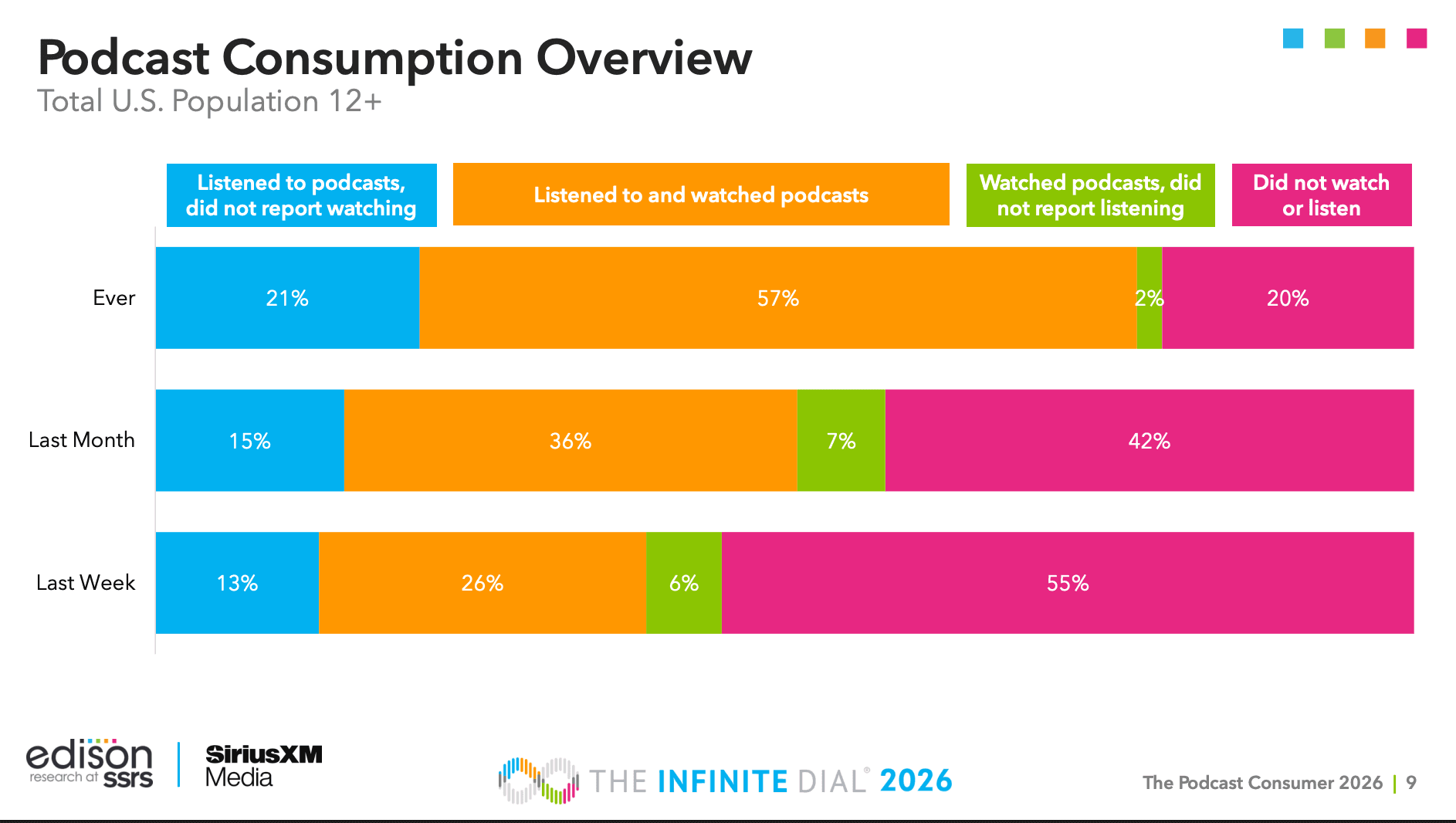
But does this mean audiences are abandoning audio? The 2025 U.S. Podcast Report from Triton Digital paints a much more nuanced picture. Among consumers aged 18 and older, nearly 13% listen exclusively via audio, 7% consume watch-only content, and a massive 80% do both—they listen and watch.
This highlights a critical reality: Audio and video are highly complementary in how audiences consume media.
Listeners haven’t changed their desire for great content; they simply choose the best medium for their current situation. When sitting at a desk or in front of a smart TV, they might open YouTube for a richer visual experience. But during a commute, a run, or while doing chores, audio remains the irreplaceable “companion medium.”
Format Should Serve Content and Context
The Triton Digital report also revealed that consumption preferences are heavily genre-dependent. Categories that rely on immersive storytelling and imagination—such as Science (58%), History (56%), and True Crime (50%)—are primarily consumed via audio. Conversely, genres with stronger entertainment and interactive elements, like Music, Sports, and Comedy, skew heavily toward video.
This means forcing every podcast into a video format is not only unnecessary but can sometimes be detrimental. A deep philosophical discussion might lose its impact if the listener is distracted by a static, low-quality video feed.
Format should not be an obsession for creators; it should serve the nature of the content and the audience’s context.
The Creator’s New Strategy: Liquid Content
If audiences demand different formats for different situations, how should creators respond? Do we need to produce two entirely separate shows for audio and video platforms?
At PodcastorAI, we believe the answer is liquid content. The core of your content is the knowledge, the insight, and the story. Audio, video, and short clips are merely the “containers.” In the AI era, creators shouldn’t be trapped in just one container.
This is why PodcastorAI is built as a “write once, publish everywhere” platform. Whether you start with a PDF report, an in-depth blog post, or a simple voice memo, PodcastorAI extracts the core value and transforms it into the right format for the right channel:
-
For YouTube and Social Media: Generate video podcasts with customizable AI hosts, split-screen layouts, and visual aids to satisfy visual learners.
-
For Spotify and Apple Podcasts: Export high-quality, clean audio files to accompany your audience on their daily commute.
Giving the Choice Back to the Audience
The idea that “podcasts must be video” is a false dichotomy. The real trend is that audiences want valuable content delivered in the format they prefer, exactly when and where it’s most convenient for them.
As creators, our primary focus should always be on the quality of our insights and the depth of our stories. Whether that story is delivered as an MP3, an MP4, or a text transcript is a problem that tools should solve. By embracing AI-driven, multi-format distribution, we can break down media barriers and let great content flow naturally to wherever it is needed.