
TL;DR
The best true crime podcasts are not all trying to do the same thing. In the Dark offers investigative depth, Bear Brook develops one carefully reported forensic case, Criminal works well for standalone episodes, and Crime Junkie shows how a repeatable conversational format can build a listening habit.
If these shows inspire you to create your own true crime podcast, this article will show you how to do it. The main guide shows how to choose a case, organize sources, generate an editable script, and produce an audio or video podcast with PodcastorAI.
What do you actually need: another show to listen to, or a workflow for turning your research into an original episode? If it is the second one, use the recommendations as structure inspiration, not as a branding template.
Best True Crime Podcasts at a Glance
If you only want a recommendation, use this table. The shows are ranked by use case, not by a claim that one podcast is universally “the best.” Each official link is the best place to check the current catalog and episode descriptions.
| Podcast | Best for | Why start here |
|---|---|---|
| In the Dark | Investigative reporting | Deep reporting, legal context, and institutional accountability |
| Bear Brook | Forensic storytelling | One carefully developed case with evidence and identity questions |
| Serial | Beginners and serialized stories | A clear case question, timeline, and multi-episode narrative |
| Someone Knows Something | Unresolved cases | Human-centered reporting that leaves room for uncertainty |
| Criminal | Standalone episodes | Shorter, self-contained stories across a wide range of crime topics |
| Casefile | Focused narration | Direct case coverage with detailed timelines and an anonymous host |
| Your Own Backyard | A single-case deep dive | A narrow premise that shows how reporting can develop over time |
| Crime Junkie | Conversational weekly listening | A repeatable, approachable case-led format |
| My Favorite Murder | Host chemistry and community | Personality-led conversation and a strong listener community |
| The Vanished | Missing-person stories | A focused catalog built around unresolved disappearances |
The short version: choose In the Dark for reporting depth, Criminal for a standalone episode, Serial for a serialized introduction, or Crime Junkie for a conversational weekly format.
If these shows make you want to build your own, the workflow below is the part to follow.
How to Make a True Crime Podcast with PodcastorAI
PodcastorAI is most useful after you have a real topic and source folder. It can organize research into a script and help produce audio or video, but you remain responsible for the case selection, evidence review, editorial judgment, and final claims.
Step 1: Choose a case and define the episode question
Start with a narrow question rather than a dramatic title. For example: What is confirmed about the timeline? Why did the investigation change direction? What does a court filing establish, and what does it leave unknown?
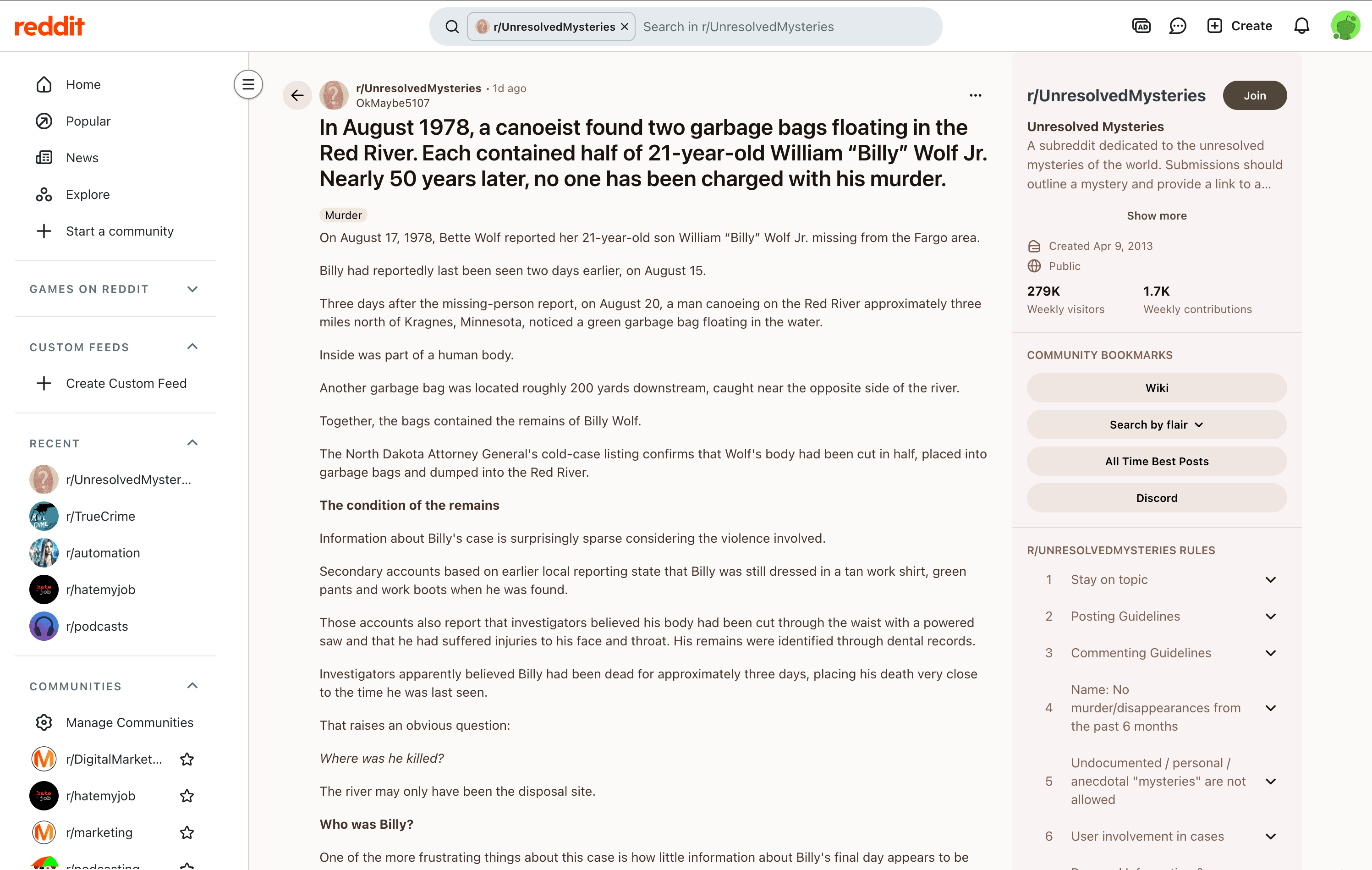
Use Reddit communities such as r/TrueCrime, r/TrueCrimePodcasts, and r/UnresolvedMysteries to discover listener questions and possible story leads. Treat those communities as audience research only. A post or comment is not enough evidence for a factual claim.
For verification, move to stronger sources. Check NamUs or the Charley Project for missing-person leads. Use the FBI Wanted database for federal notices. Search CourtListener for public U.S. court opinions and filings.
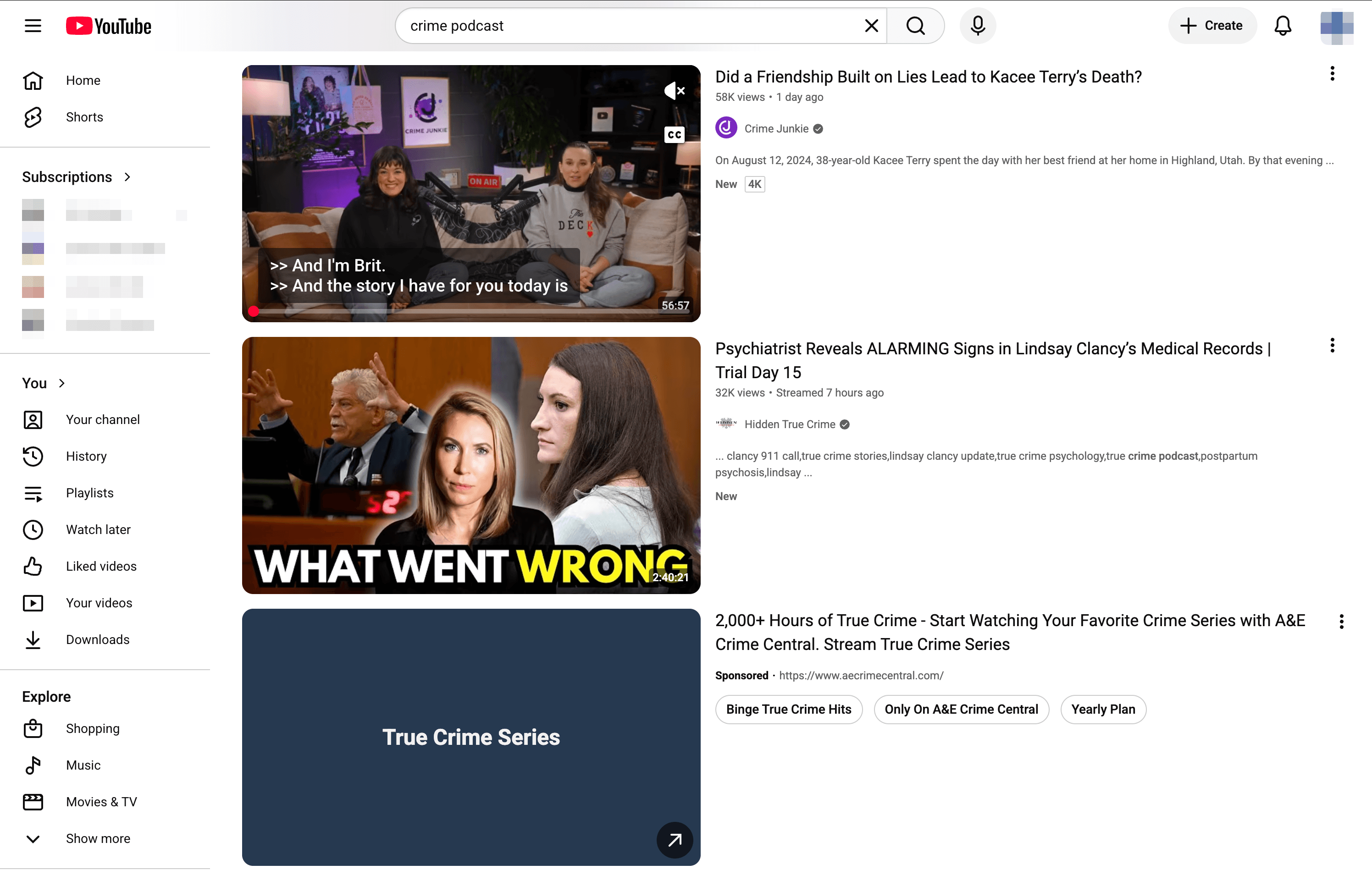
Before opening PodcastorAI, write a one-sentence brief:
This episode explains [case or topic] for [audience], focusing on [question], using [source set].
That sentence keeps the generated episode focused. It also gives you a standard for deciding which details do not belong.
Step 2: Build a source folder before generating anything
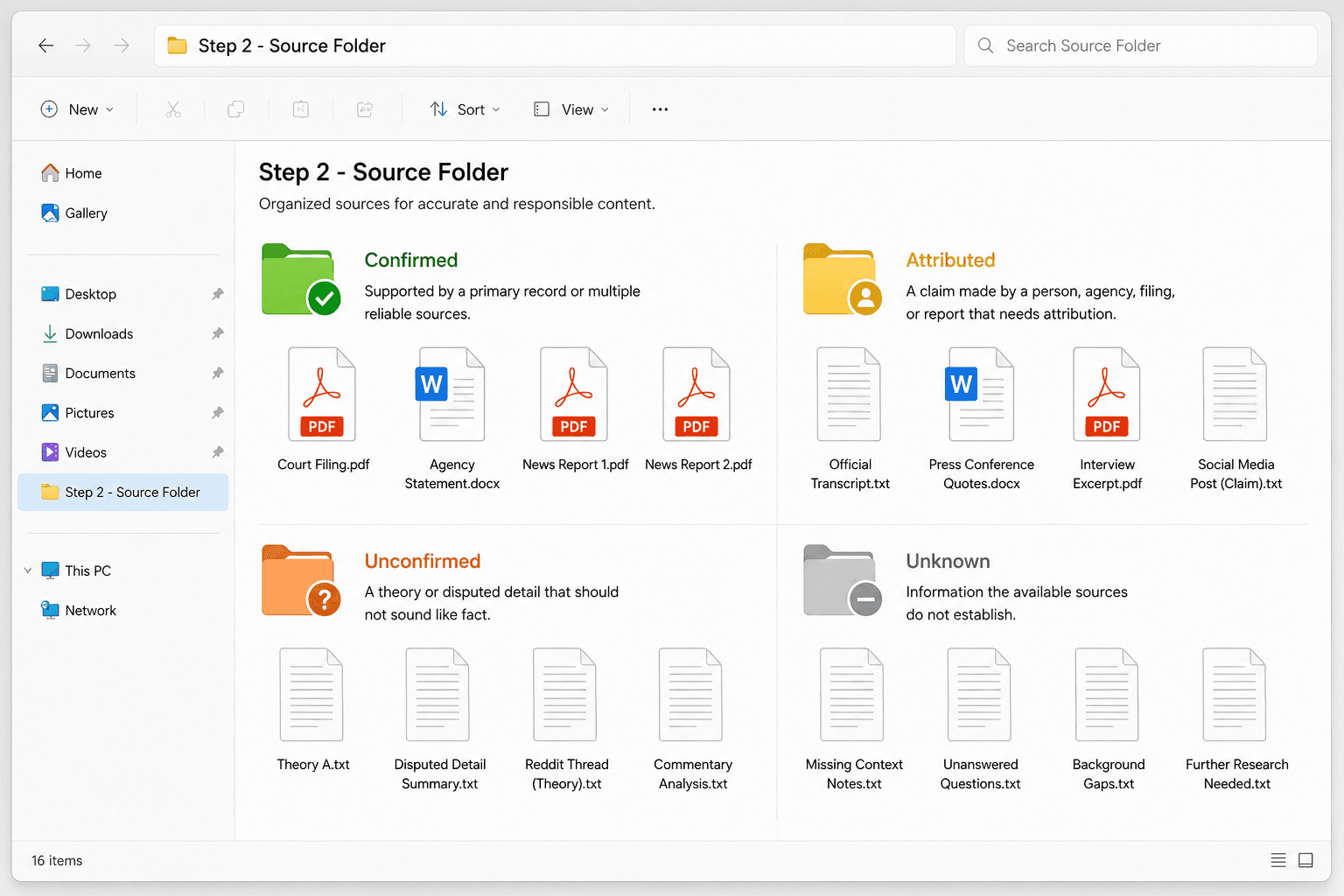
Collect the material you are actually willing to cite. A practical source folder may include a court filing, agency statement, two independent news reports, a transcript, and your own research notes.
Separate the material into four labels:
-
Confirmed: Supported by a primary record or multiple reliable sources.
-
Attributed: A claim made by a person, agency, filing, or report that needs attribution.
-
Unconfirmed: A theory or disputed detail that should not sound like fact.
-
Unknown: Information the available sources do not establish.
This labeling step matters because AI can make a repeated claim sound certain. Your source folder should tell you how each important sentence must be phrased before you generate a script.
Step 3: Create an AI host for your show
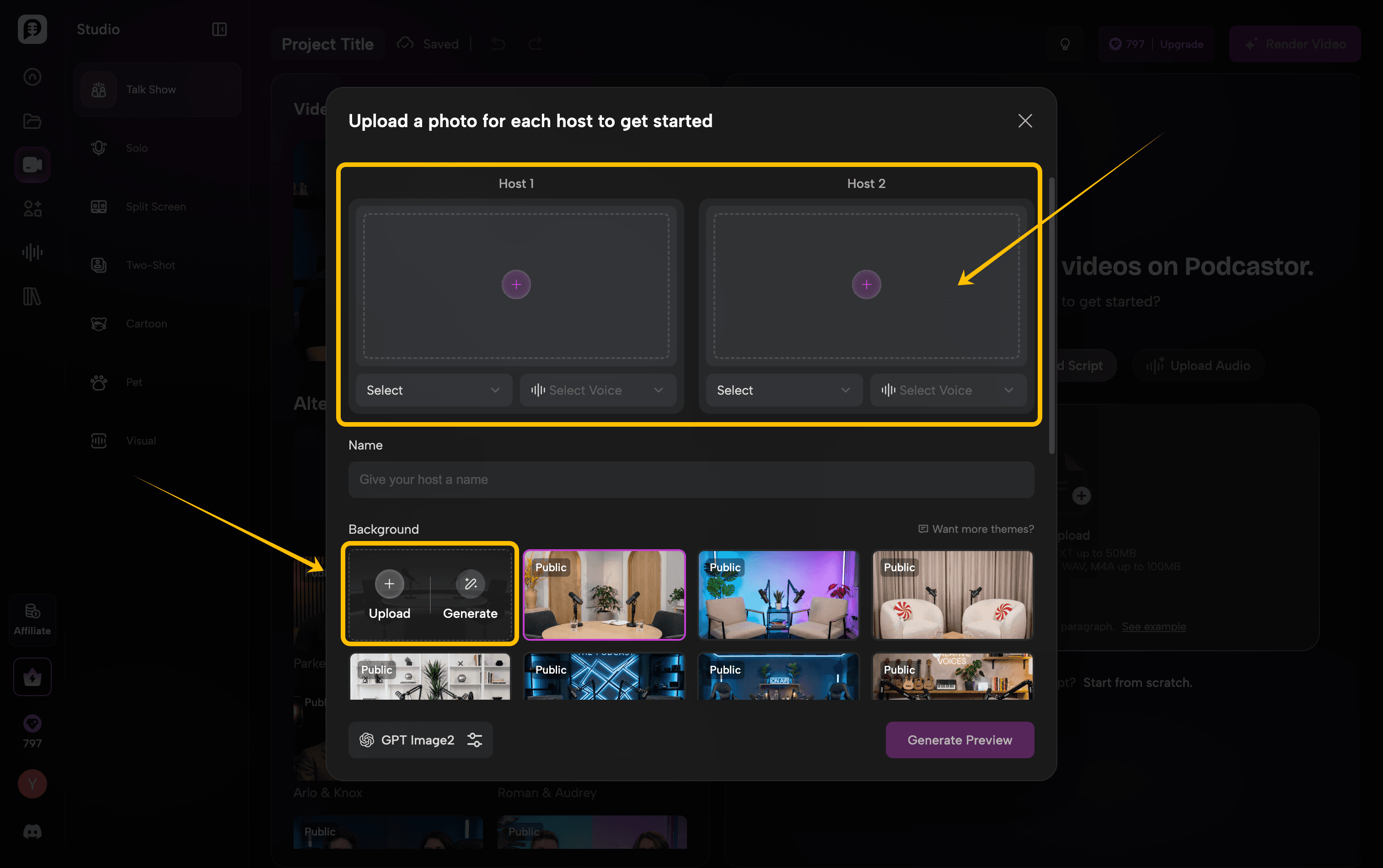
Open PodcastorAI and create the host for the channel. You can upload your own photo to create a custom AI host, describe the host you want with a prompt, or choose from the public avatar library.
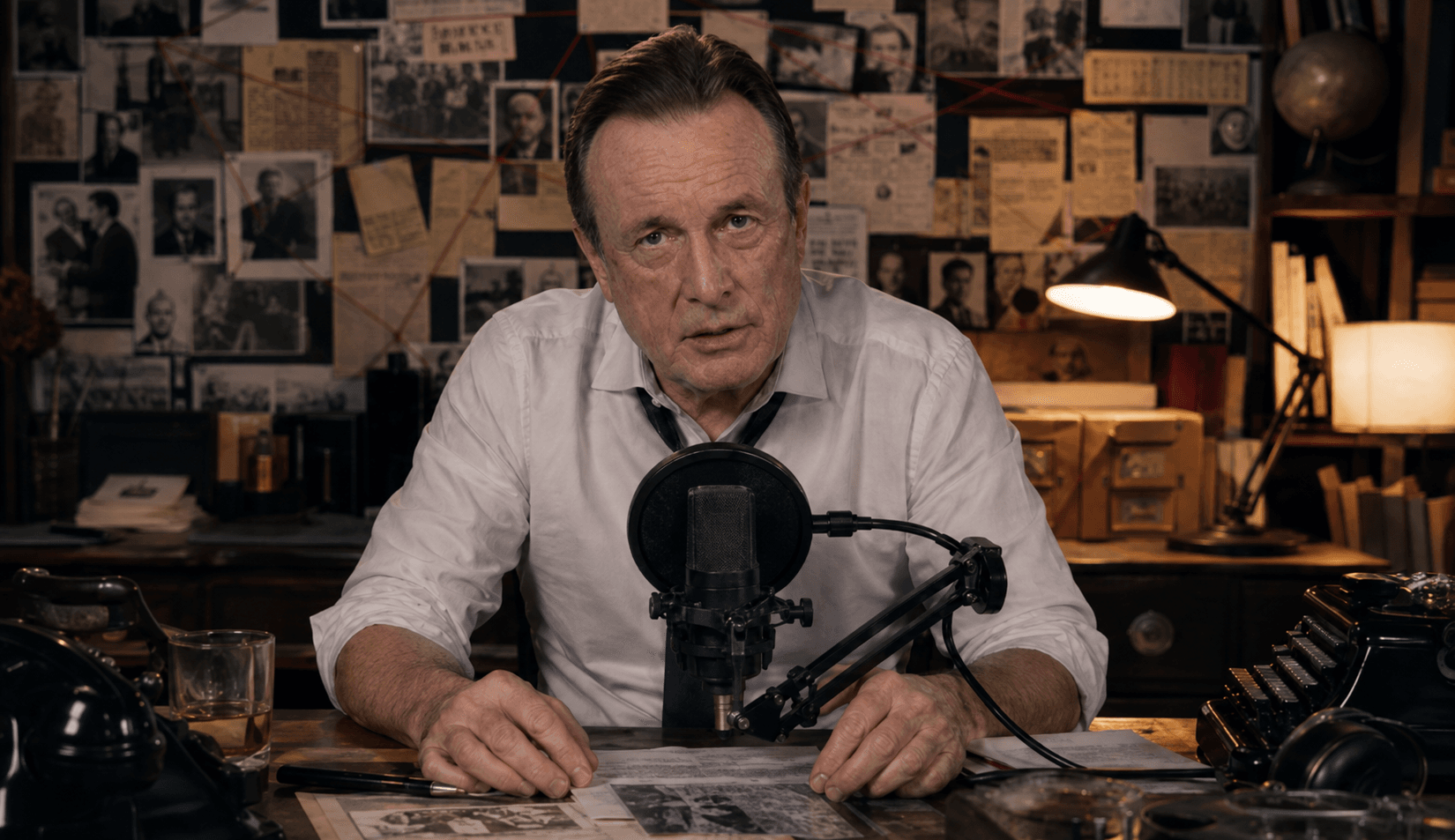
For sensitive true crime topics, choose a restrained presentation. A calm host, simple background, and readable source cards usually fit the subject better than a highly expressive avatar or a sensational thumbnail. Keep the host’s name, artwork, and show identity original. Do not imitate another podcast’s branding.
Step 4: Upload your case research to true crime podcast generator
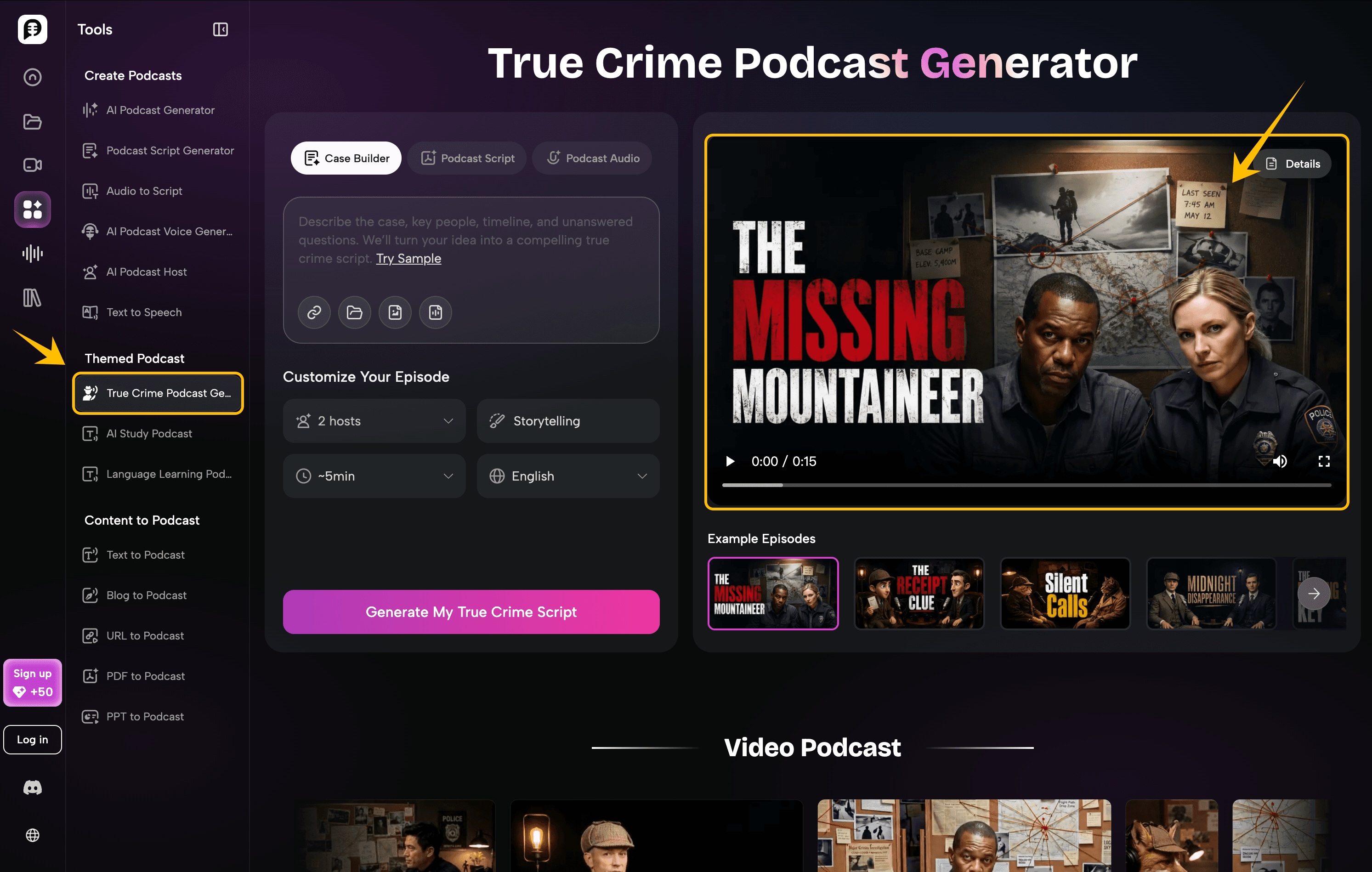
Use True Crime Podcast Generator to bring your case research into one project. Add source materials such as web pages, court filings, reports, research documents, notes, audio, or an existing script.
Combine related sources so the AI has enough context to understand the case before generating your script. If you enable Web Search, use it to find additional context rather than replace your verified source folder. Review any new claims it introduces before keeping them.
Step 5: Review and edit your script
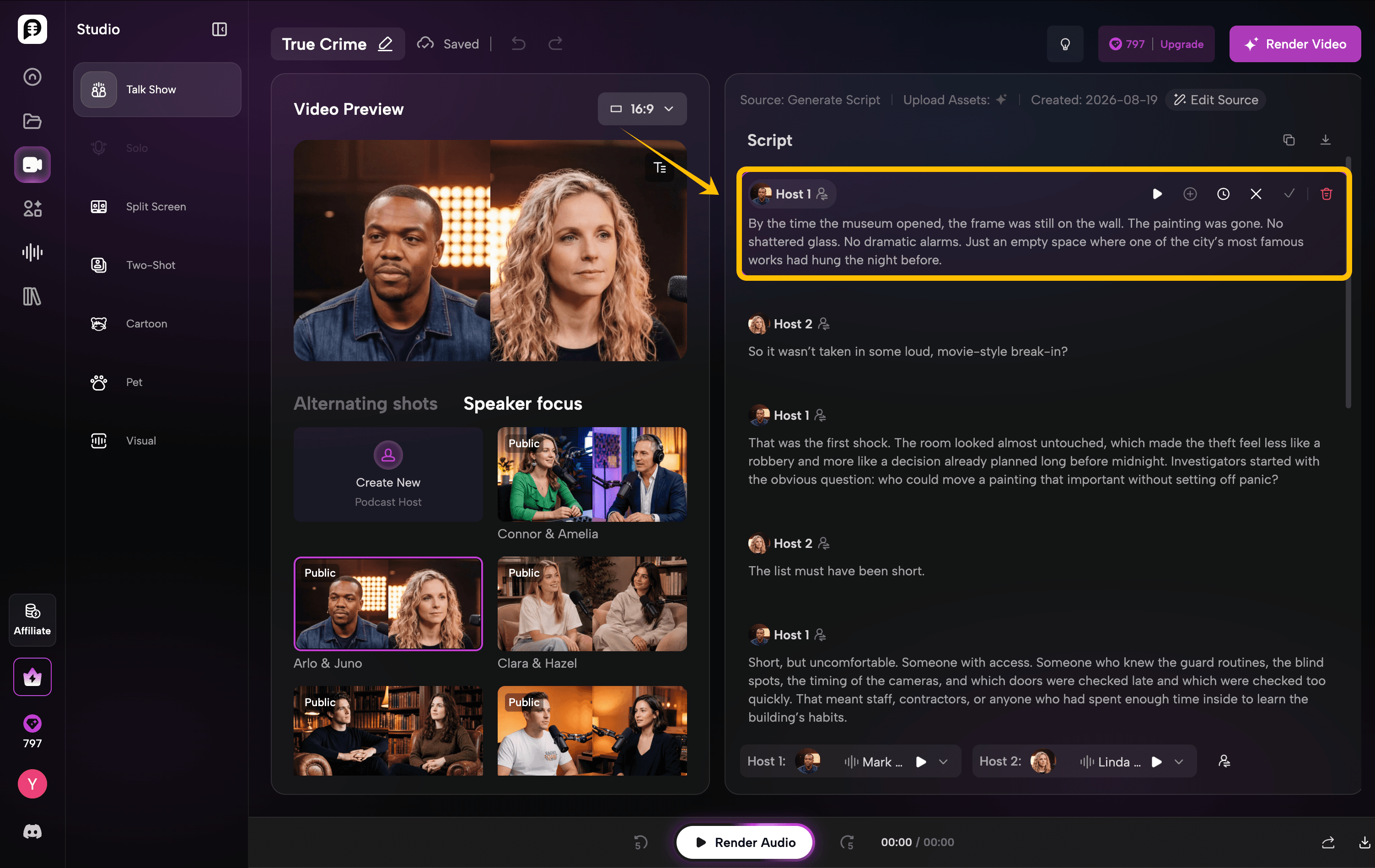
Once the script is generated, read through it and adjust anything that does not fit your episode.
You can rewrite sections, shorten or expand certain parts, change the tone, reorganize the story, or remove details you do not want to include. Make sure the final script matches both your source material and the way you want to tell the story.
Step 6: Render audio first, then make the video version
When the script and voices are ready, render the audio version and listen for pronunciation, pacing, speaker changes, awkward transitions, and overconfident wording.
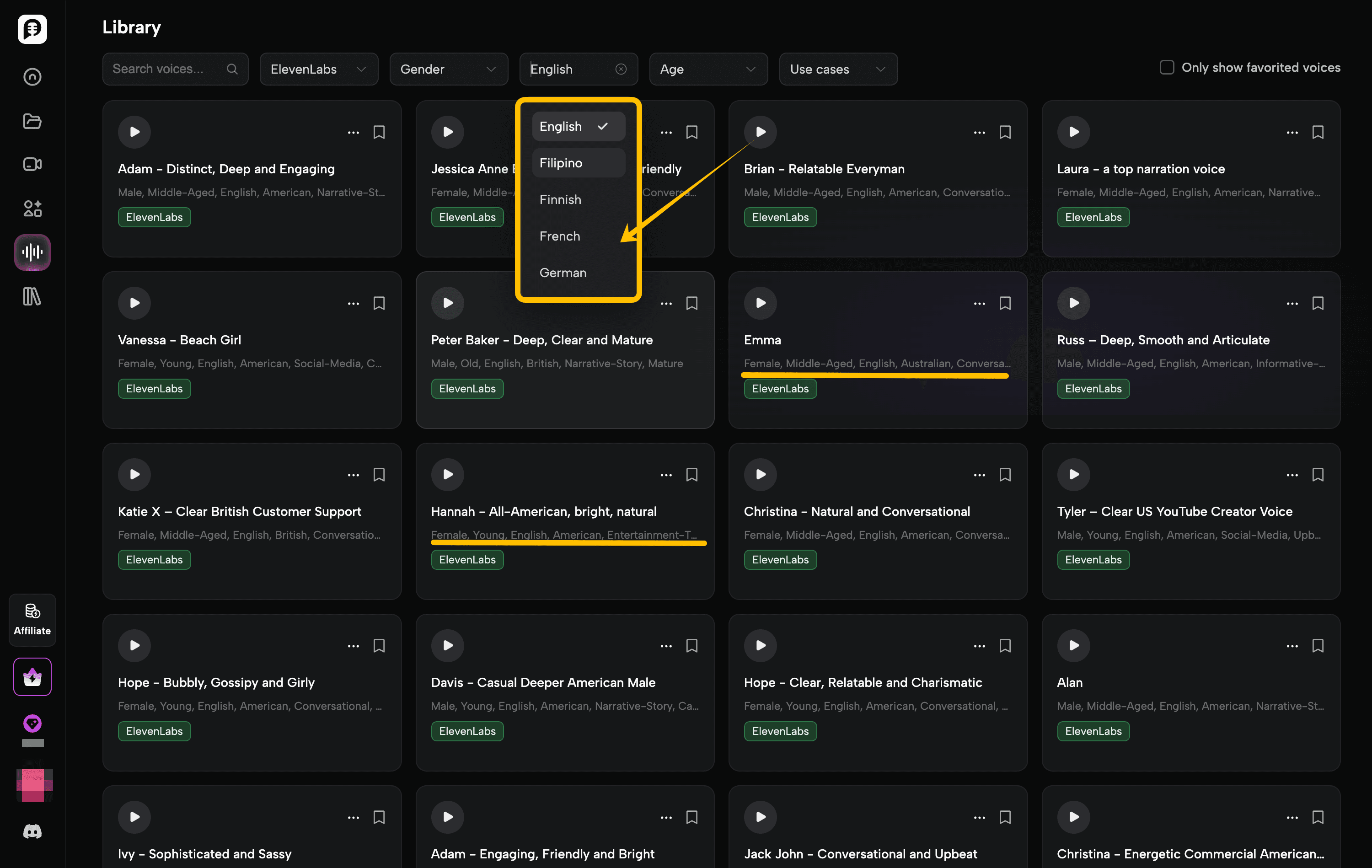
Then create a video podcast if it serves your distribution plan. PodcastorAI can pair AI hosts with layouts, alternating shots, speaker-focused views, and subtitles.
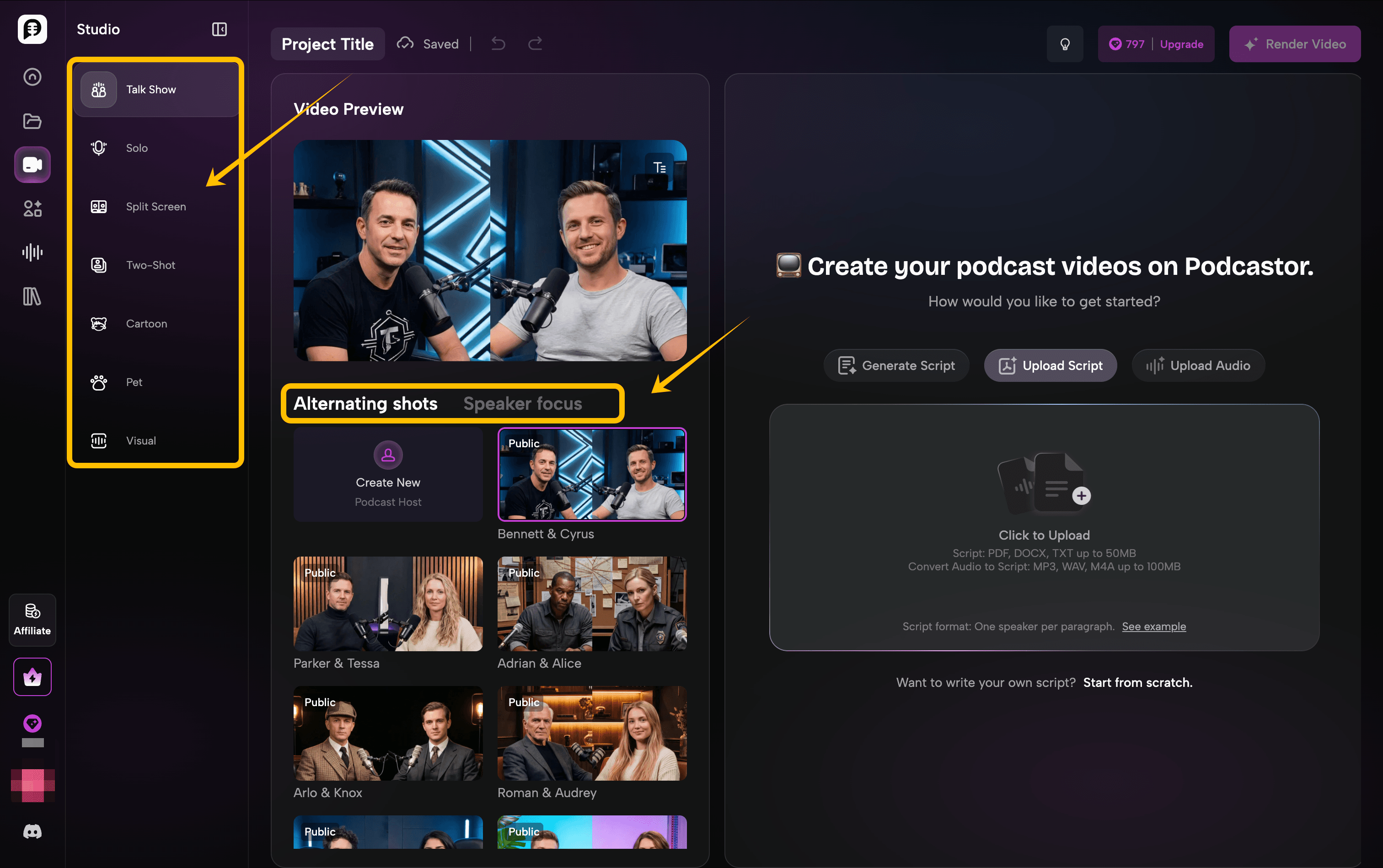
Use source cards or captions to help viewers follow dates and evidence. Export the approved episode for YouTube, Spotify, Apple Podcasts, or social media based on the format you selected.
If you are still defining the show itself, read the complete guide to making a true crime podcast or the more focused Crime Junkie-style podcast workflow.

Before You Publish: Final True Crime Checklist
AI can speed up research, scripting, and production, but the final episode still needs a human review.
Before publishing, check that:
-
The facts are accurate: Names, dates, locations, and key events match your sources.
-
Uncertain claims are clear: Separate confirmed facts from allegations, theories, or details that are still unknown.
-
The story is respectful: Remove unnecessary graphic details or anything that sensationalizes victims and real people.
-
Your media is safe to use: Make sure you have the right to use any photos, footage, music, maps, or other third-party material.
If new information appears after publishing, update or correct the episode when necessary.
For copyright questions, review YouTube’s copyright and fair use guidance and advertiser-friendly content guidelines before publishing.
For source and rights guidance, see YouTube’s copyright and fair use guidance and the YouTube advertiser-friendly content guidelines. Publicly available does not automatically mean free to reuse.
Final Verdict
The best true crime podcasts win for different reasons. In the Dark and Bear Brook lead when reporting depth matters. Criminal is the most flexible starting point for standalone listening. Serial is a strong structure study, while Crime Junkie and My Favorite Murder show how repeatable host formats build listening habits.
If you want to create your own show, start with a well-documented case and a clear episode question. Put your sources into PodcastorAI and generate a structured draft. Then verify the claims, preserve uncertainty, and edit with respect for the people in the story. Create your true crime podcast with PodcastorAI.
FAQ
Can I make a true crime podcast with AI?
Yes. PodcastorAI’s True Crime Podcast Generator can help you turn case research, URLs, PDFs, notes, and other source material into a structured podcast script. You can then edit the script and generate the final audio or video episode in the same workflow.
How does PodcastorAI help create a true crime podcast?
PodcastorAI helps organize your source material, generate a first draft of the story, and turn that script into an audio or video podcast. You can adjust the tone, structure, hosts, language, and episode length before generating the final episode.
What should I upload to a true crime podcast generator?
Start with reliable case materials such as court filings, official statements, reputable news reports, transcripts, research notes, and relevant web pages. The more useful context you provide, the easier it is to create a clear and structured script.
Can PodcastorAI turn a true crime article or case URL into a podcast?
Yes. You can add a web page or article as source material and use PodcastorAI to turn the information into a podcast-style script and episode. For more complex cases, combining the URL with PDFs, notes, or additional research usually gives the AI more context.
Can I edit the AI-generated true crime script?
Yes. The generated script is editable, so you can rewrite sections, change the storytelling style, remove details, adjust the pacing, or reorganize the case before producing the episode.
Can PodcastorAI create a true crime video podcast?
Yes. PodcastorAI can generate both audio and video podcasts, so you can create a traditional narrated true crime episode or turn the same script into a video podcast for platforms such as YouTube.
Do I still need to fact-check an AI-generated true crime podcast?
Yes. PodcastorAI should be treated as a production assistant rather than the final authority on a real case. Review important names, dates, events, allegations, and conclusions against your original sources before publishing.