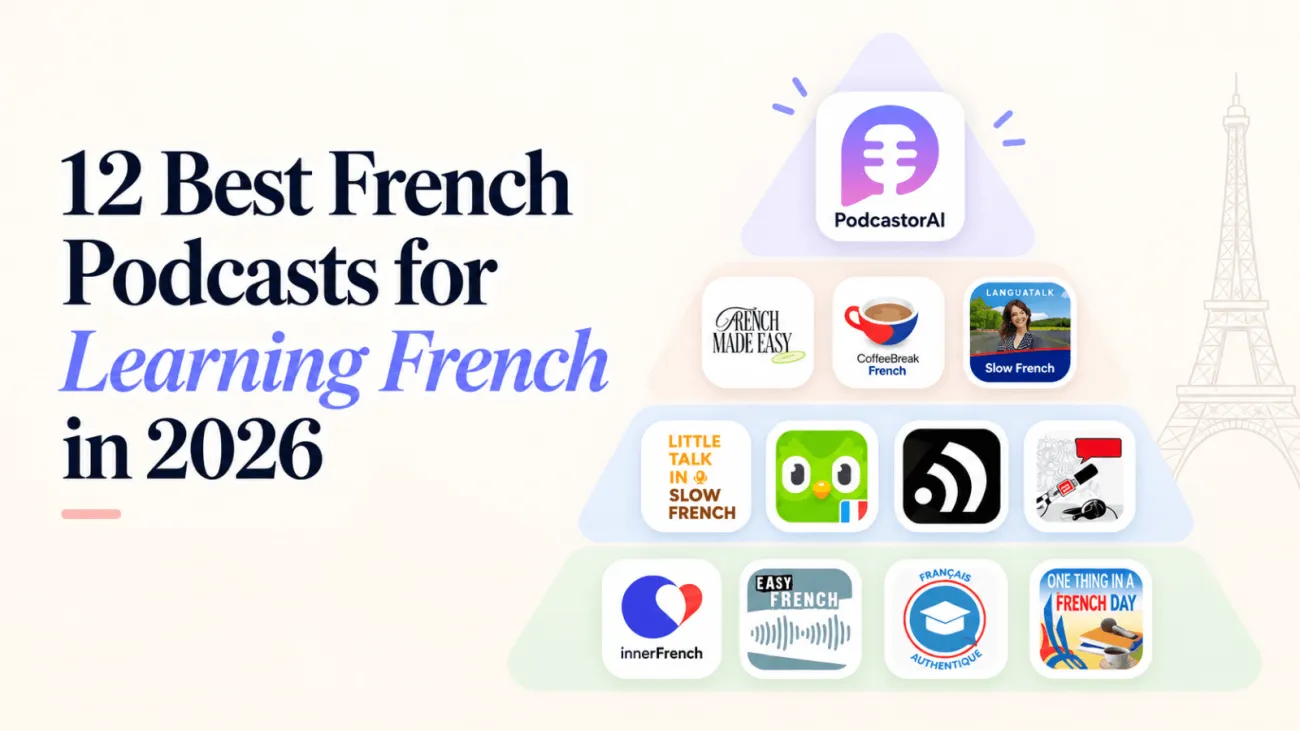

Listening to French is easy. Finding French you can actually understand and want to return to is harder.
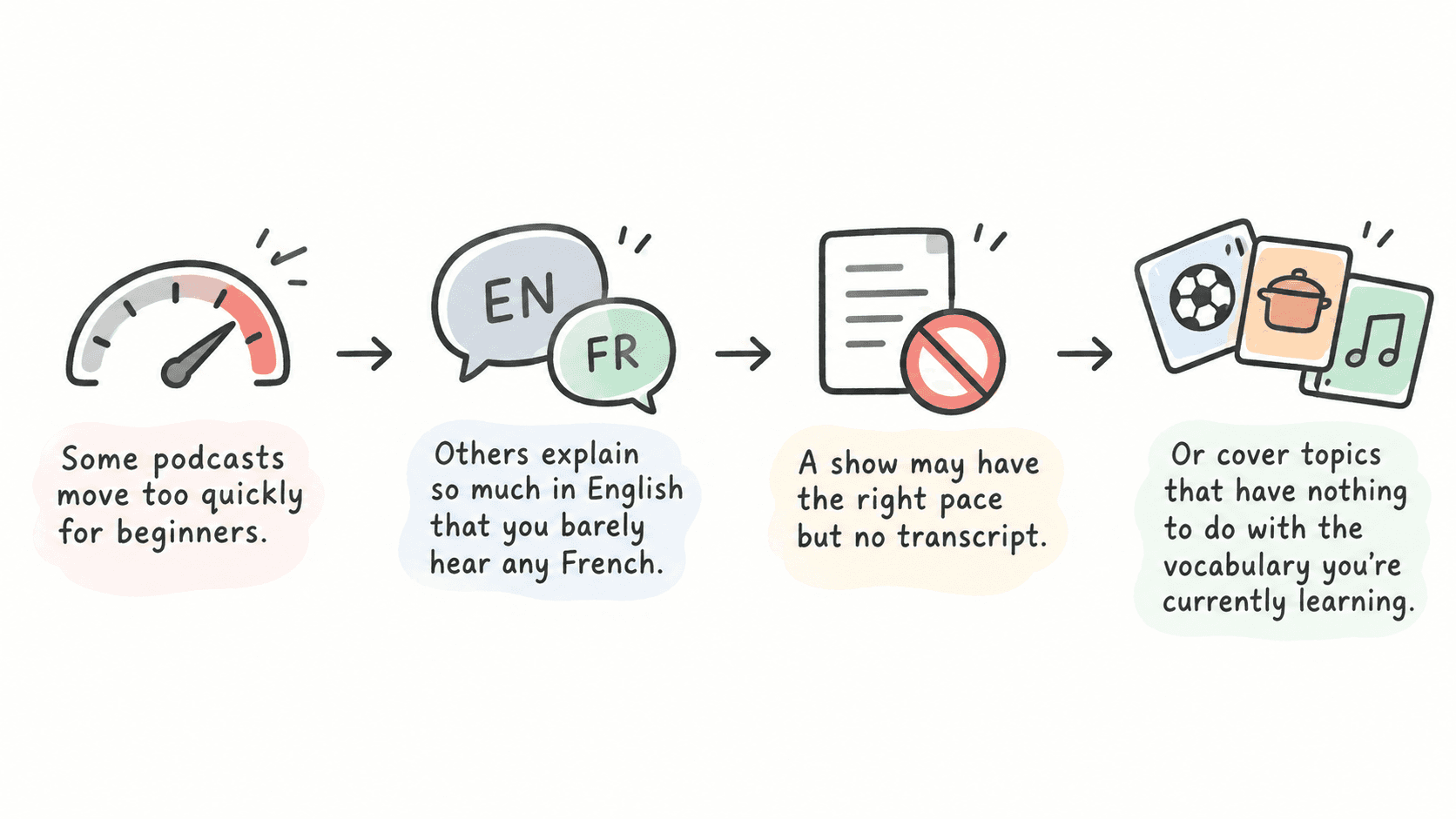
Some French podcasts move too quickly for beginners. Others explain so much in English that you barely hear any French. A show may have exactly the right pace but no transcript, or cover topics that have nothing to do with the vocabulary you are currently learning.
That is why the best French podcast is not simply the most popular one. It is the one that matches your level, your interests, and the way you like to learn.
For this guide, we compared 11 of the best French podcasts for learning French and one personalized podcast tool by approximate CEFR level, speaking speed, episode format, transcript availability, and learning goal. You will find a tool for creating lessons from your own materials, structured shows for complete beginners, slow French podcasts for developing your listening skills, and native level content that can help you move beyond textbook French.
We also cover what to do when no public podcast fits what you need to learn next. With PodcastorAI, you can turn your own French notes, vocabulary lists, articles, PDFs, and lesson materials into personalized audio or video podcasts.
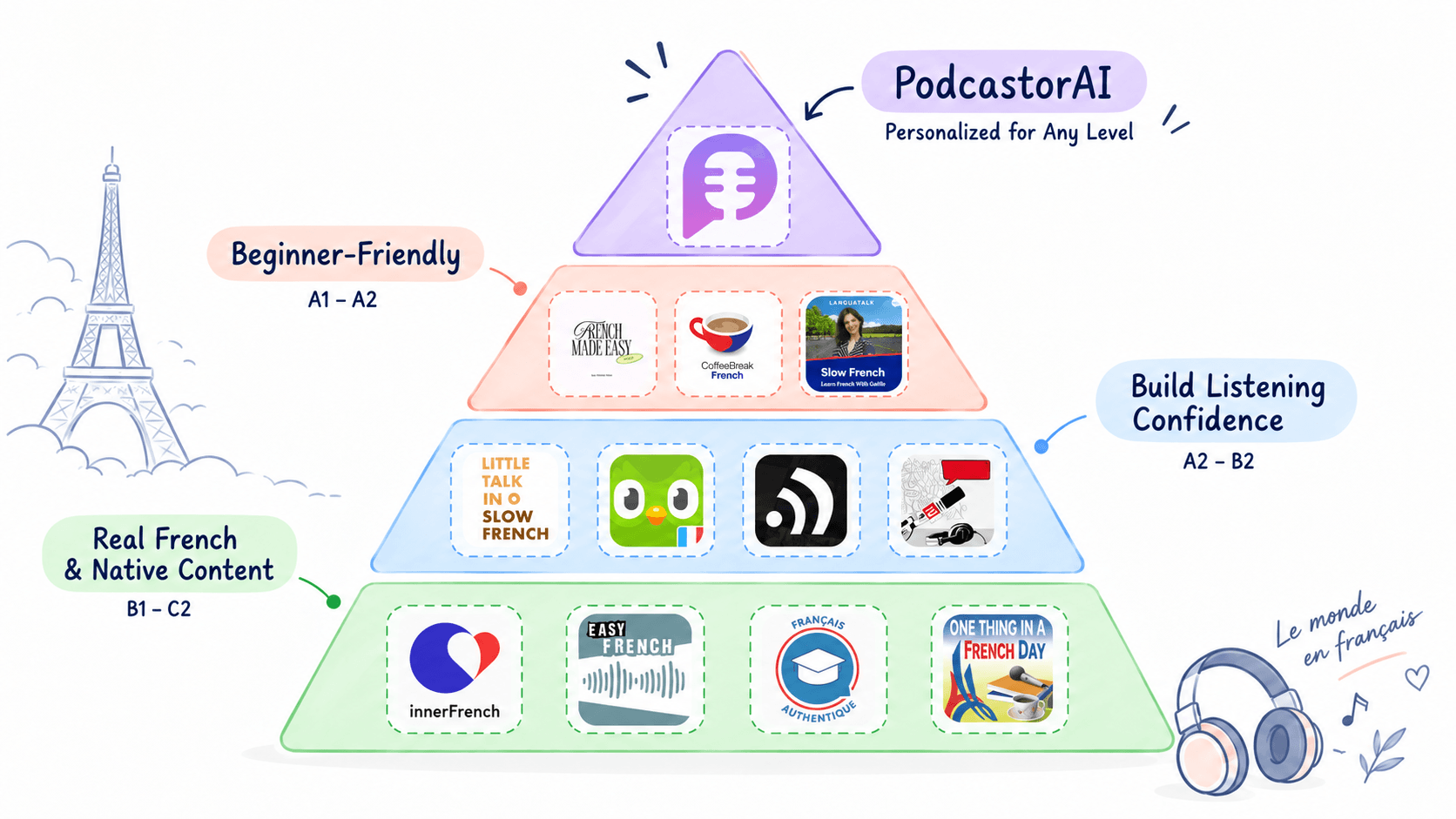
The Best French Podcasts Tools for Learning French at a Glance
| French podcast | Best for | Suggested level | Format |
|---|---|---|---|
| PodcastorAI | Creating podcasts from your own French materials | A1–C1 | Personalized AI-hosted audio and video |
| Coffee Break French | Structured, course-like learning | A1–B2 | Teacher-led lessons |
| French Made Easy | Short beginner lessons | A1–A2 | Vocabulary, grammar, and pronunciation |
| Little Talk in Slow French | Interesting topics in slower French | A2–B1 | Solo explanations and stories |
| LanguaTalk Slow French | Slow French with interactive text | A2–B1 | Francophone culture and everyday topics |
| Duolingo French Podcast | Bilingual real-life stories | A2–B1 | French storytelling with English context |
| InnerFrench | Moving beyond beginner materials | B1–B2 | Culture, society, history, and ideas |
| Easy French | Authentic conversations and expressions | B1–B2 | Two-host conversations |
| Français Authentique | Natural French and confident expression | B1–C1 | Solo reflections and language lessons |
| One Thing in a French Day | Short stories about everyday life in France | B1–C1 | Personal audio journal |
| News in Slow French | Current affairs at a learner-friendly pace | A2–C1 | News, grammar, and expressions |
| Journal en français facile | Free daily French news practice | A2–B2 | Ten-minute news bulletin |
Our quick recommendations
-
Best for creating a podcast from your own materials: PodcastorAI
-
Best for absolute beginners: French Made Easy
-
Best structured course: Coffee Break French
-
Best slow French podcast with free transcripts: LanguaTalk Slow French
-
Best for bilingual storytelling: Duolingo French Podcast
-
Best for intermediate learners: InnerFrench
-
Best for everyday conversational French: Easy French
-
Best free French news podcast: Journal en français facile
1. PodcastorAI — Best for Creating Personalized French Learning Podcasts
Recommended level: A1–C1
Best for: Turning your own French notes, lessons, vocabulary, and documents into listening practice
Typical format: Editable AI generated scripts with one or two hosts, available as audio or video
Most French podcasts decide the topic, vocabulary, and difficulty for you. PodcastorAI works in the opposite direction: you begin with the French you actually need to learn, then turn it into a podcast made for your goal.
You can upload French notes, vocabulary lists, dialogues, articles, PDFs, webpages, or classroom materials. PodcastorAI organizes the source material into an editable podcast script, so you can check the French, adjust the explanation, change the examples, or make the lesson easier or more advanced before generating anything.
You can then choose one or two AI hosts, select or design a voice, and generate both audio and video from the same script. This makes it useful not only for individual learners, but also for French teachers and course creators who want to turn existing lessons into repeatable listening content.
For example, an A2 learner could upload a vocabulary list about ordering at a café and ask PodcastorAI to create:
-
a short conversation between a customer and a server;
-
clear explanations of the key expressions;
-
several examples using the vocabulary in complete sentences;
-
a recap that repeats difficult phrases naturally.
Instead of searching for an episode that happens to match what you are studying, you create the episode you need.
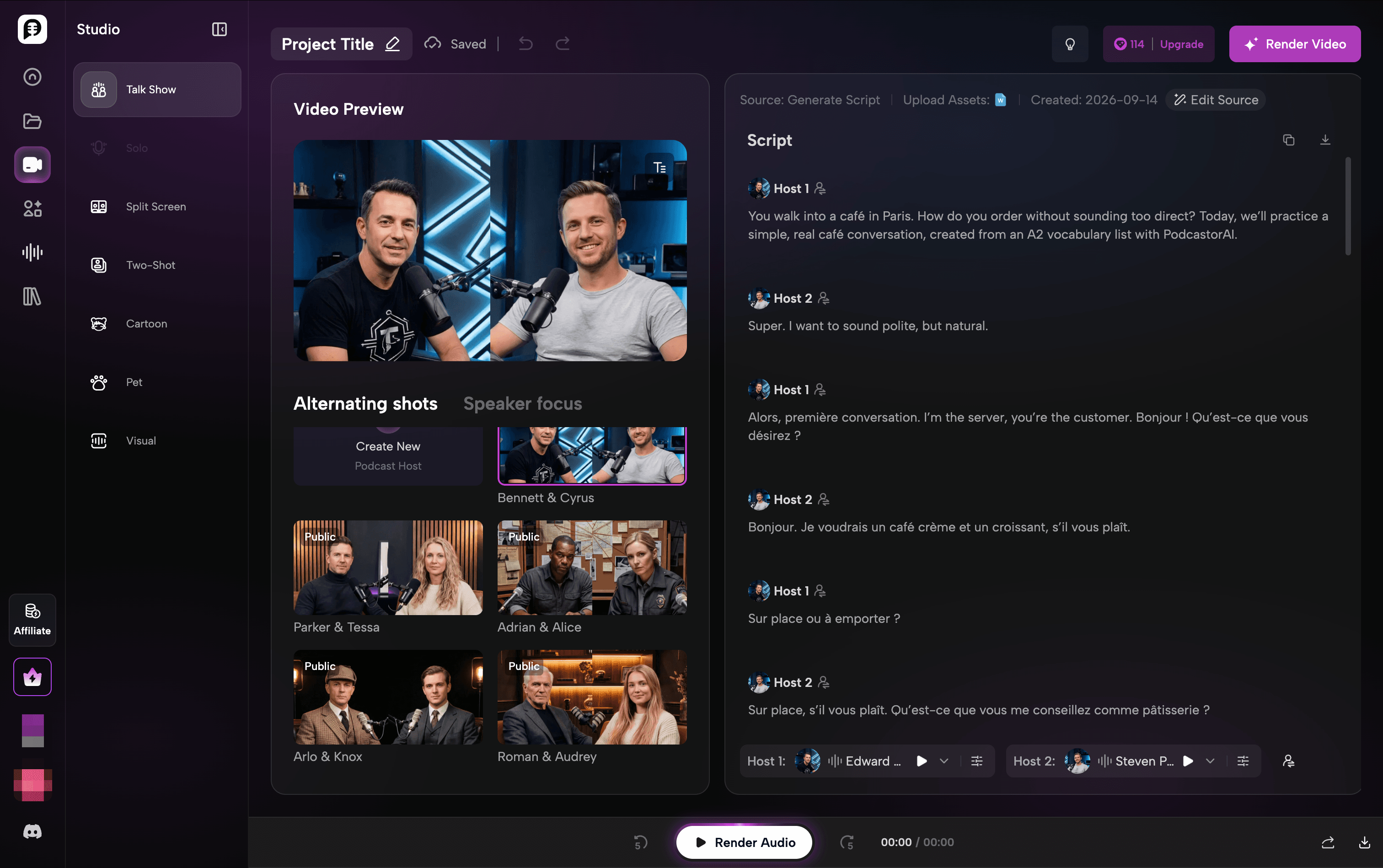
Why we recommend it: PodcastorAI gives you control over the source material, topic, script, host, voice, and output format. It can also turn one lesson into both an audio podcast and a video podcast without requiring you to record either one yourself.
Keep in mind: PodcastorAI is a podcast creation tool, not a published French course. You should review the generated script especially for exam preparation or highly technical material and combine personalized episodes with native speaker content to hear a wider range of real voices and accents.
Create a French learning podcast with PodcastorAI
2. Coffee Break French
Recommended level: A1–B2
Best for: Learners who want lessons to become progressively more difficult
Typical format: Teacher-and-learner conversations, explanations, and cultural topics
Coffee Break French is one of the easiest places to begin if you want a podcast that feels like a course rather than a collection of unrelated episodes.
The earlier material introduces foundational vocabulary and sentence patterns with plenty of English guidance. Later seasons gradually use more French and explore grammar, culture, and authentic conversations. That progression makes Coffee Break French especially useful for learners who do not know what to listen to next.
The free podcast gives you access to the core audio lessons. More complete lesson materials including notes, extended audio, video lessons, and transcripts for selected series are part of the paid courses.
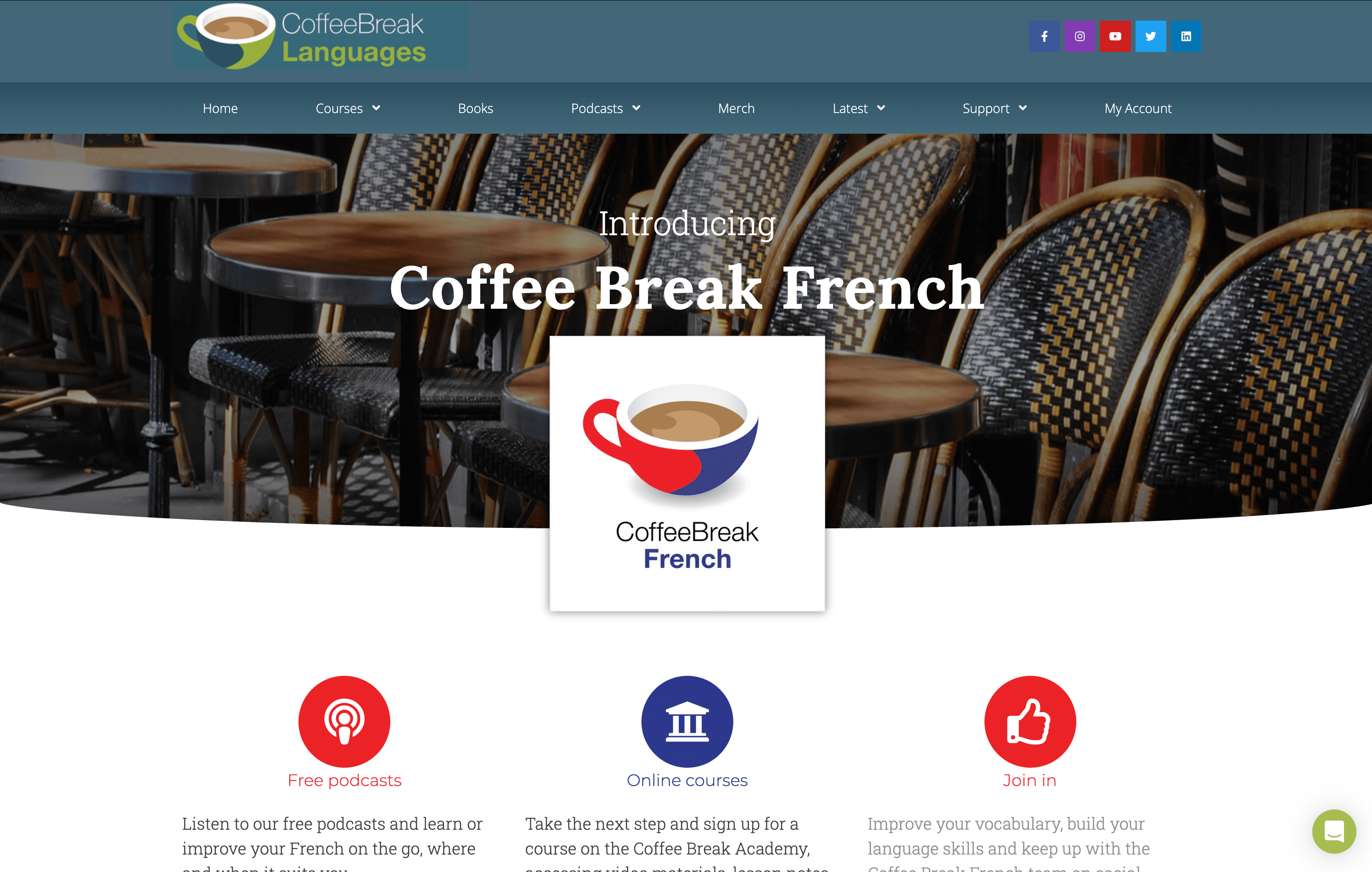
Why we recommend it: The teacher-led format makes new material feel manageable, and the season structure gives beginners a clear path forward.
Keep in mind: If your main goal is French immersion, the amount of English in the early lessons may eventually feel limiting. Intermediate learners can move to the later seasons or the En Route series for more natural French.
3. French Made Easy
Recommended level: A1–A2
Best for: Short lessons on pronunciation, grammar, and everyday expressions
Typical format: Five-to-ten-minute teaching episodes
Hosted by native French teacher Mathilde Kien, French Made Easy is designed for people who are starting from zero—or who have been stuck at beginner level for a long time.
Each episode stays focused on one manageable task. You might practice French nasal sounds, learn how to ask for directions, review a group of useful expressions, or listen to a short beginner story. Because the episodes are brief, it is easy to replay them until the words no longer feel unfamiliar.
Many episodes include a transcript, cheat sheet, or exercise, which helps solve one of the biggest problems with audio only learning: hearing a sound without knowing how the word is written.
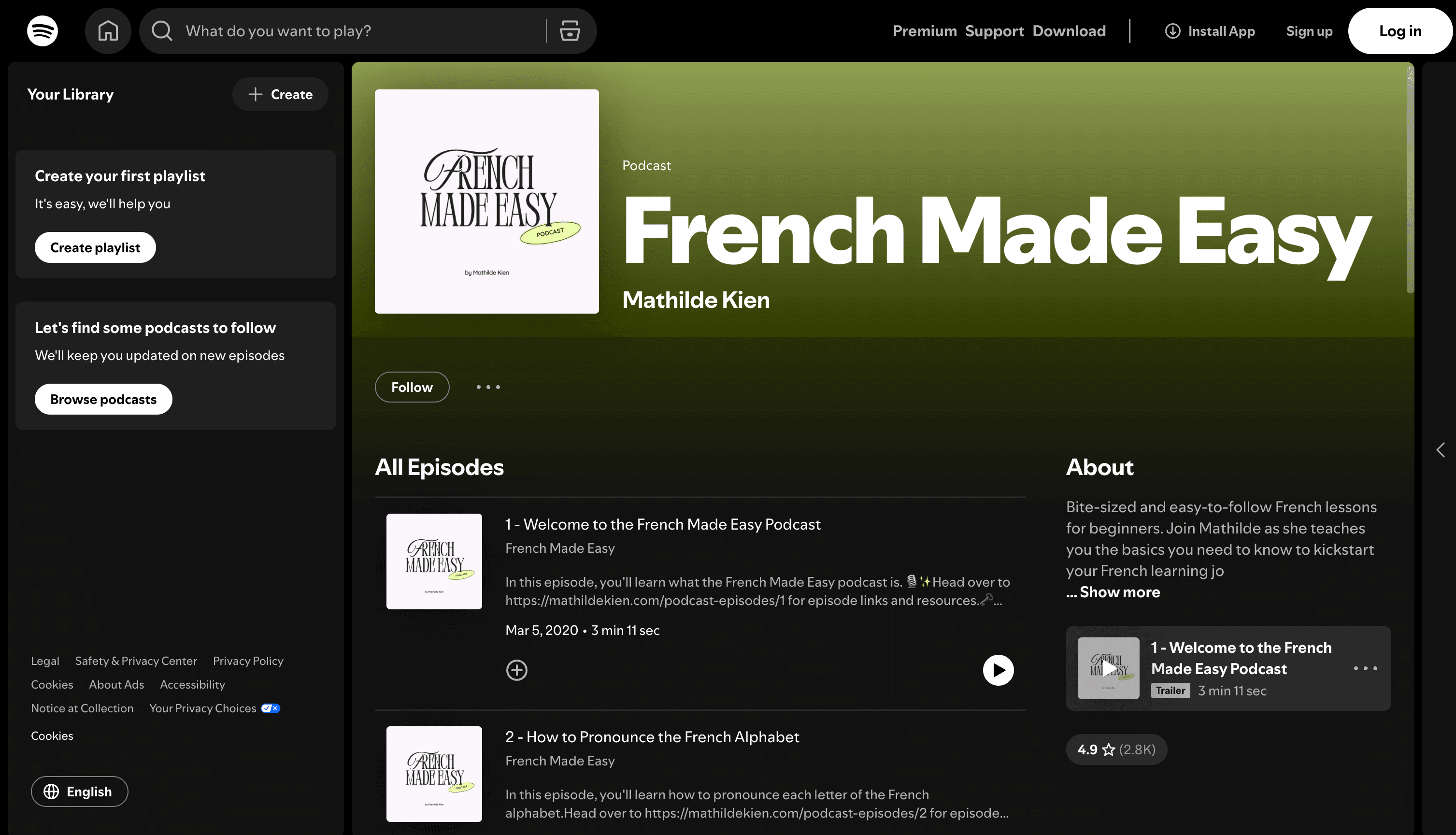
Why we recommend it: The lessons are specific and practical. You can complete one during a commute or use it as a ten-minute daily listening habit.
Keep in mind: Advanced learners will outgrow the instructional pace. This podcast works best as a foundation before moving into longer, all-French episodes.
4. Little Talk in Slow French
Recommended level: A2–B1
Best for: Building listening confidence through culture, history, and current topics
Typical format: Calm solo narration with occasional English support
Little Talk in Slow French, hosted by Nagisa Morimoto, sits in the useful space between a traditional lesson and a native podcast.
The French is clear and slower than everyday conversation, but the episodes still explore substantial topics such as French history, culture, society, and current events. Difficult words or ideas are sometimes clarified in English, so learners can continue listening without reaching for a dictionary every few seconds.
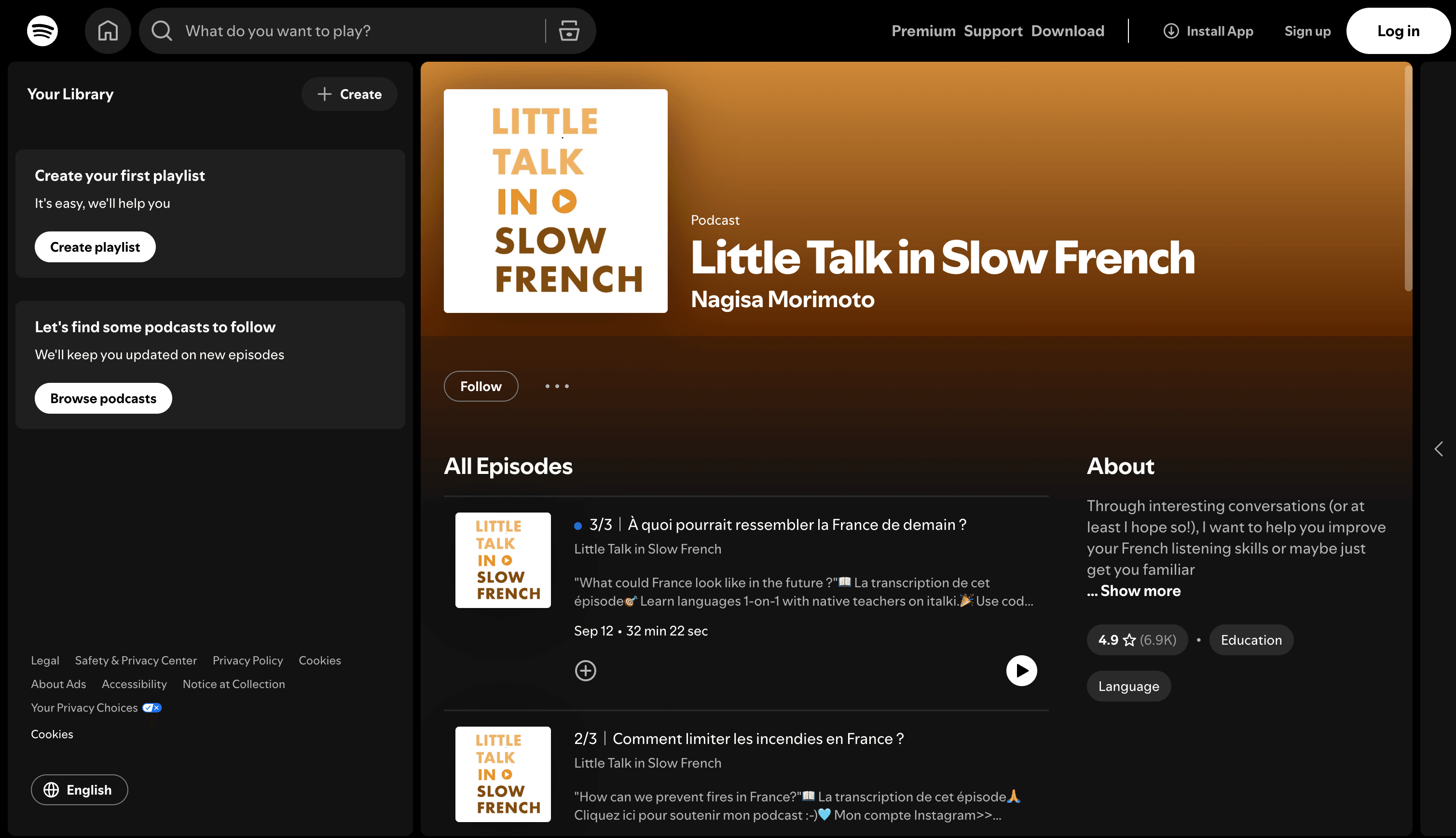
Why we recommend it: It gives upper beginners meaningful French input without reducing every episode to basic travel phrases.
Keep in mind: Although the title says “slow French,” complete beginners may still find it challenging. Transcripts are linked from episodes and are commonly provided through the show’s Patreon, so check access before choosing an episode for intensive study.
5. LanguaTalk Slow French
Recommended level: A2–B1
Best for: Listening and reading at the same time
Typical format: Clear French about life and culture across the Francophone world
In LanguaTalk Slow French, French teacher Gaëlle discusses places, people, traditions, and everyday questions from around the French-speaking world.
Its strongest feature is the connection between the audio and the text. Free interactive transcripts make it easier to locate the sentence you missed, check unfamiliar vocabulary, and listen again without losing your place.
The content is intended for learners around A2 to B1, making it a sensible bridge between beginner courses and podcasts spoken at a natural native pace.
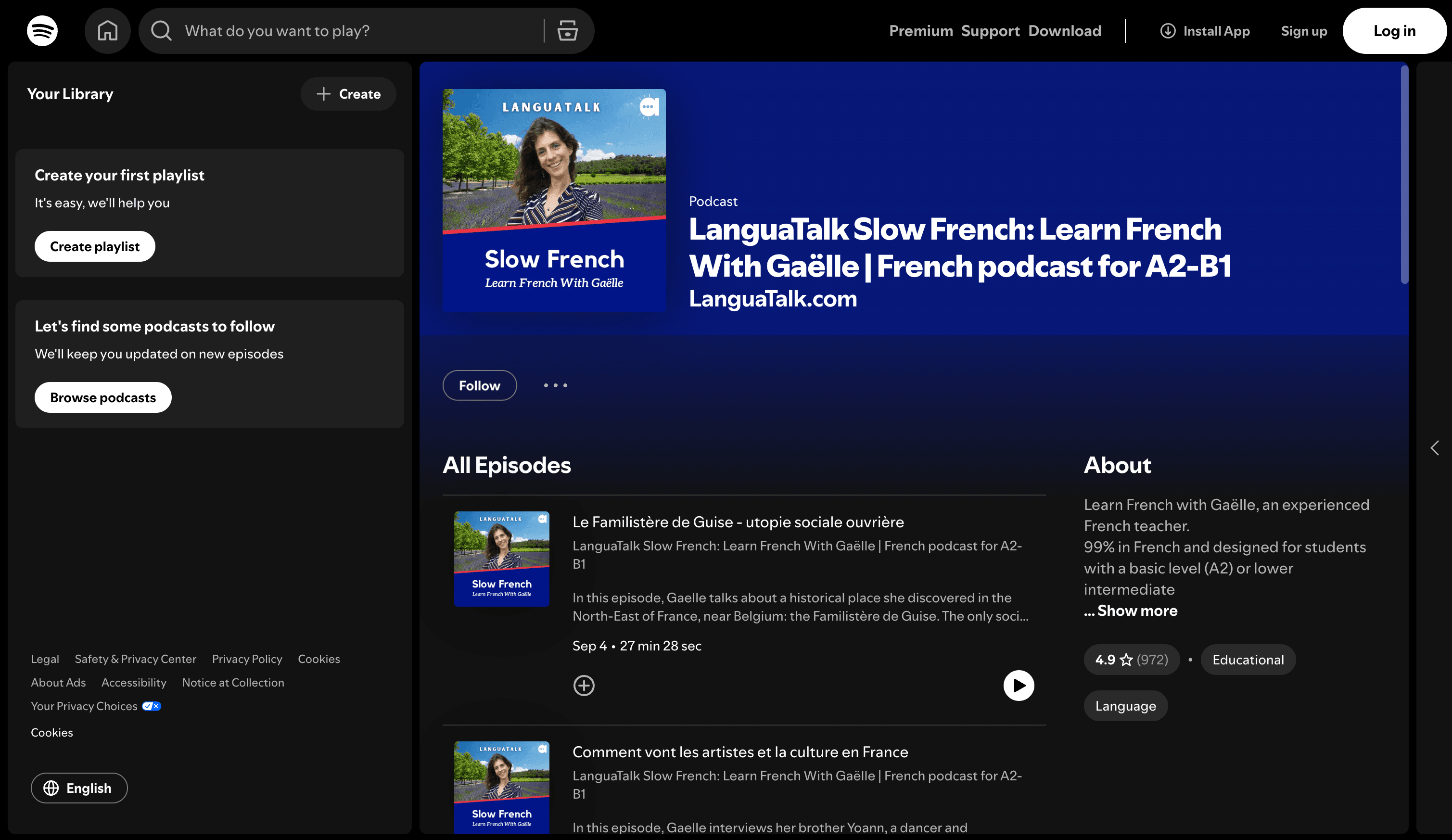
Why we recommend it: The transcript experience makes the show useful for active study, not only passive background listening.
Keep in mind: If you already understand intermediate French comfortably, the slower delivery may feel too controlled. At that point, try InnerFrench or Easy French.
6. Duolingo French Podcast
Recommended level: A2–B1
Best for: Learners who want compelling stories with English support
Typical format: Real-life French stories connected by English narration
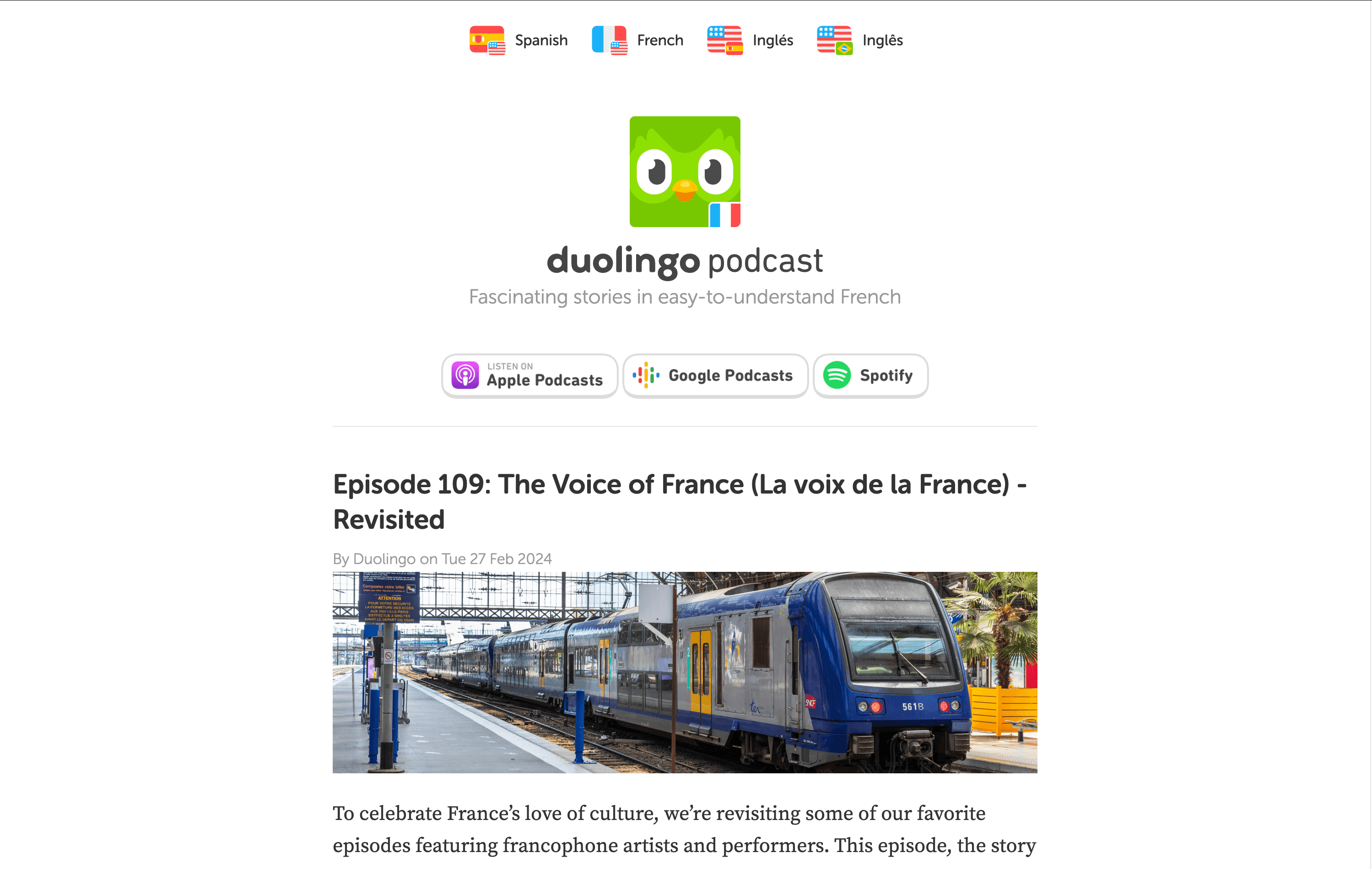
The Duolingo French Podcast uses a bilingual format: the central story is told in accessible French, while an English-speaking narrator provides context and helps the listener follow the plot.
This makes it particularly good for learners who can understand short French passages but are not ready for twenty or thirty minutes of uninterrupted French. The stories introduce voices and experiences from across the French-speaking world, and the free transcripts make it possible to revisit difficult sections.
There is one important 2026 update: Duolingo has ended the podcast series. The existing episodes remain available to stream, so it is still a valuable free archive, but you should not expect new episodes.
Why we recommend it: Storytelling creates a reason to keep listening, while the English narration prevents upper beginners from getting completely lost.
Keep in mind: Because the series has ended and includes substantial English narration, it is better as a bridge than as your only source of French immersion.
7. InnerFrench
Recommended level: B1–B2
Best for: Learners ready to understand ideas—not just language lessons—in French
Typical format: Thoughtful episodes about culture, history, society, and language
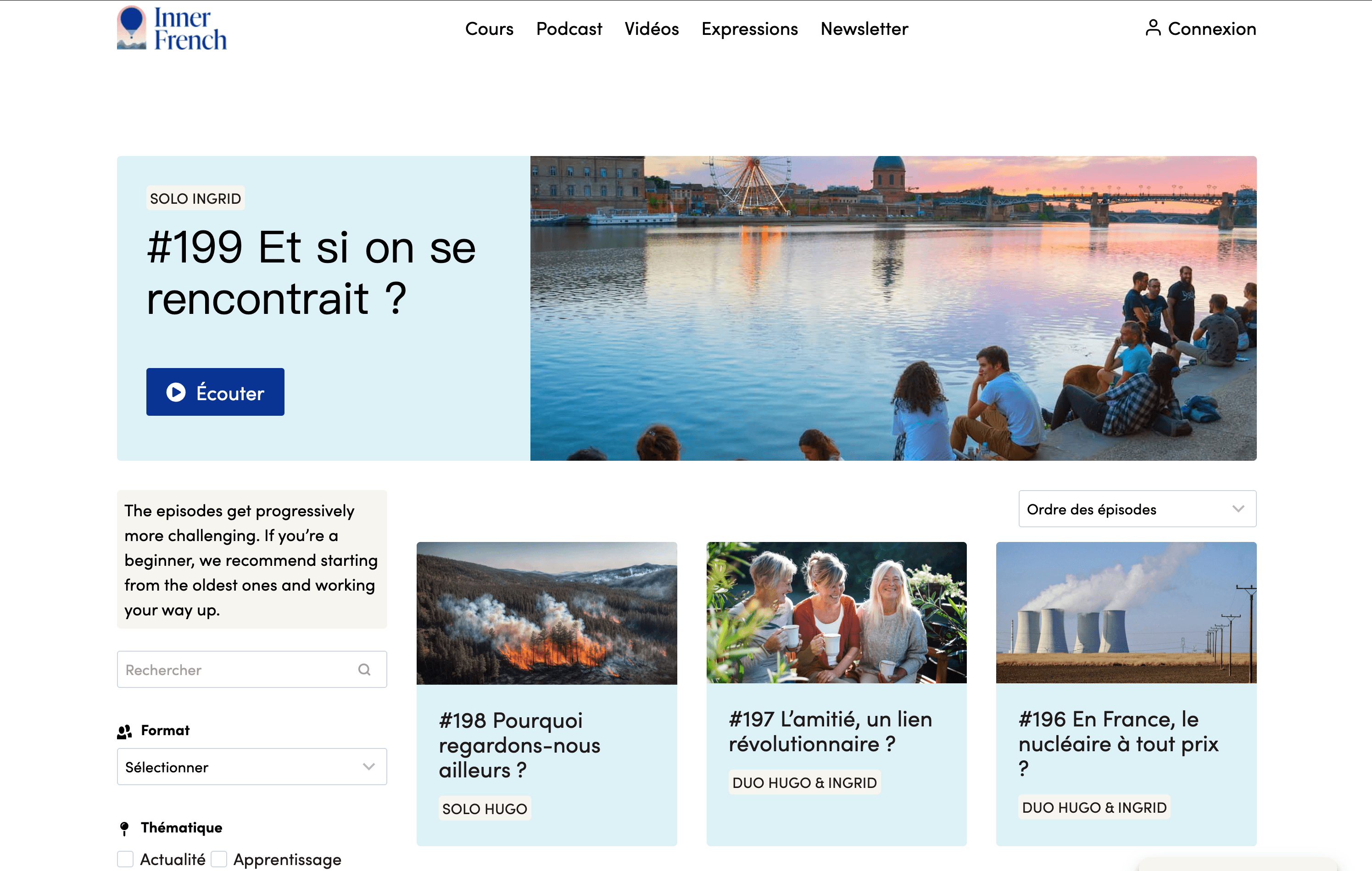
InnerFrench is often recommended to learners who have completed beginner courses but still find native podcasts overwhelming.
Rather than teaching disconnected vocabulary lists, the hosts use clear French to discuss topics that adults might genuinely want to hear about: social questions, psychology, history, language, and life in France. The earlier episodes are generally more accessible, while later material becomes faster and more complex.
Transcripts are available online, making InnerFrench particularly useful for the listen–read–listen method.
Why we recommend it: It is one of the strongest bridges from “French made for students” to meaningful French content. You learn to follow an argument and understand how sentences connect over a longer episode.
Keep in mind: This is not an A1 podcast. If you understand very little without the transcript, start with Little Talk in Slow French or LanguaTalk and return later.
8. Easy French
Recommended level: B1–B2
Best for: Hearing how French speakers discuss ordinary life, culture, and opinions
Typical format: Relaxed conversations between two hosts
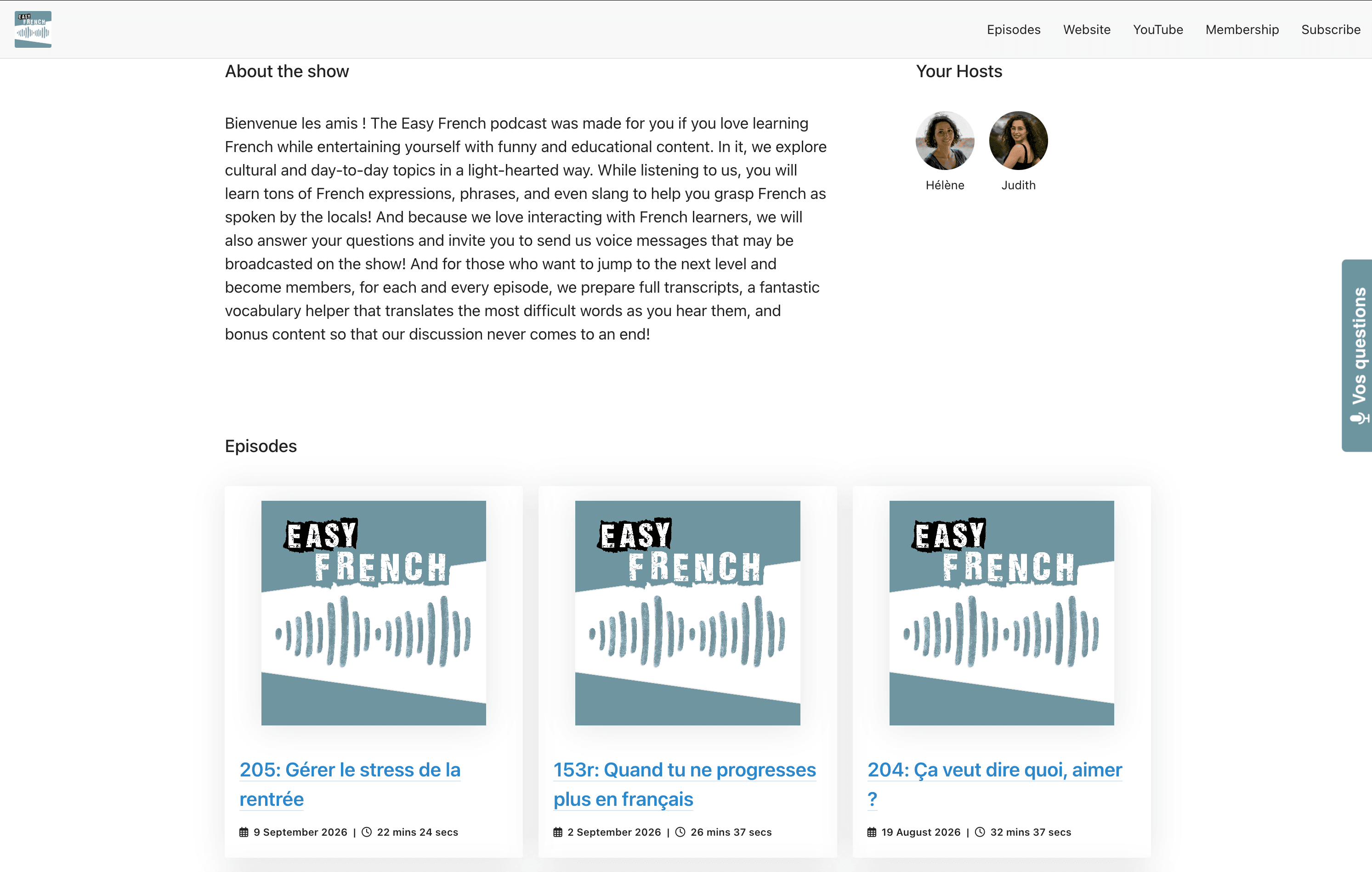
The Easy French Podcast is hosted by Hélène and Judith and focuses on authentic conversation. The hosts discuss life in France, language questions, books, social habits, pronunciation, and subjects suggested by listeners.
Unlike a carefully paced solo lesson, a two-person conversation exposes you to interruptions, reactions, informal phrasing, and the rhythm of real interaction. This makes it especially useful for intermediate learners who understand clear narration but struggle when two native speakers talk to each other.
Members can access interactive transcripts, a vocabulary helper, and bonus content.
Why we recommend it: You hear useful modern expressions and conversational patterns in context instead of studying them one at a time.
Keep in mind: Natural exchanges can feel faster and less predictable than learner narration. Try listening once for the main idea before studying the transcript line by line.
9. Français Authentique
Recommended level: B1–C1
Best for: Natural French, common expressions, and speaking confidence
Typical format: Solo episodes about language, habits, mindset, and daily life
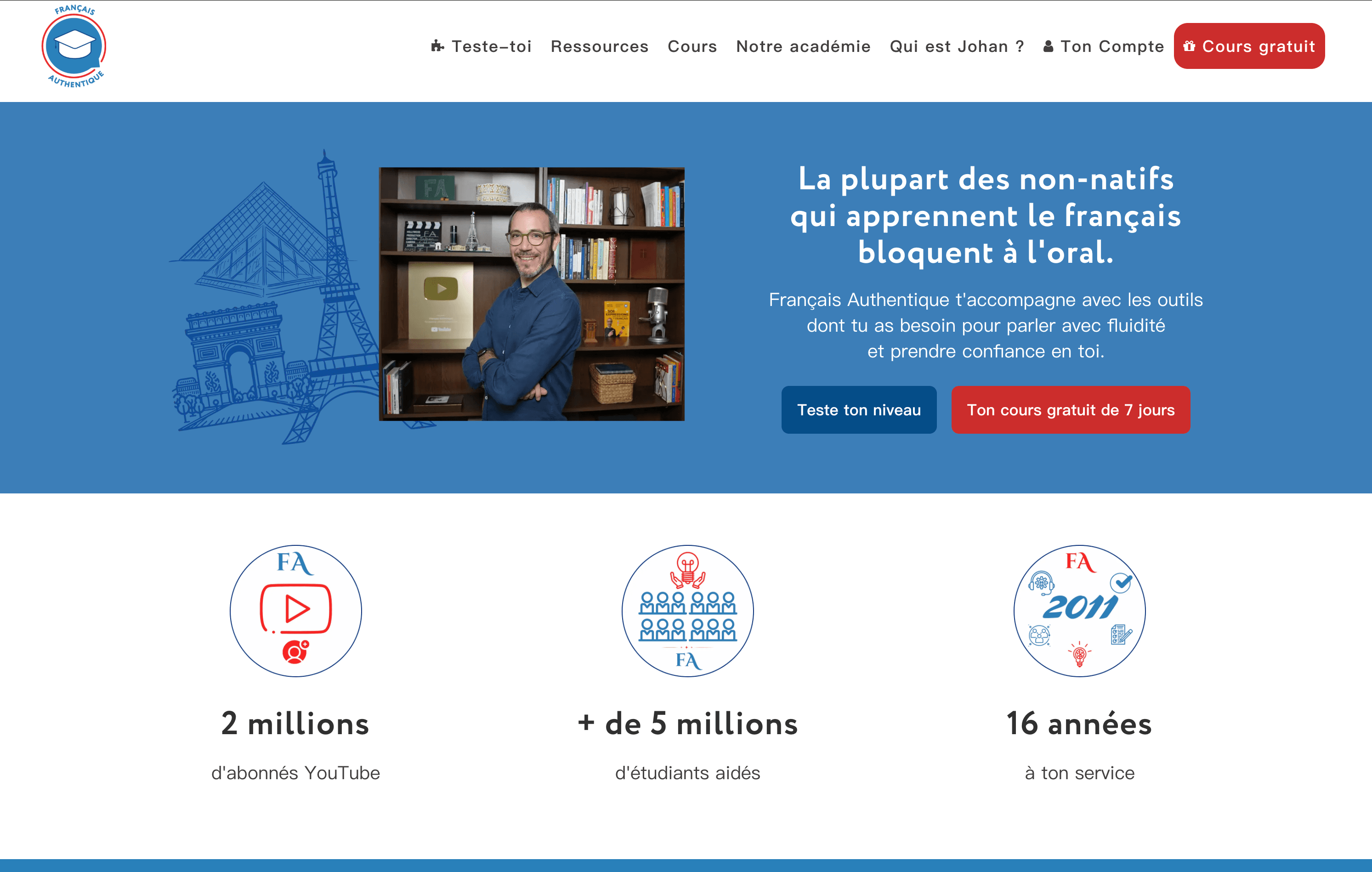
Johan Tekfak created Français Authentique for learners who understand a reasonable amount of French but still freeze when they try to speak.
Episodes mix practical language topics—such as common verbs and expressions—with reflections on habits, learning, work, and life. Johan speaks clearly without making the French sound artificial, which helps learners become comfortable with complete, naturally connected sentences.
Many episode pages include a written transcription, and new podcast content was still being published when this guide was checked in September 2026.
Why we recommend it: The podcast encourages learners to absorb French in context and reuse complete phrases instead of translating word by word.
Keep in mind: Some episodes lean more toward personal development than direct language instruction. Choose by topic if your priority is vocabulary or grammar.
10. One Thing in a French Day
Recommended level: B1–C1
Best for: Frequent, bite-sized exposure to authentic French
Typical format: A short personal audio journal
One Thing in a French Day follows Laetitia Perraut through small moments of everyday life in and around Paris. An episode might revolve around a shop, a conversation, a museum visit, a meal, or something that happened during the day.
The episodes are short, but they contain the details, transitions, and ordinary vocabulary that make real French different from textbook dialogues. The show describes itself as a bridge between textbooks and real-life conversation for intermediate and advanced learners.
Transcript based learning materials are available through the show’s subscriber products and archives.
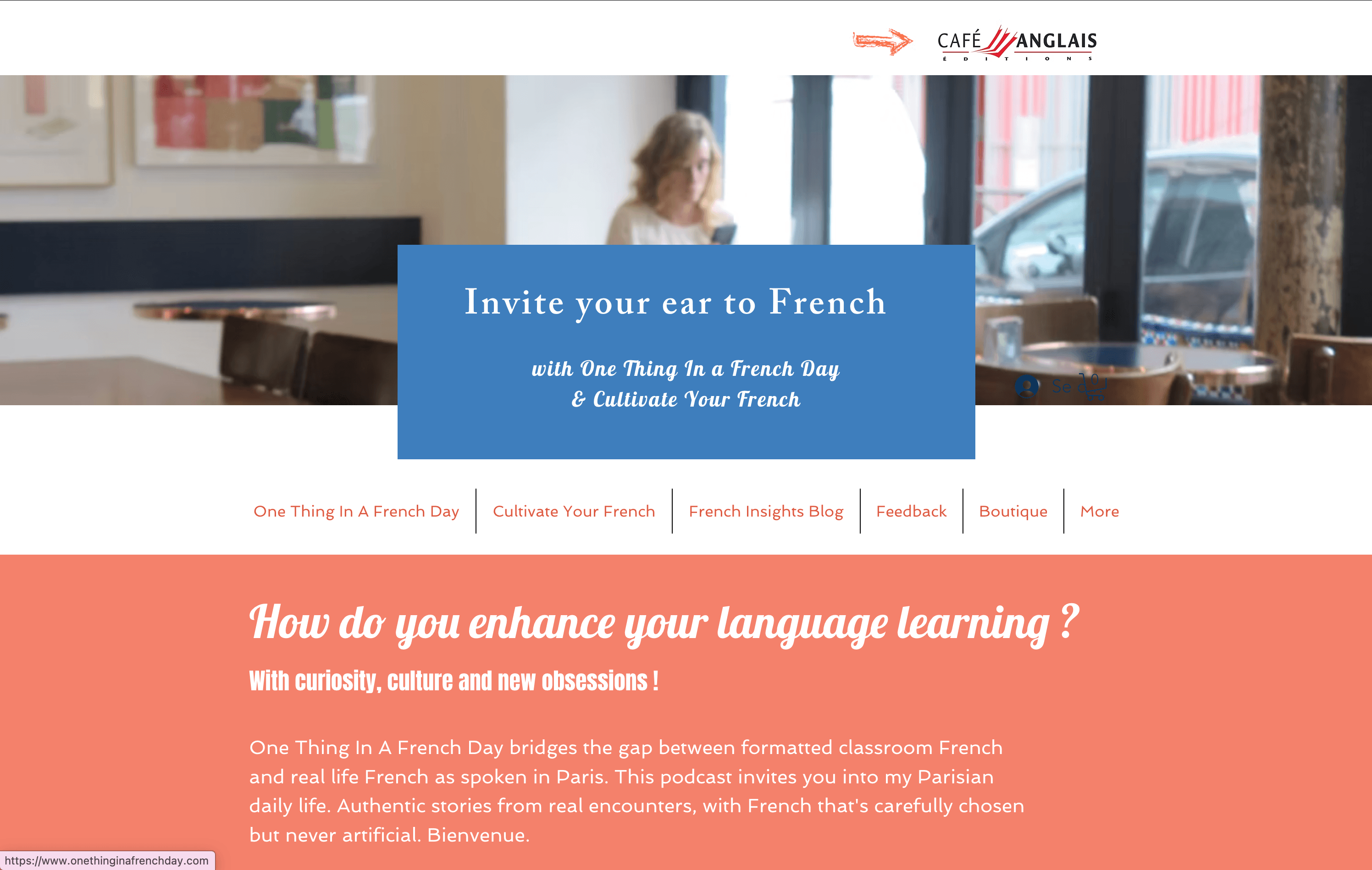
Why we recommend it: A few minutes of authentic French is easier to repeat consistently than an hour-long interview. The personal format also provides cultural context without turning into a formal lesson.
Keep in mind: The French is carefully delivered but not simplified for complete beginners. Transcript access is not entirely free.
11. News in Slow French
Recommended level: A2–C1
Best for: Learners who want structured news, grammar, and expressions
Typical format: Weekly news and language-learning segments
News in Slow French turns current events into structured listening practice. Learners can select material at different levels and use transcripts, contextual translations, grammar lessons, and expression-focused content alongside the audio.
News works well for language learning because names, events, and international vocabulary provide context. Even when you miss part of a sentence, you may still understand what the story is about.
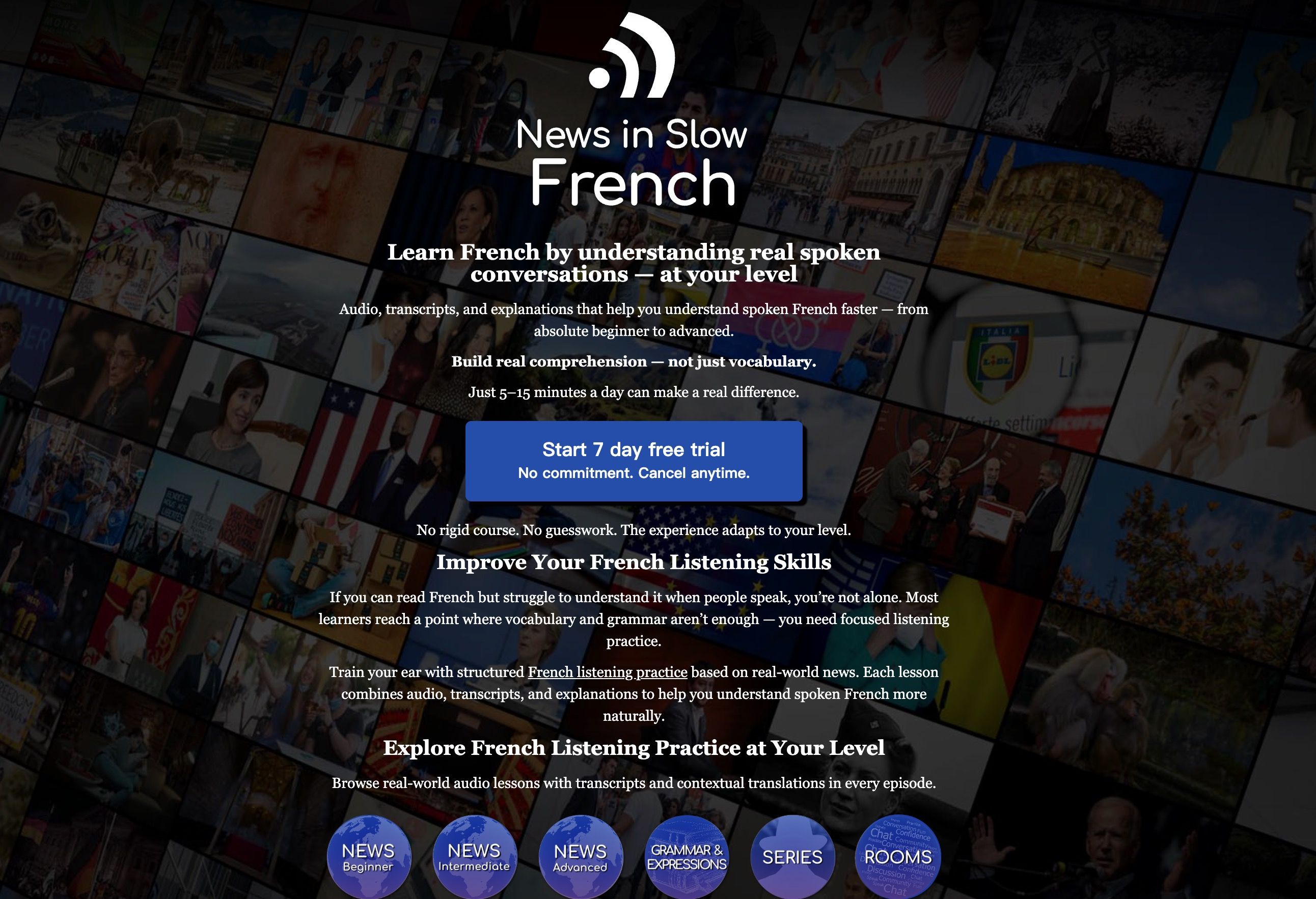
Why we recommend it: It combines regular listening material with the written and explanatory support many learners need. It is also a good choice for people who find traditional language-learning topics repetitive.
Keep in mind: Full access to transcripts and learning tools is part of a subscription. News vocabulary is useful, but it will not cover every kind of everyday conversation.
12. Journal en français facile
Recommended level: A2–B2
Best for: A short, consistent news-listening routine
Typical format: A weekday news bulletin of about ten minutes
Journal en français facile is produced by RFI and presents international news using clearer language and additional context. Episodes are published with a free transcript, and RFI also provides regular exercises based on selected news stories.
The ten minute format is long enough to introduce several voices and topics but short enough to replay. Because the subject matter changes every day, it also gives you repeated exposure to names, numbers, dates, places, and high-frequency news vocabulary.
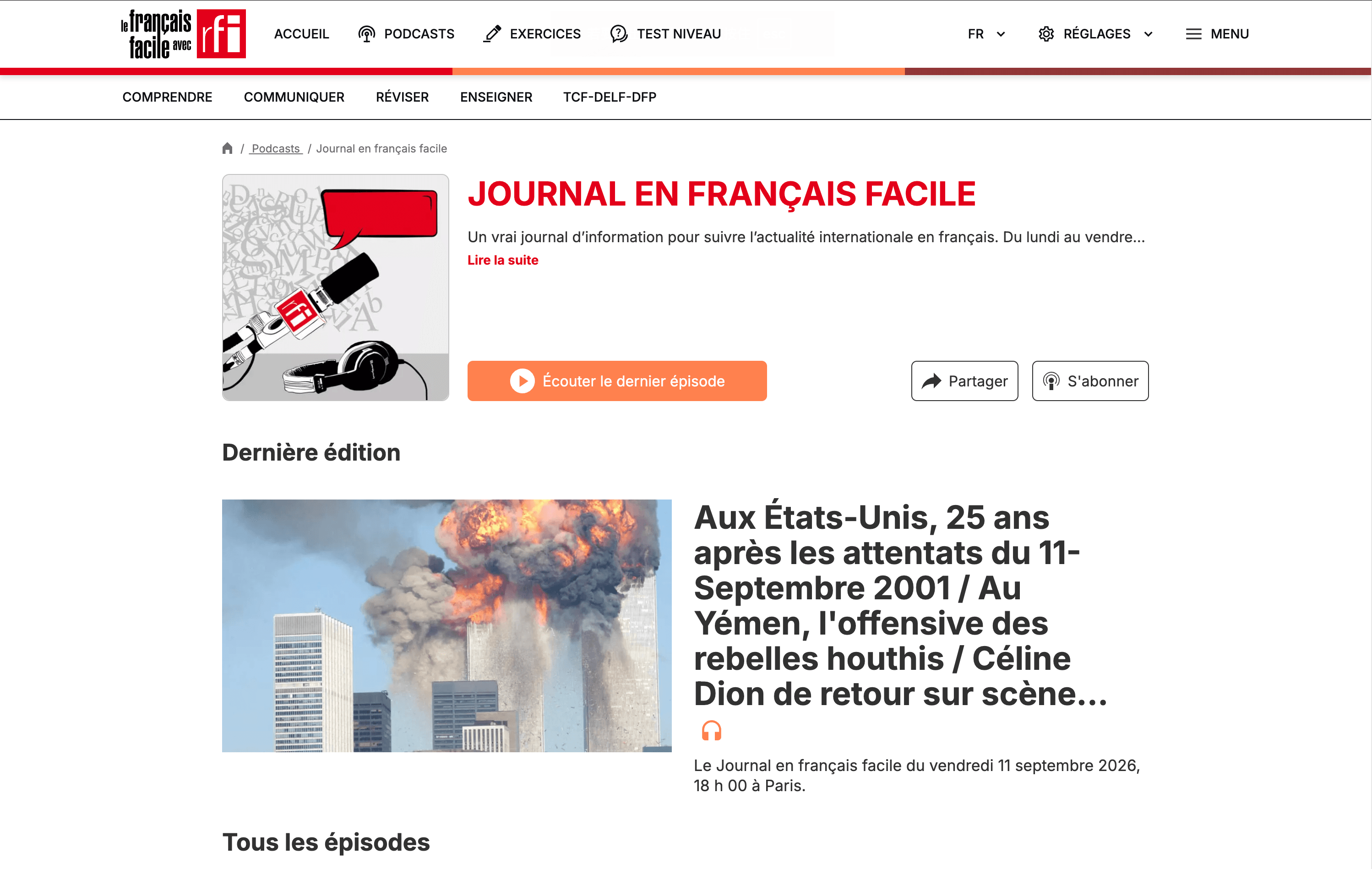
Why we recommend it: It is free, current, transcript-supported, and easy to turn into a daily routine.
Keep in mind: “Easy French” does not mean beginner French. The program is still real news, so the vocabulary can become dense when stories involve politics, economics, or international conflict.
Can’t Find the Right French Podcast? Create One From What You Are Learning
Public podcasts have to serve thousands of listeners at once. They do not know which vocabulary you reviewed this morning, which grammar point you keep forgetting, or whether you are preparing for a café conversation, a DELF exam, or a move to Lyon.
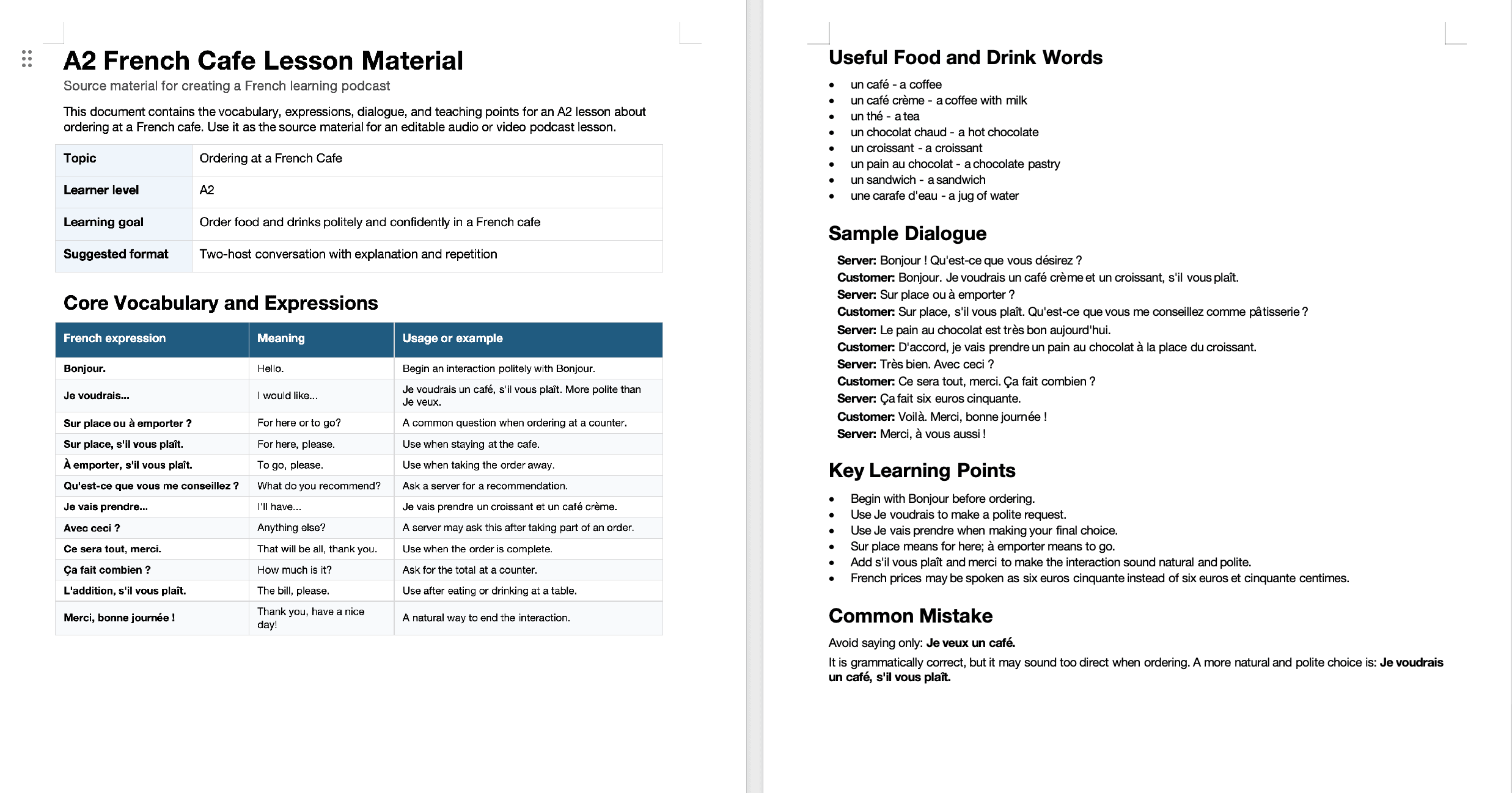
PodcastorAI’s French podcast generator lets you create listening practice from the French you already have.
You can add:
-
French notes and vocabulary lists
-
Textbook passages and lesson materials
-
Dialogues and grammar explanations
-
Articles, webpages, and links
-
PDFs and study documents
-
Topics you want to discuss in real life
PodcastorAI organizes the material into an editable podcast script. You can review the wording, change the examples, simplify or expand the explanation, and make sure the episode focuses on what you actually need to learn.
You can then choose an AI voice or design your own, create a consistent AI host, and generate audio and video from the same script.
For example, instead of searching through dozens of episodes for one that teaches restaurant vocabulary, you could turn your own phrase list into:
-
a two-host conversation at a Paris café;
-
an explanation of the most useful expressions;
-
contextual examples for ordering and asking questions;
-
a short recap that repeats the phrases naturally.
This does not replace the French podcasts in this list. It fills the space between them. Listen to public shows for new voices, stories, accents, and culture; use personalized episodes to review the exact material you need to remember.
Frequently Asked Questions
What is the best tool for creating personalized French learning podcasts?
PodcastorAI is designed for creating French learning podcasts from your own materials. Instead of choosing only from published episodes, you can add the vocabulary, lesson, document, or topic you want to study and turn it into an editable podcast script. You can then select AI hosts and voices and generate the finished lesson as audio or video.
Can PodcastorAI turn French notes, PDFs, or links into a podcast?
Yes. You can add French notes, vocabulary lists, lesson materials, PDFs, articles, and webpages to PodcastorAI. It organizes the source content into a structured script rather than simply reading the text aloud. You can review and edit the dialogue, explanations, and examples before generating the podcast.
Can I use PodcastorAI to create French podcasts for different levels?
Yes. You can shape the script around the learner’s current level and edit its vocabulary, sentence length, explanations, and examples before generation. For example, an A1 episode might use short everyday exchanges and English support, while a B1 or B2 episode can use longer all-French conversations and more natural expressions. PodcastorAI does not provide an official CEFR assessment, so teachers and exam learners should review the final script themselves.
Can PodcastorAI create both French audio podcasts and video podcasts?
Yes. The same reviewed script can be used to generate an audio podcast or a video podcast with one or two AI hosts. This makes it possible for learners to listen on the go and review the same lesson visually, while teachers and course creators can reuse one lesson across different platforms.
What is the best French podcast for complete beginners?
French Made Easy is one of the most approachable options for complete beginners because its episodes are short and focus on specific pronunciation, vocabulary, and grammar tasks. Coffee Break French is a better choice if you want a longer, structured course that becomes progressively more difficult.
Can I learn French by listening to podcasts?
Podcasts can improve listening comprehension, vocabulary, pronunciation awareness, and familiarity with natural sentence patterns. However, listening alone is unlikely to develop every skill. Combine podcasts with reading, speaking, writing, and deliberate vocabulary review.
Should beginners listen to French podcasts with transcripts?
Yes. A transcript helps beginners connect French sounds with written words and identify the parts they could not understand. For best results, listen once before reading, then listen again while following the text.
Which French podcasts have free transcripts?
InnerFrench, Duolingo French Podcast, LanguaTalk Slow French, French Made Easy, and Journal en français facile provide free transcripts or transcript resources for their episodes. Access policies can change, so check the individual episode page before beginning a study plan.
Is InnerFrench suitable for beginners?
InnerFrench is primarily designed for intermediate learners. A strong A2 learner may be able to begin with its earlier episodes, but most complete beginners will find Coffee Break French, French Made Easy, or LanguaTalk Slow French easier.
What is the best slow French podcast?
LanguaTalk Slow French is especially useful if you want free interactive transcripts. Little Talk in Slow French is a good alternative if you prefer longer episodes about culture, history, and current topics. News in Slow French works well for learners who want current affairs and structured learning tools.
Are there good French podcasts on Spotify?
Yes. Most of the podcasts in this guide—including Coffee Break French, Little Talk in Slow French, InnerFrench, Easy French, Français Authentique, and the Duolingo French Podcast archive—are available through major podcast platforms such as Spotify and Apple Podcasts. Transcript and exercise materials are usually hosted on each podcast’s own website.
How often should I listen to French podcasts?
Short, regular sessions are more useful than occasionally completing a very long episode. Start with ten to twenty minutes three or four times a week. Replaying one useful episode can be more effective than constantly moving to new material.
Find or Create the French Podcast You Will Keep Listening To
There is no single best French podcast for every learner. PodcastorAI is the strongest choice when you want an episode built around your own vocabulary, lesson materials, topic, or target level rather than a public feed.
French Made Easy and Coffee Break French provide the guidance beginners need. LanguaTalk and Little Talk in Slow French make the transition to all-French listening less intimidating. InnerFrench, Easy French, and Français Authentique help intermediate learners follow more natural ideas and conversations. News in Slow French and Journal en français facile connect language practice with what is happening in the world.
Start with the podcast that matches your current level, not the level you think you should have. Use the transcript, replay short sections, and choose subjects that make you curious enough to return tomorrow.
And when the vocabulary, topic, or difficulty never feels quite right, create the episode you wish you could find.