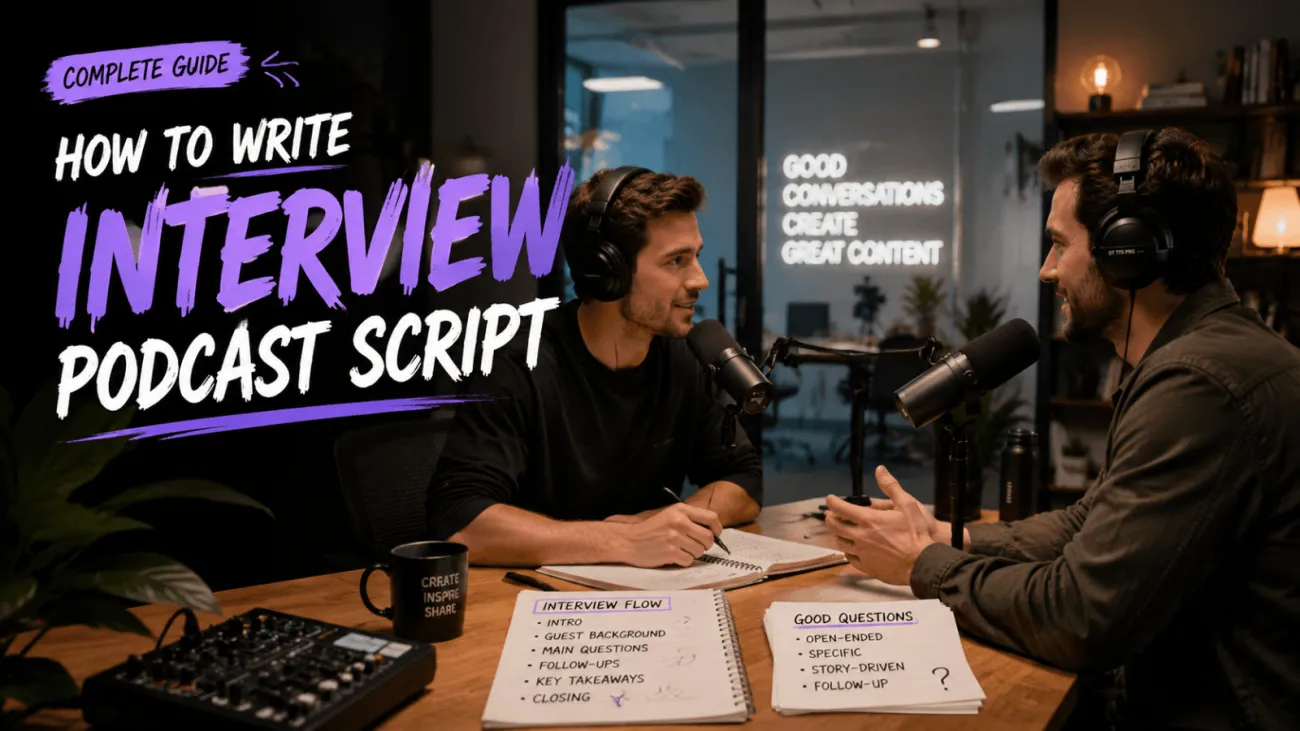

An interview podcast script is a lightweight structure that helps hosts guide a conversation without making it sound stiff. The best interview podcast scripts include a short opening, guest introduction, topic-based question flow, transition lines, follow-up prompts, and a clear closing. If you want better interviews, fewer awkward pauses, and more useful answers, a script gives you a framework without removing spontaneity.
Many hosts avoid scripting because they worry it will make the episode feel robotic. In practice, the opposite is usually true. A good script reduces mental load, keeps the interview on track, and gives you room to listen more carefully.
For many teams, the real bottleneck is not recording the interview. It is turning raw source material into a usable script fast enough to publish consistently. That is why tools such as PodcastorAI are useful in modern podcast workflows: they help creators turn notes, links, transcripts, PDFs, or audio into a structured first draft.
What Is an Interview Podcast Script?
An interview podcast script is a flexible plan for how an episode will unfold. It is not a word-for-word document in most cases. It is a conversation guide that helps you open strongly, move between topics, ask better follow-up questions, and end with purpose.
A useful script usually covers:
-
The opening hook
-
The guest introduction
-
The first 3 to 5 core questions
-
Transition lines between sections
-
Follow-up prompts
-
The closing summary and call to action
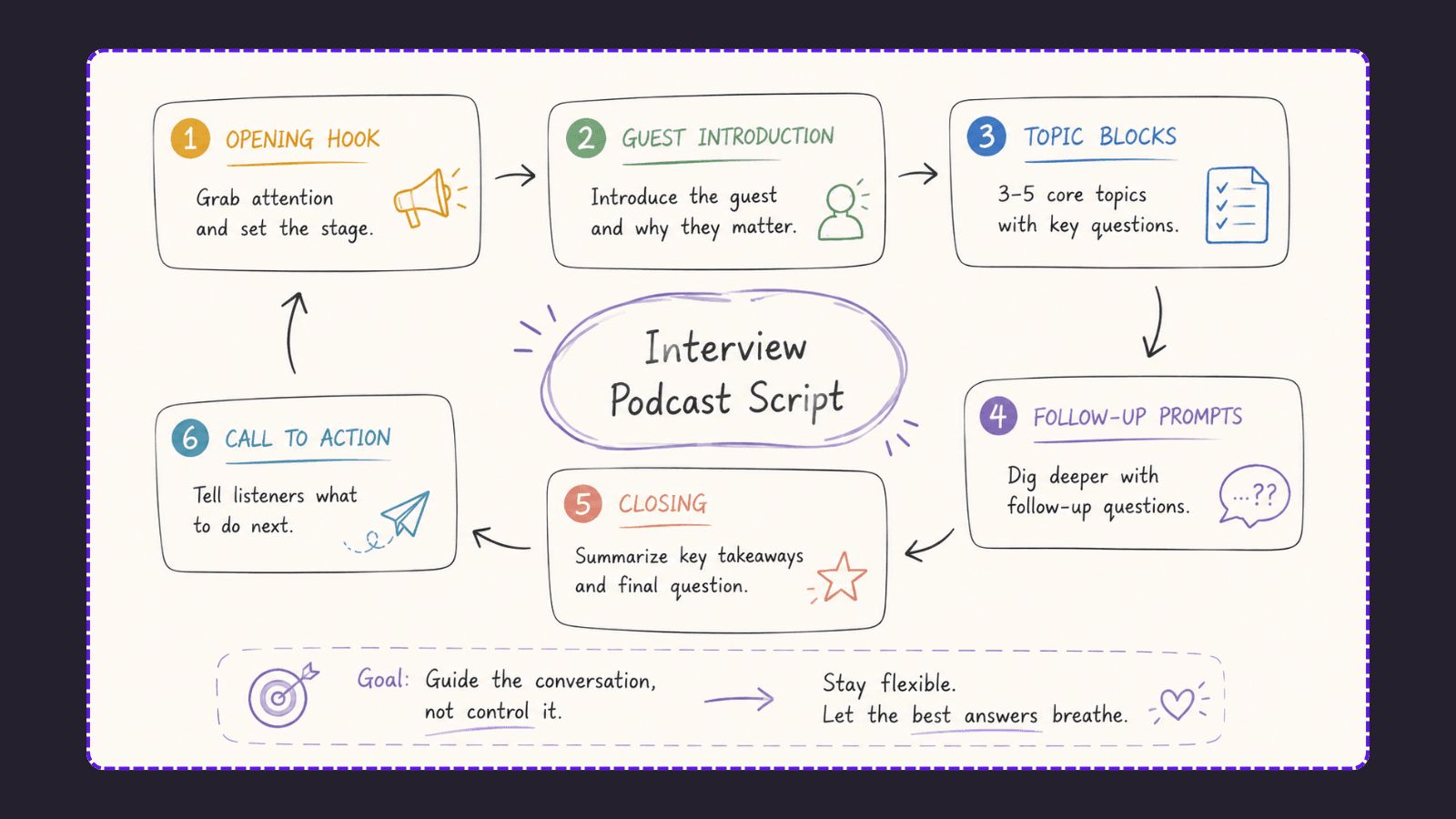
If your show depends on guest insights, your script should support the conversation, not control it. That structure also helps with discoverability. In a 2021 study on podcast introduction, researchers noted that intros often carry the core summary signals of an episode, including its topic, host, and guest. That is one reason a clear opening matters beyond style alone: it helps both listeners and platforms understand what the episode is about.
Why Podcast Hosts Need a Script
Hosts often think experience alone is enough. But even experienced interviewers benefit from a clear episode structure.
Here are the main reasons an interview podcast script helps:
-
It keeps the conversation focused on the listener’s problem.
-
It prevents repetitive or weak questions.
-
It gives you backup prompts when the discussion stalls.
-
It makes editing easier because the episode has a clearer arc.
-
It helps guests feel prepared without sounding over-rehearsed.
For most shows, the real goal is not to ask more questions. It is to ask better ones in the right order.
The format of the show matters too. Podcast consumption is no longer purely audio-first. On February 26, 2025, YouTube said more than 1 billion people were watching podcasts on the platform every month, a shift that makes sharper openings, cleaner segments, and stronger clip moments even more valuable for creators who want discoverability across both audio and video surfaces.
The Core Structure of a Strong Interview Podcast Script
The easiest way to build an interview podcast script is to break it into six sections.
| Section | Purpose | What to Include |
|---|---|---|
| Hook | Capture attention fast | A surprising fact, problem, or promise |
| Intro | Set context | Show name, host name, episode topic |
| Guest setup | Build credibility | Who the guest is and why they matter |
| Main interview | Deliver substance | 3 to 5 topic clusters with questions |
| Wrap-up | Create closure | Key takeaway, final question, next step |
| CTA | Drive action | Subscribe, share, visit site, related resource |
This structure works because it matches how listeners process spoken content. They need a reason to care, a clear path through the conversation, and a memorable finish.
How to Write an Interview Podcast Script Step by Step
1. Start with the listener’s outcome
Before writing any questions, define what the listener should learn by the end of the episode. A strong outcome might be:
-
Understand how a founder validates a product idea
-
Learn how a recruiter evaluates candidates
-
See how a creator turned a side project into a business
If the outcome is vague, the conversation will be vague too.
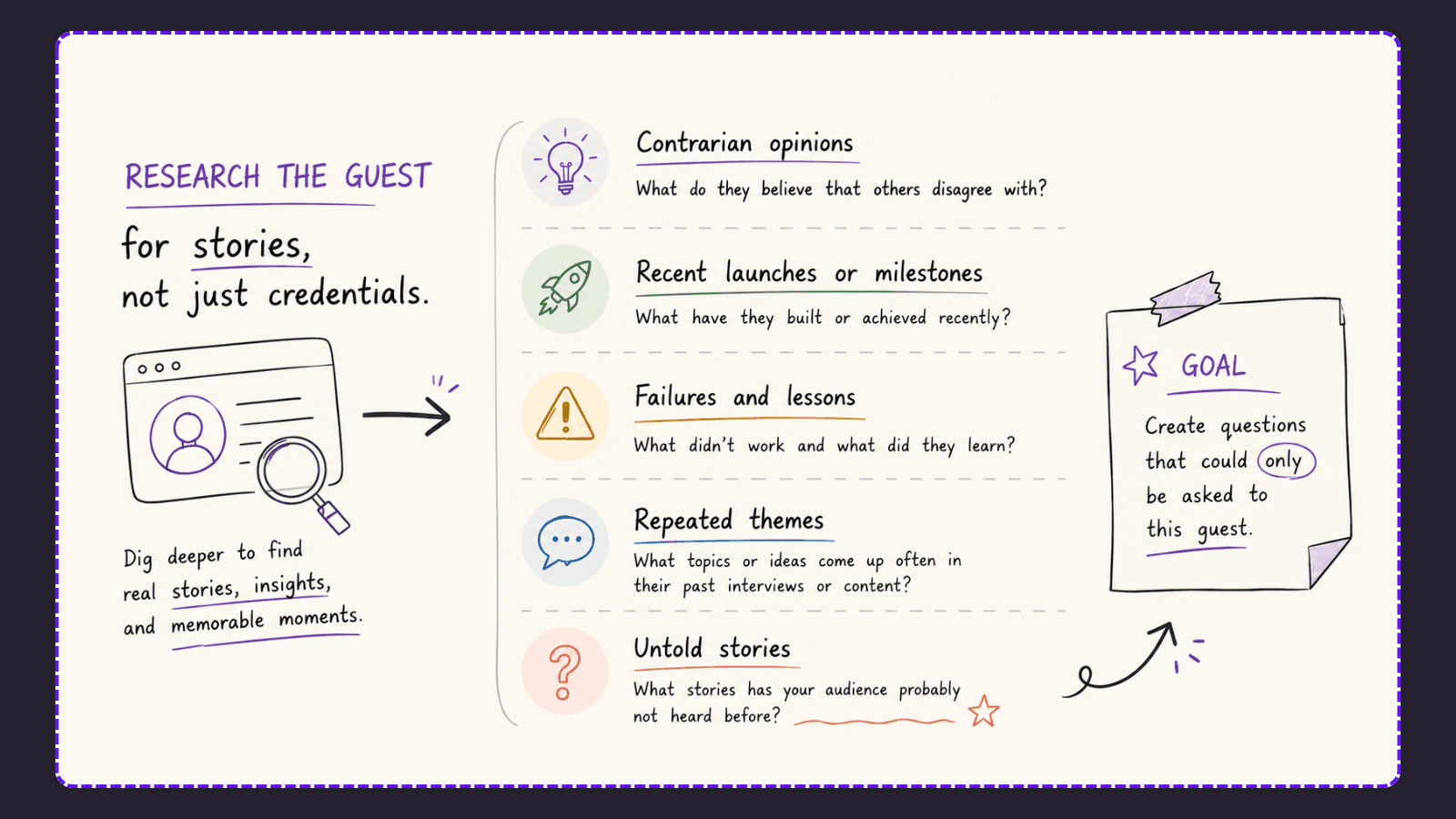
2. Research the guest for stories, not just credentials
A weak interview script relies on generic questions. A strong one is based on specifics from the guest’s work, career, ideas, or recent projects.
Look for:
-
Contrarian opinions
-
Recent launches or milestones
-
Failures and lessons
-
Repeated themes in past interviews
-
Stories your audience has probably not heard before
The goal is to create questions that could only be asked to this guest.
3. Group questions into topic blocks
Do not build your episode as one long list of unrelated questions. Group them into sections such as:
-
Background and context
-
Main challenge
-
Process or framework
-
Mistakes and lessons
-
Advice for listeners
This makes the interview feel more coherent and easier to follow.
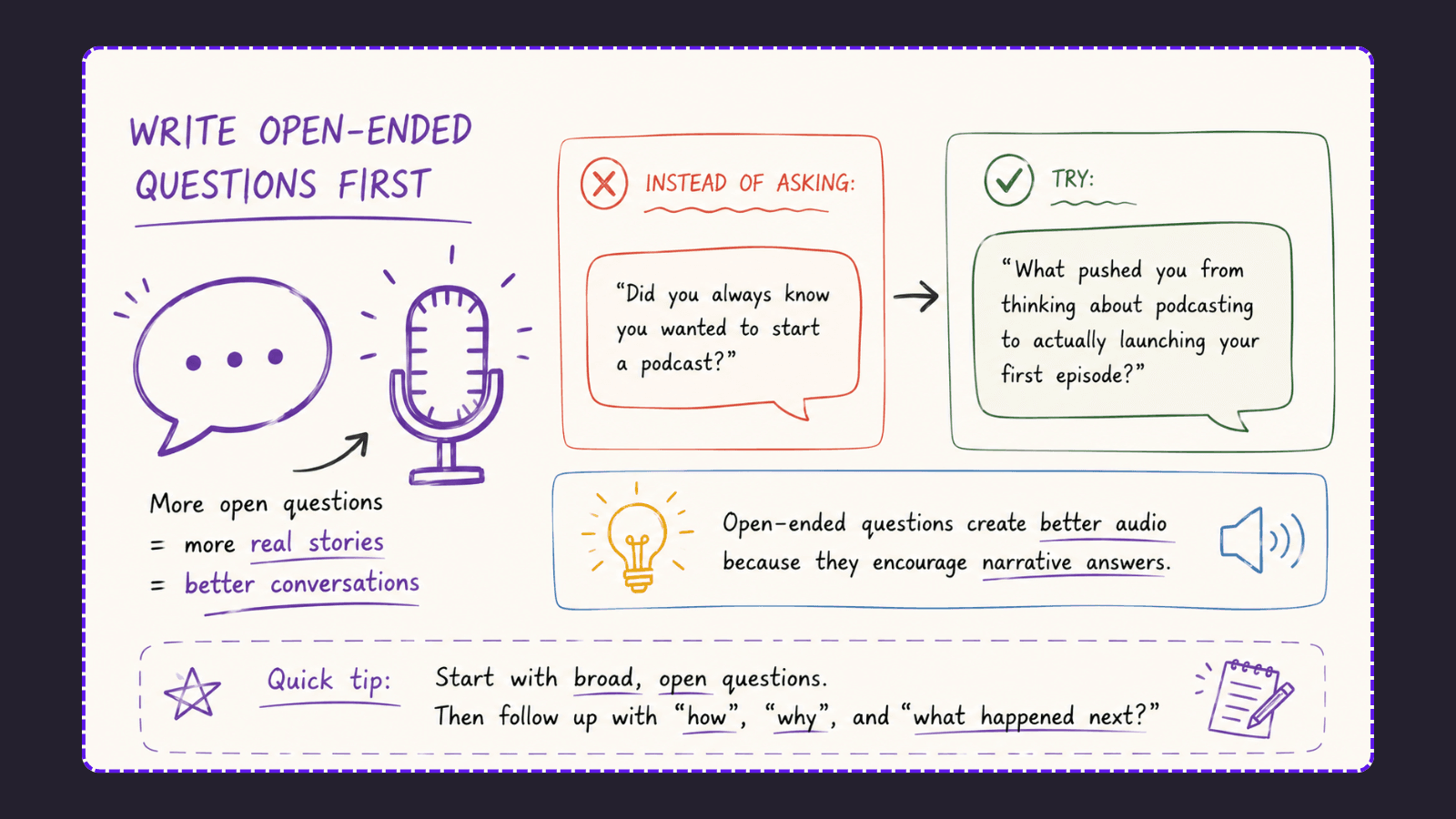
4. Write open-ended questions first
The best interview podcast scripts use open-ended questions that invite stories, decisions, and examples.
Instead of asking:
“Did you always know you wanted to start a podcast?”
Try:
“What pushed you from thinking about podcasting to actually launching your first episode?”
Open-ended questions create better audio because they encourage narrative answers.
5. Add follow-up prompts under each main question
Most of the best moments in interviews come from follow-ups, not the original question.
Useful follow-up prompts include:
-
“Can you give me an example?”
-
“What made that difficult?”
-
“What did you get wrong at first?”
-
“How did your thinking change?”
-
“What should people not copy from your approach?”
These prompts keep the conversation dynamic while preventing dead ends.
6. Script your transitions and closing
Many podcasts lose momentum between topics. A simple transition line fixes that.
Examples:
-
“Let’s shift from the early days to what changed once the show gained traction.”
-
“I want to stay on that point for a minute, because it connects to how you prepare guests now.”
-
“Before we wrap up, I’d love to ask one practical question for people trying this themselves.”
Your closing should also be intentional. End with a summary, a final question, and a clear next step for listeners.
Do Not Forget the Episode Description
Your interview podcast script should work together with your episode metadata. A strong conversation can still underperform if the title, description, or feed data are weak.
At a minimum, make sure your published episode includes:
-
A title that tells listeners what the conversation is really about
-
A description that names the guest, topic, and main takeaway
-
Clean episode-level metadata in your RSS feed
-
Clear links to the guest, resources, or tools mentioned in the conversation
This matters for both listeners and platforms. Apple Podcasts requires technically valid RSS feeds, episode enclosures, GUIDs, and properly formatted metadata. Research on podcast RSS metadata also suggests that creators do not always use feed fields consistently, which can make discovery and interpretation harder across platforms.
Interview Podcast Script Template
Use this interview podcast script template as a starting point:
[Opening Hook] Welcome back to [Podcast Name]. Today we’re talking about [topic/problem listeners care about].
[Guest Intro] Today’s guest is [Guest Name], [short credibility line]. We’re going to explore [main promise of episode].
[Warm-Up Question] To start, can you give us the short version of how you got into [topic]?
[Topic Block 1: Context]
-
What problem were you trying to solve at the beginning?
-
What did most people misunderstand about that stage?
[Topic Block 2: Process]
-
Walk me through how you approached [specific challenge].
-
What worked better than you expected?
-
What failed or took longer than planned?
[Topic Block 3: Lessons]
-
What would you do differently if you started again today?
-
What advice would you give someone in the first 30 days?
[Rapid Follow-Ups]
-
Can you give an example?
-
What changed your mind?
-
What should listeners avoid?
[Closing] For someone listening to this who wants to improve at [topic], what’s the first step they should take this week?
[CTA] Where can people find your work? If you enjoyed this episode, subscribe to [Podcast Name] and share it with someone who’d find it useful.
Using PodcastorAI to Generate a First Draft Faster
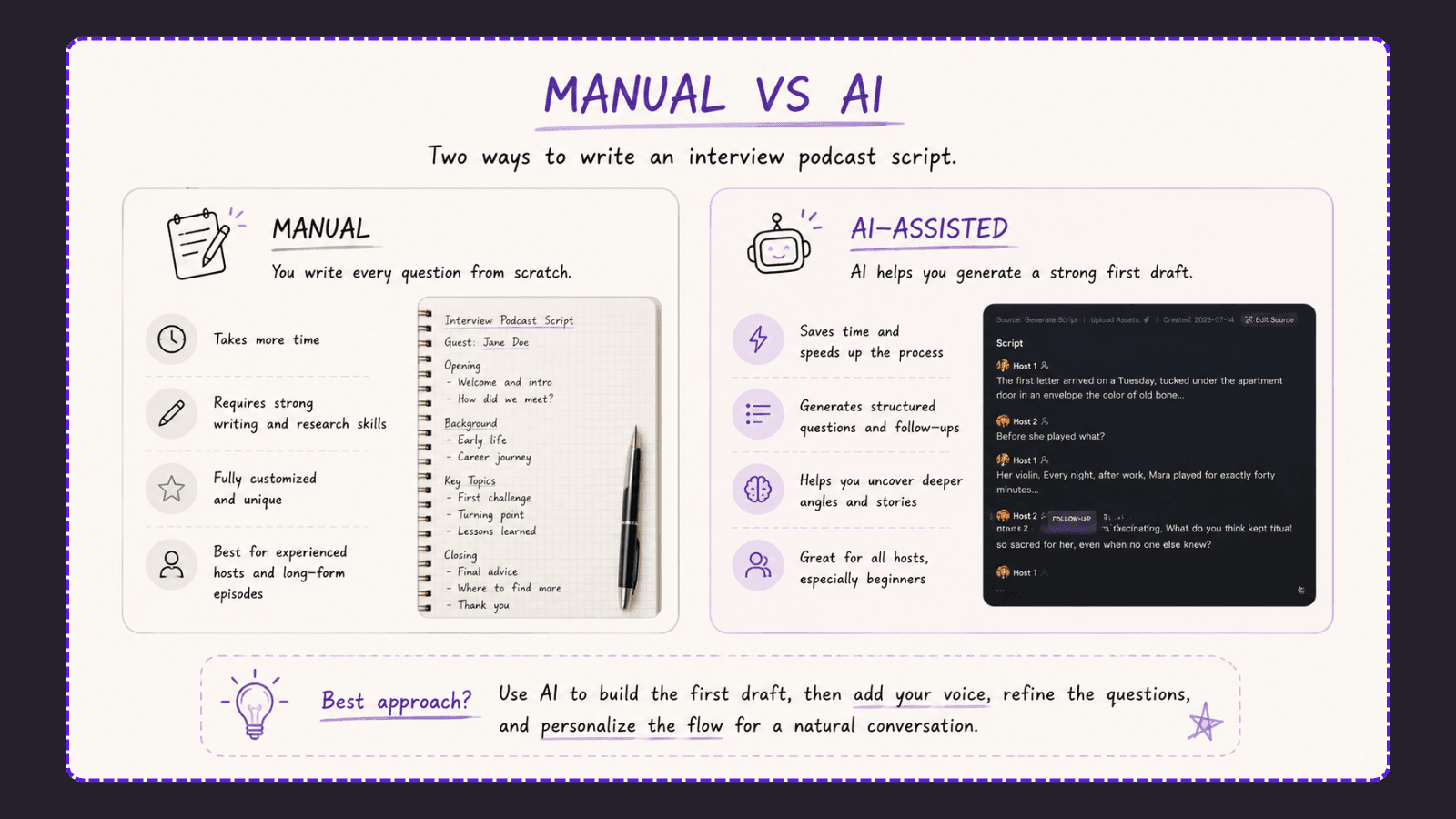
If your biggest bottleneck is getting from a rough idea to a usable interview structure, an AI script generator can save a lot of time. The key is to use AI as a first-draft partner, not as the interviewer.
For example, PodcastorAI centers its Generate Script workflow on turning links, documents, notes, images, or audio into a structured podcast script. On its homepage, the product describes outputs with chapters, key insights, and natural conversation flow. The value is not just text generation. It is turning raw source assets into something closer to a podcast-ready script.
A practical way to use a tool like this is:
- Drop in your source material, such as a blog post, research doc, webinar notes, or voice memo.
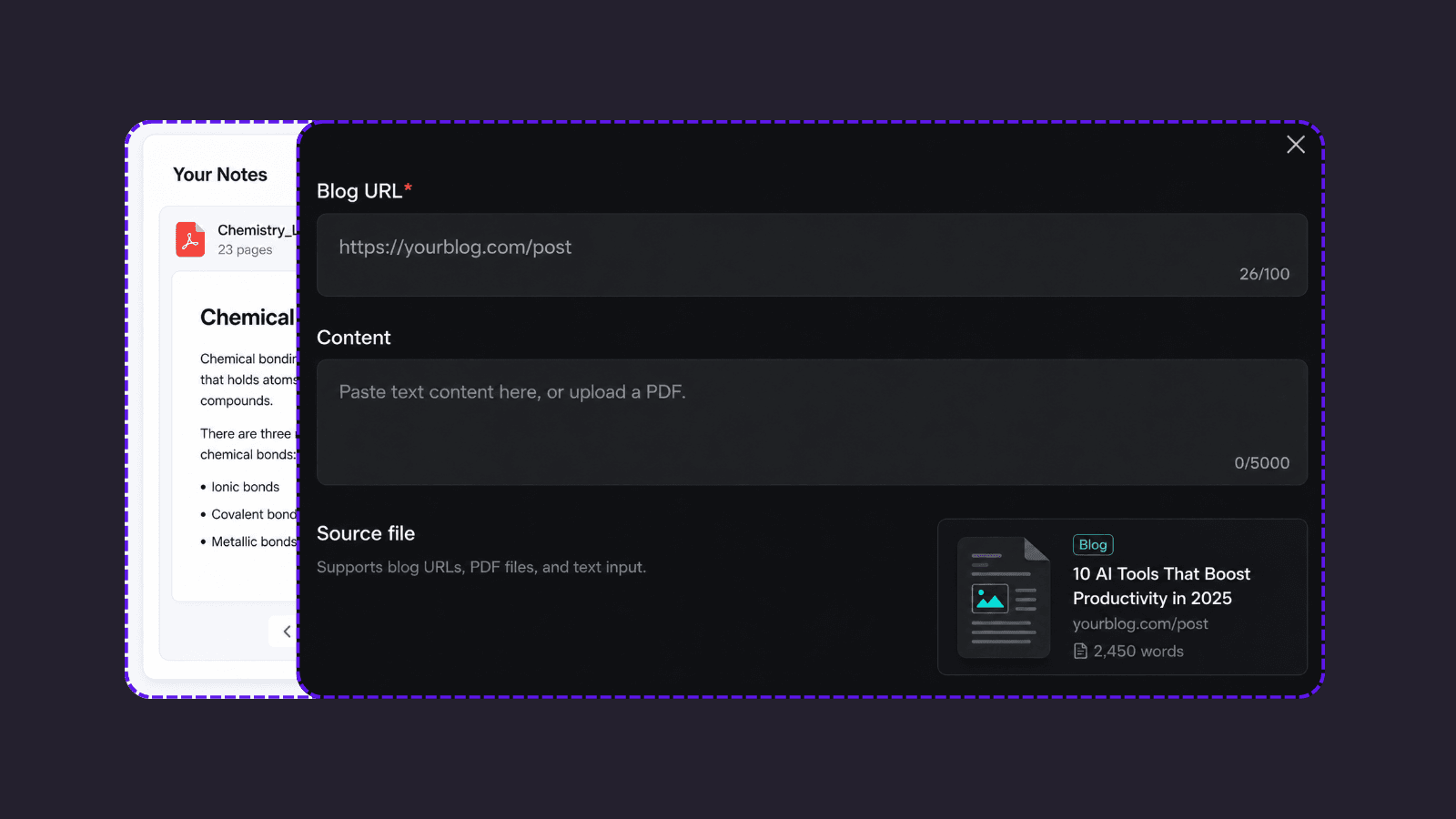
- Generate a first-pass script with sections and talking points.
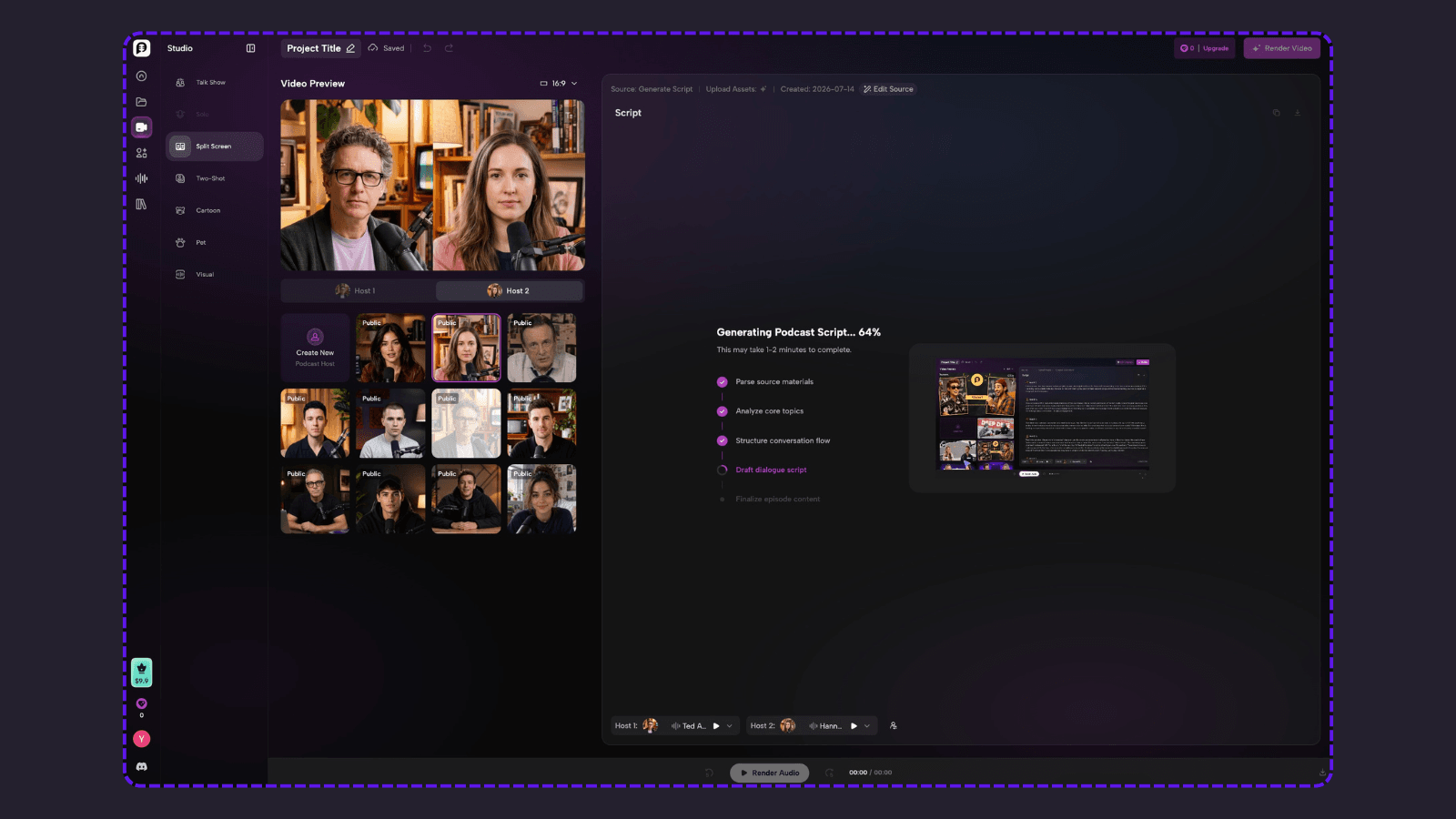
-
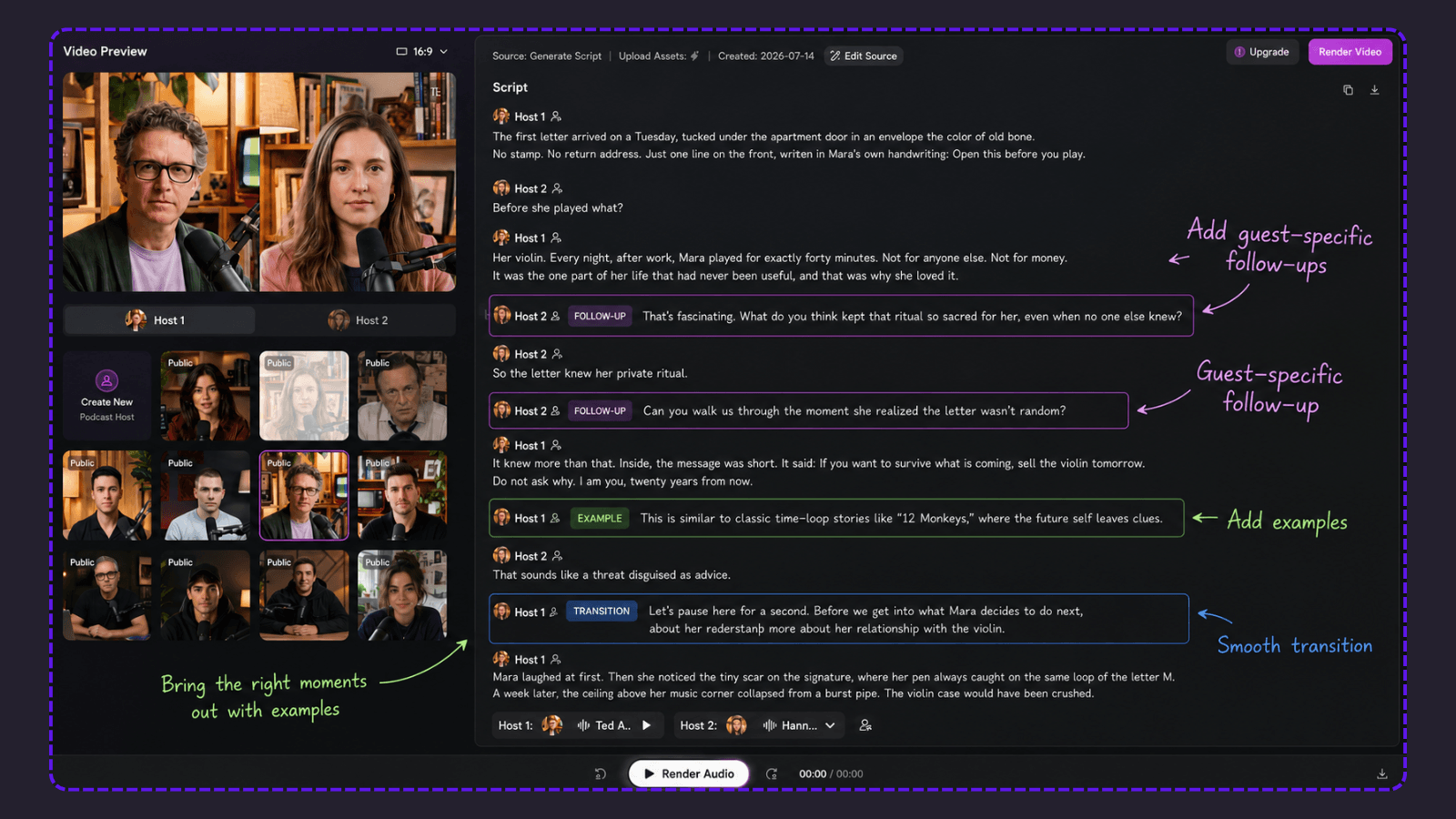
Rewrite the generic questions so they sound like your show.
-
Add guest-specific follow-ups, examples, and transitions.
-
Review the final script for tone, accuracy, and pacing before recording.
-
Render video podcast
This approach is especially helpful when you want to repurpose existing content into an interview-style episode. Instead of starting from a blank doc, you begin with structure and spend your energy improving the conversation.
What We See in Real Script Workflows
One recurring pattern in podcast production is that teams rarely struggle because they have no ideas. More often, they already have too much material: transcripts, notes, internal memos, customer interviews, webinar recaps, or blog drafts. The real slowdown happens when someone has to turn that raw material into a usable conversation outline by hand.
In practice, that manual step creates three common problems:
-
The strongest points get buried because the outline is assembled too late.
-
Questions stay generic because the host is organizing material instead of shaping the conversation.
-
The same structure gets rebuilt multiple times across scripting, recording, and editing.
That is exactly the gap a script-generation workflow is best suited to reduce.
Where PodcastorAI Fits in the Workflow
For many teams, the hard part is not recording. It is turning messy source material into a clear episode plan fast enough to publish consistently. That is where PodcastorAI fits between raw inputs and final delivery:
| Stage | Manual workflow | PodcastorAI |
|---|---|---|
| Collect source material | Gather notes, links, transcripts, PDFs, and voice memos in separate docs | Upload or paste source material into one script-generation workflow |
| Build the structure | Decide episode angle, sections, and question flow from scratch | Generate a first draft with chapters, talking points, and conversation flow |
| Shape the interview | Rewrite sections manually and rearrange prompts | Edit the generated draft to match your host voice and guest context |
| Produce the episode | Move from script to recording with more prep overhead | Use the script as the base for recording, then continue into audio or video workflows |
This is an especially good fit for:
-
Content teams repurposing blog posts, reports, or webinars into podcast episodes
-
Founders who want to turn product updates or market commentary into interview-style content
-
Agencies and creators who need to publish on a repeatable schedule without scripting every episode from zero
-
Video podcast teams that need cleaner segments for clips, chapters, and downstream editing
Instead of asking users to start with an empty document, PodcastorAI helps them start with structured material they can refine.
Why PodcastorAI Can Credibly Speak to This Problem
PodcastorAI is relevant here because the product sits directly inside the scripting workflow. It is built around turning source assets such as links, notes, PDFs, transcripts, images, and audio into structured podcast drafts. That is a more useful position than offering generic text generation alone, because the real job is not simply writing paragraphs. It is organizing source material into something a host can shape, record, and publish.
If you want this article to carry stronger authority signals when published, this section should eventually include one or two concrete facts from your team, such as:
-
The kinds of source material users most often turn into scripts
-
The most common scripting bottlenecks your users report
-
A short statement about how your team approaches script structure or content repurposing
Example: A Simple Interview Podcast Script for a Founder Guest
Here is what a shorter, more practical version might look like in a real episode.
Welcome back to The Operator’s Mic. Today we’re talking about what it really takes to grow a niche software product without a large team.
I’m joined by Maya Chen, the founder of SignalLoop, a customer research platform used by remote product teams. In this conversation, we’ll cover early traction, customer discovery, and the systems Maya uses to keep the product close to user needs.
Maya, to start us off, what problem were you obsessed with before SignalLoop existed?
Once you had that idea, what did your first version actually look like?
What did early users tell you that changed your roadmap?
Was there a moment when you realized the product had real traction?
For founders listening, what is one customer research habit they should build immediately?
And finally, where can people follow your work?
This script is simple, but it gives the host enough structure to lead confidently while leaving space for genuine conversation.
Frequently Asked Questions About Interview Podcast Script
How long should an interview podcast script be?
Most interview podcast scripts should fit on one to three pages. You need enough structure to guide the conversation, but not so much detail that you stop listening.
Should an interview podcast script be fully written out?
Usually no. Most hosts do better with a structured outline, key lines, and follow-up prompts instead of a full manuscript.
What makes a good interview question for podcasts?
A good podcast interview question is specific, open-ended, and likely to produce a story, decision, or example rather than a short opinion.
How many questions should I prepare for a 30-minute interview?
Prepare around 8 to 12 main questions, but expect to ask fewer. Strong follow-ups often matter more than the total number of planned questions.
Can AI generate an interview podcast script?
Yes, AI can generate a strong first draft, especially when you provide source material like notes, links, transcripts, or documents. Tools such as PodcastorAI can help turn raw material into a structured script, but the best results still come from human editing, stronger follow-up questions, and guest-specific context.
Try This Workflow With PodcastorAI
If you want to apply this guide in a practical way, do not start by writing a full script from scratch.
Try this instead:
-
Pick one source asset you already have, such as a blog post, PDF, transcript, URL, or set of notes.
-
Run it through PodcastorAI to generate a first-pass script structure.
-
Edit the result with your host voice, guest context, and follow-up questions before recording.
This is a fast way to see whether script generation actually improves your workflow. It keeps the human part where it matters most and removes the repetitive part that slows teams down.