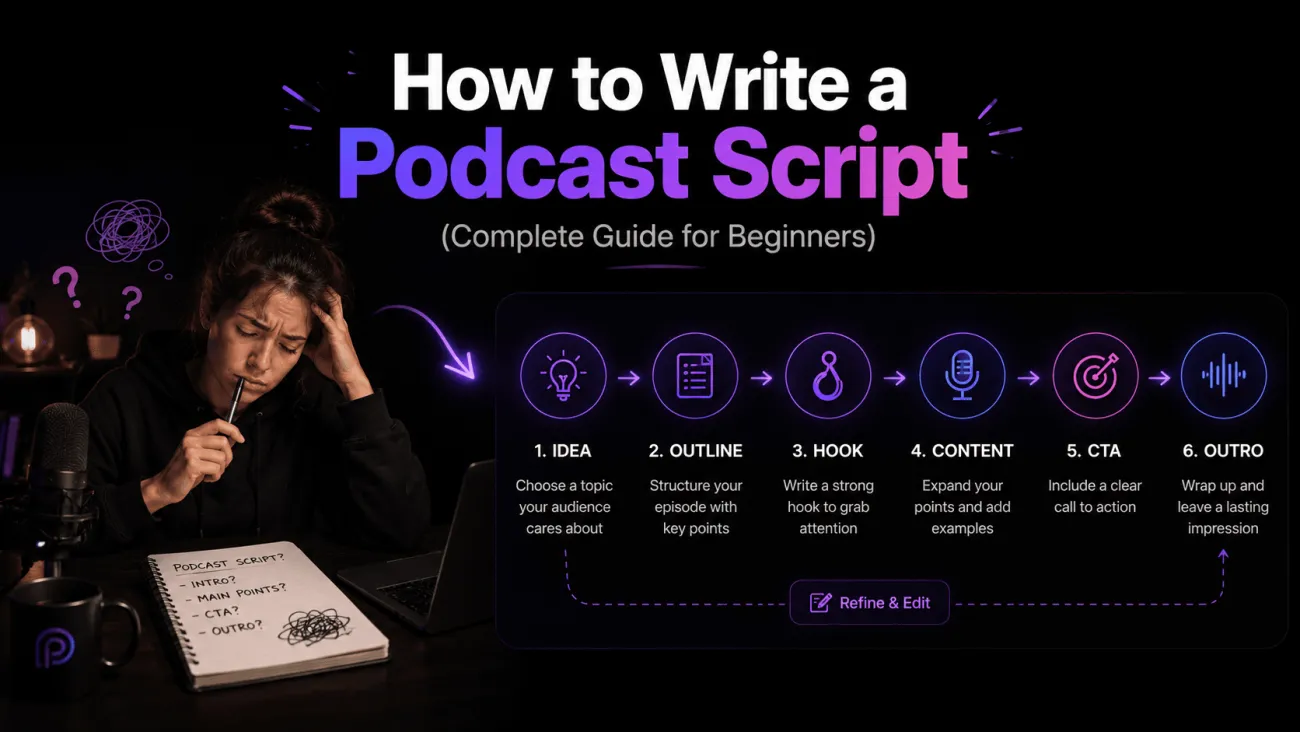

The easiest way to write a podcast script is to start with a clear structure: define your topic, identify your audience, create a simple outline, write conversationally, and revise for listening rather than reading. If you’re a beginner, AI tools like PodcastorAI can also help you generate podcast-ready scripts in minutes.
What Is a Podcast Script?
A podcast script is more than just words on a page—it’s the blueprint for your episode. It helps you organize ideas, keep the conversation flowing naturally, and deliver a clear message without sounding unprepared.
Unlike a blog post or an essay, a podcast script is written to be spoken. That means it should sound conversational, include natural transitions, and leave room for personality rather than reading like formal writing.
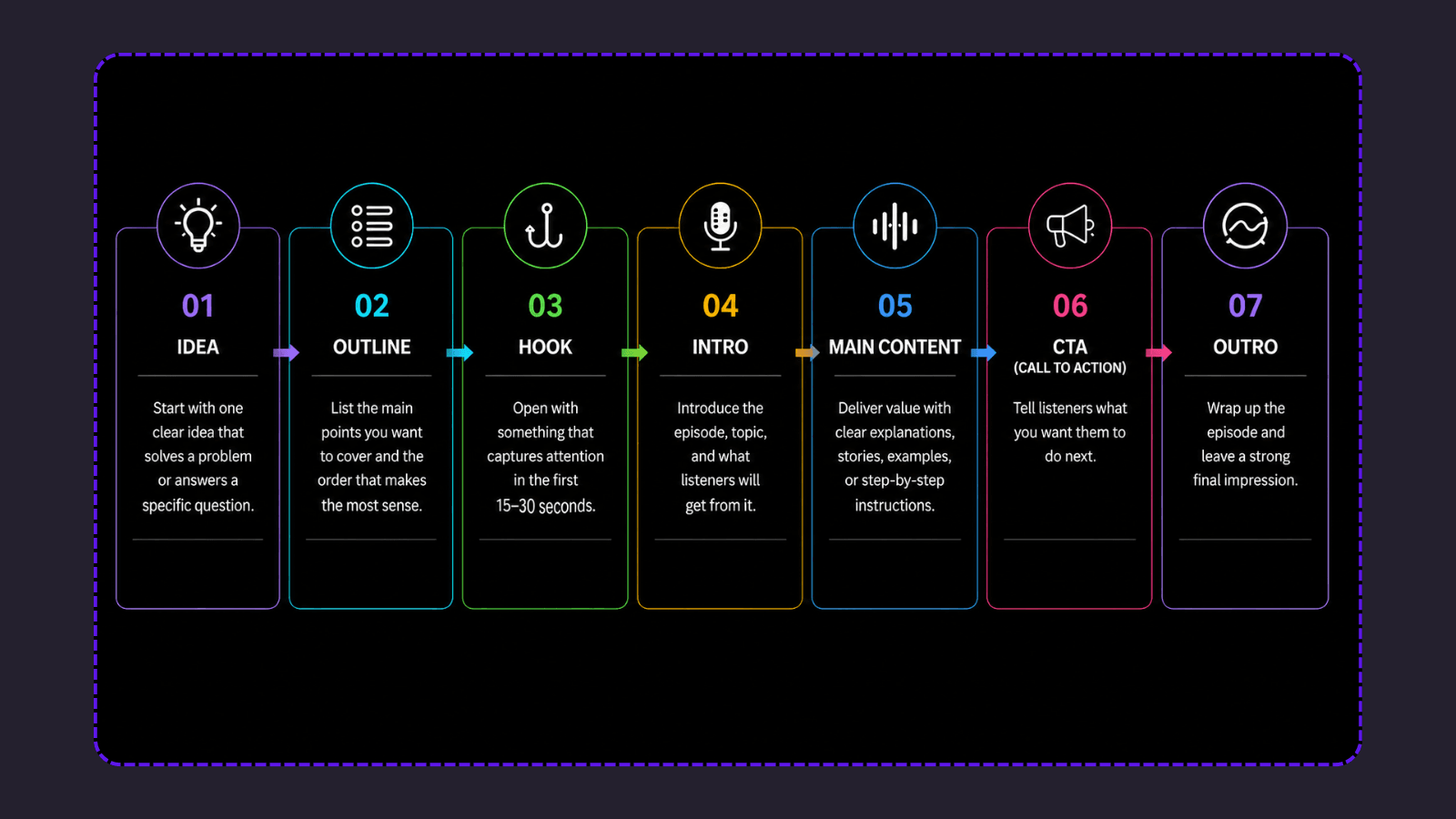
A typical podcast script doesn’t need to be complicated. Most successful episodes follow a simple structure:
| Section | Purpose |
|---|---|
| Hook | Grab the listener’s attention in the first 30 seconds. |
| Introduction | Introduce the topic and explain what the audience will learn. |
| Main Discussion | Share your ideas, stories, interviews, or insights. |
| Transition | Guide listeners smoothly between different sections. |
| Call to Action | Encourage listeners to subscribe, visit your website, or take another action. |
| Outro | Wrap up the episode and leave listeners with a memorable ending. |
Here’s a simplified example:
Hook
“Did you know most podcast listeners decide whether to keep listening within the first minute?”
Introduction
“Today we’ll show you exactly how to write a podcast script—even if you’ve never recorded a podcast before.”
Main Discussion
Step-by-step guide…
CTA
“If you found this helpful, subscribe for more podcast tips.”
Outro
“Thanks for listening. See you next week.”
The exact format depends on your podcast style. An interview show, a storytelling podcast, and an educational podcast all require different script structures. However, they all share the same goal: helping you communicate clearly while keeping your audience engaged.
Why Every Podcast Needs a Script
Many beginner podcasters assume great conversations happen naturally. In reality, even experienced creators rarely hit the record button without some level of preparation. While not every podcast follows a word-for-word script, having a clear structure helps you stay focused, communicate your ideas more effectively, and create a better listening experience.
Think of a podcast script as a roadmap rather than a speech. It gives you direction without taking away your personality.
Here’s what a good podcast script helps you achieve:
Stay Focused Instead of Going Off Topic
It’s easy to lose your train of thought once you start recording. What begins as a discussion about one idea can quickly turn into unrelated stories or repeated points.
A podcast script keeps your episode moving in the right direction while making sure every section supports your main topic.
Sound More Natural and Confident
Many beginners avoid scripts because they worry about sounding robotic. Ironically, the opposite is often true.
When you already know your key talking points, you spend less time thinking about what to say next and more time focusing on how you say it. The result is a smoother, more confident conversation that feels natural to listeners.
Save Hours of Editing
Without a script, it’s common to record long pauses, repeated ideas, unnecessary tangents, or forgotten sections that require additional recording.
A simple script reduces these problems before you even press record, making post-production much faster and easier.
Create a Better Experience for Your Audience
Listeners stay engaged when an episode has a clear beginning, logical flow, and memorable ending.
A good script helps you introduce your topic, transition between ideas smoothly, and finish with a strong takeaway instead of ending abruptly.
Stay Consistent Across Every Episode
Whether you’re publishing once a week or running a daily show, consistency matters.
Following a repeatable script structure makes every episode easier to produce while giving your audience a familiar listening experience they can recognize and trust.
How to Write a Podcast Script (Step by Step)
Step 1-Choose a Clear Topic
Start with one specific idea. A beginner podcast script should not try to cover everything in one episode.
Instead of choosing a broad topic like:
“AI tools”
narrow it down to something easier to explain, such as:
“How AI tools can help students turn lecture notes into podcasts.”
A clear topic makes your script easier to write, easier to record, and easier for listeners to follow.
Before you start writing, ask yourself:
-
What is this episode about?
-
Who is it for?
-
What should listeners understand or do after listening?
If you can answer these three questions, you already have the foundation of your podcast script.
Here Are a Few Great Places to Find Podcast Ideas
If you’re not sure what to talk about, these resources can help you discover topics that people are already searching for or discussing:
| Platform | Best For |
|---|---|
| Apple Podcasts Charts | Discover trending podcast topics |
| Spotify Charts | Analyze popular podcast formats |
| YouTube | Find audience questions & content ideas |
| Understand real audience pain points |
Step 2-Understand Your Audience
A good podcast script is not only about what you want to say. It is about what your audience needs to hear.
For example, a script for beginners should use simple explanations, clear examples, and shorter sections. A script for professionals can include more technical terms, deeper analysis, and faster pacing.
Before writing, define your listener:
| Question | Example |
|---|---|
| Who are they? | Students, creators, marketers, educators |
| What problem do they have? | They want to learn faster, create content, or explain ideas clearly |
| What format do they prefer? | Solo explanation, interview, two-host conversation, or video podcast |
| What is the desired outcome? | Learn something, make a decision, or take action |
This matters because your audience will shape your tone, structure, and examples.
Step 3-Create a Simple Outline
Before writing your first sentence, organize your episode into a simple outline. This keeps your ideas focused and makes the writing process much easier.
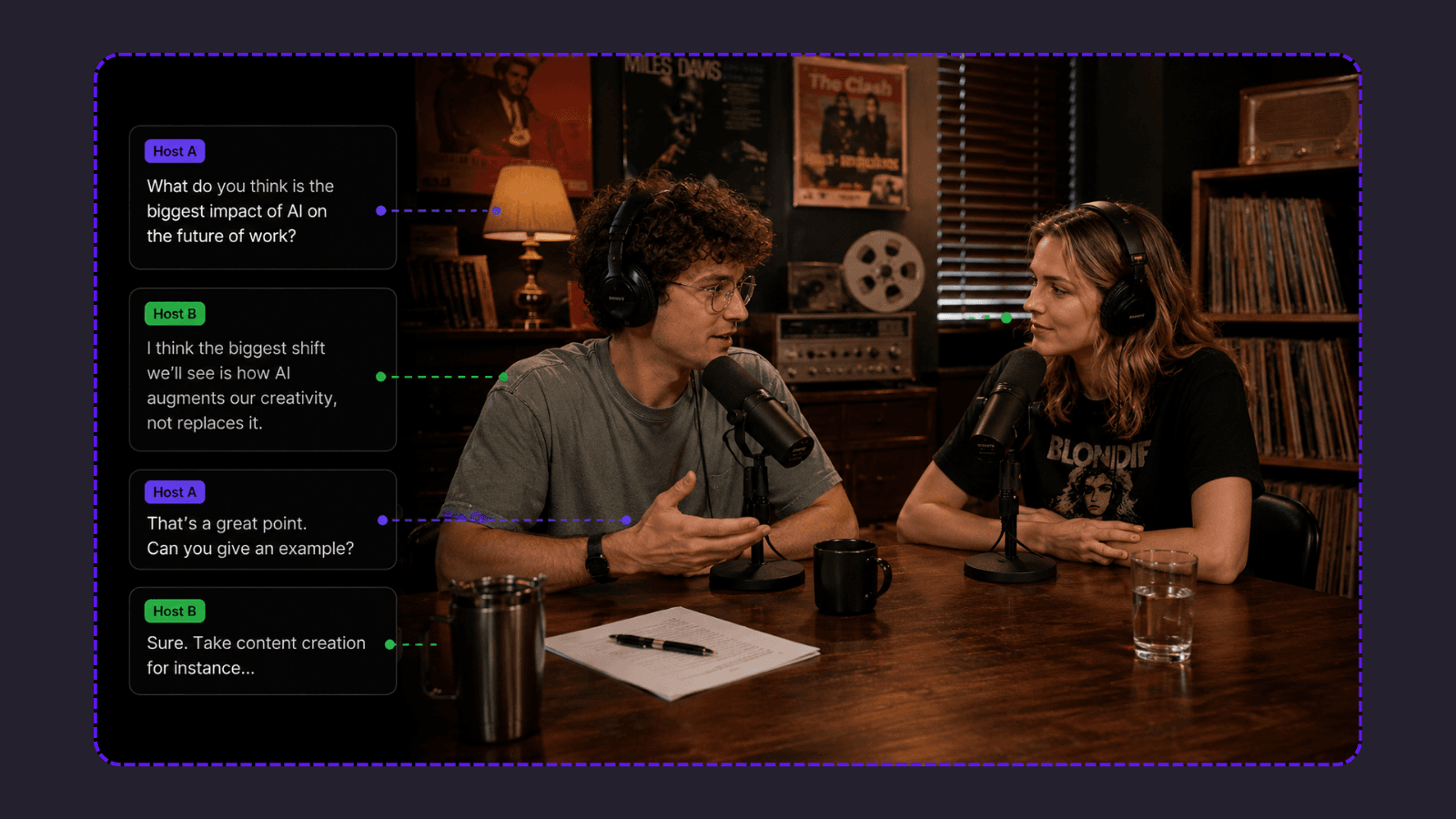
A basic podcast outline usually includes: Hook、Introduction、Main Points、Transitions、Call to Action、Outro.
At this point, you have two options: write the outline manually or let PodcastorAI generate the structure for you.
Option 1: Write Your Outline Manually
Manual outlining works well if you already know your topic and want full creative control.
A simple manual outline might look like this:
Topic: How to write a podcast script
Goal: Help beginners create a clear, recordable script
Audience: New podcasters
Hook: “Most beginners don’t struggle with recording. They struggle with knowing what to say.”
Main Point 1: Choose a clear topic
Main Point 2: Understand your audience
Main Point 3: Create an outline
Main Point 4: Write naturally
CTA: Try creating your first script
Outro: Recap the process and encourage the listener to start simple
This approach gives you control, but it also takes more time. You need to organize the structure, write each section, and revise the script yourself.
Option 2: Let PodcastorAI Generate It for You
If you do not want to start from a blank page, PodcastorAI can help you turn almost any input into a podcast script.
According to the PodcastorAI PRD, the product is designed as a “zero-barrier AI podcast workspace,” with script creation as the first step of a broader creator workflow. It supports script generation from text prompts, URLs, PDFs, and PPTs, instead of limiting users to manual writing only.
That means you can start with:
-
A short idea
-
A URL
-
A PDF
-
A PPT
-
Existing notes
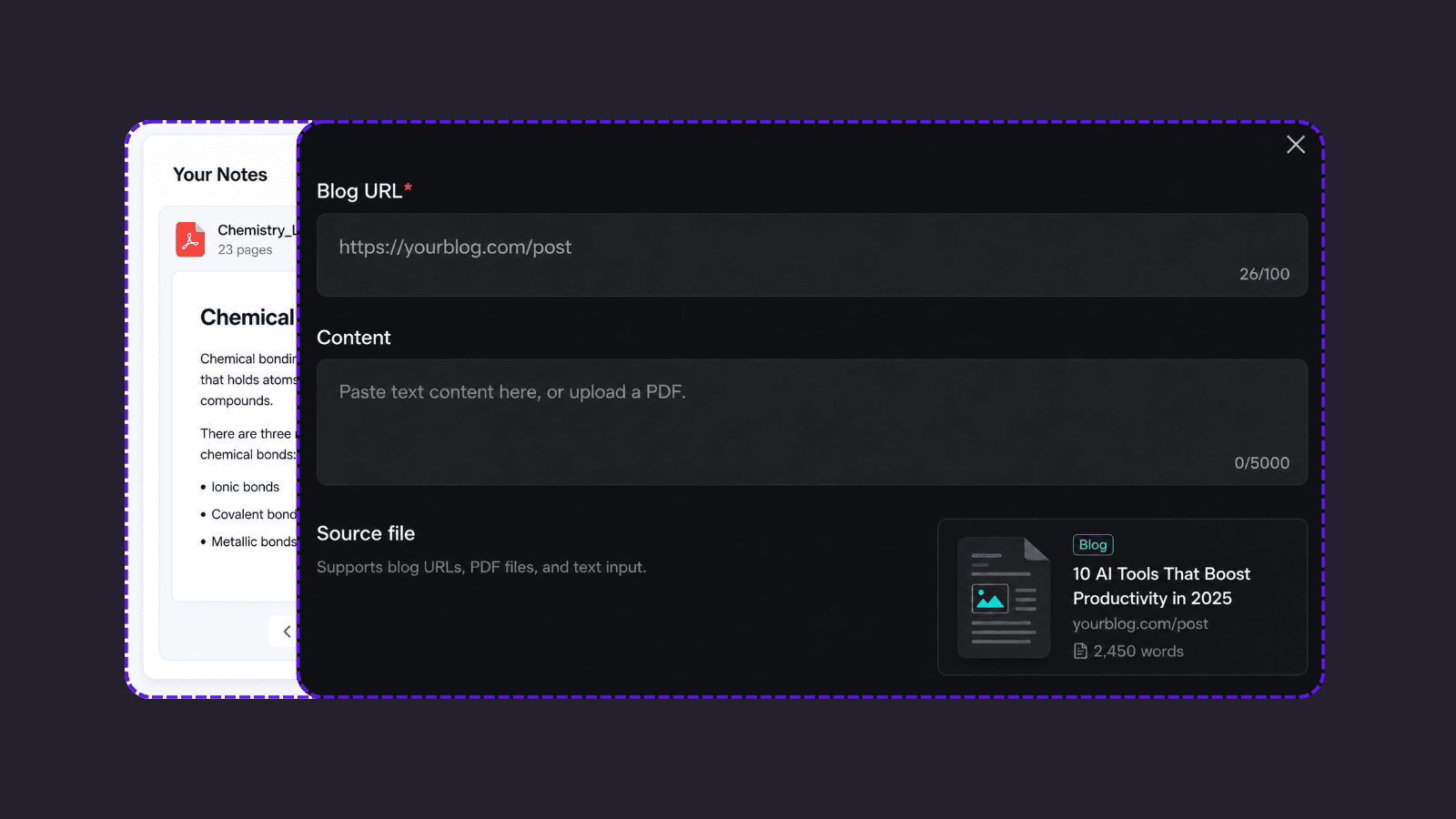
For beginners, this is useful because you do not need to know the full structure before you begin. You can give PodcastorAI your idea or source material, generate a first draft, and then edit it into your own voice.
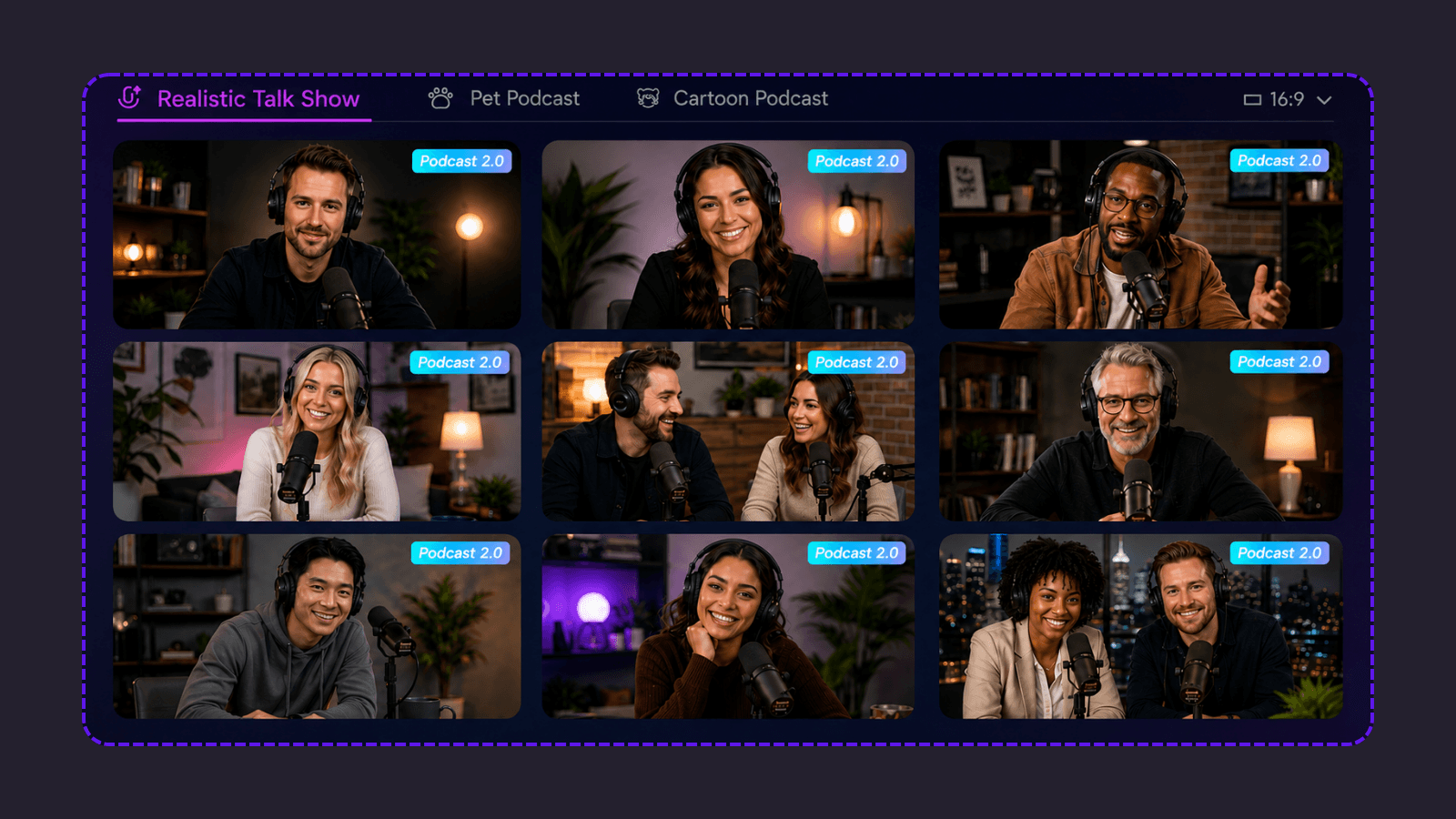
PodcastorAI also supports single-host and two-host podcast creation, which makes it easier to create solo explanations, interviews, or conversational podcast formats.
Step 4-Refine Your Script
Whether you write manually or generate a draft with AI, the first version should not be the final version.
A podcast script needs to sound natural when spoken out loud. That means you should edit for listening, not just reading.
When refining your script, focus on:
-
Shorter sentences
-
Clear transitions
-
Natural spoken language
-
Fewer repeated ideas
-
Better pacing
-
Stronger opening and closing lines
For example:
Too formal:
In this episode, we will examine the importance of podcast scripting and its impact on content production efficiency.
More natural:
Today, we’re going to talk about why a simple podcast script can make your episode easier to record and much easier to listen to.
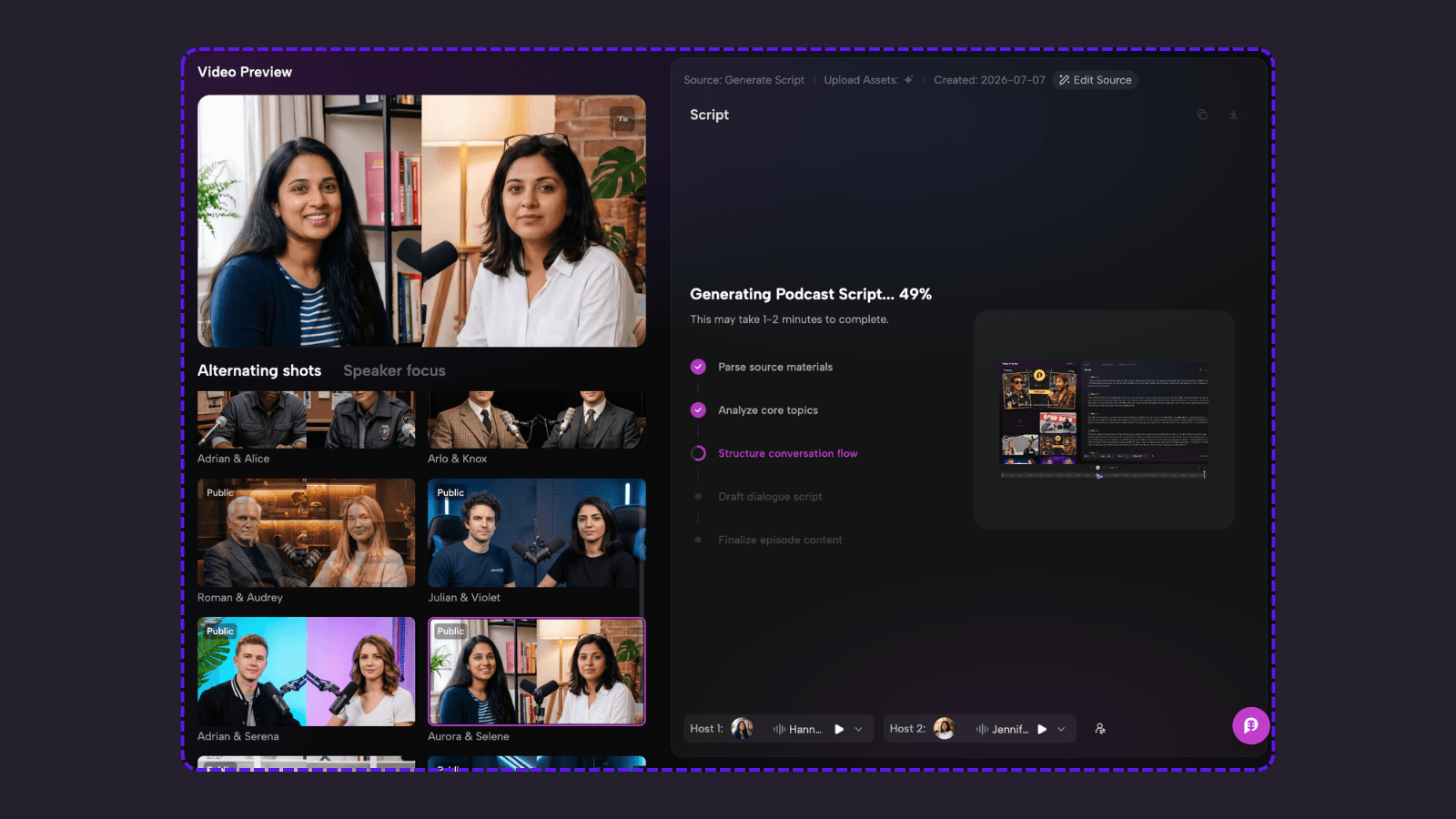
After refining the script, PodcastorAI can also help continue the workflow from script to audio or video. Including script preview and editing, audio preview, script download, copy-to-clipboard, voice replacement, role switching, and pause insertion as part of the editing and production flow.
So the goal is not just to “finish a script.” The goal is to create a podcast-ready script that can move smoothly into recording, audio generation, or video podcast production.
Which AI Tool Should You Use?
AI has changed the way creators write podcast scripts, but no single tool is perfect for every stage of the process.
Some AI tools are great for brainstorming ideas. Others specialize in turning research into conversations, generating realistic voices, or creating talking avatar videos. The best choice depends on where you are in your podcast creation workflow.
Here’s a quick comparison of some of the most popular AI tools.
| Tool | Best For | What It Does Well | Consider Before Choosing |
|---|---|---|---|
| ChatGPT | Brainstorming & first drafts | Quickly generates ideas, outlines, and first drafts from simple prompts. Great for overcoming writer’s block. | You’ll still need to organize the script, edit the conversation, and use separate tools for audio or video production. |
| Claude | Long-form writing & rewriting | Produces natural writing and handles long documents well. Excellent for refining educational or storytelling scripts. | Focuses on writing only and doesn’t provide podcast production features. |
| PodcastorAI | End-to-end podcast creation | Turns prompts, URLs, PDFs, PPTs, and documents into editable podcast scripts, then continues seamlessly to audio and video creation in one workflow. | Best for creators who want to go from idea to publish-ready podcast without switching between multiple tools. |
| NotebookLM | Research-based podcasts | Turns PDFs, research papers, notes, and documents into conversational summaries, making it ideal for educational content. | Best when you already have source materials. It’s less flexible for creating completely original podcast ideas. |
| ElevenLabs | AI voice generation | One of the best tools for realistic AI voices and multilingual narration. | Generates audio only—you’ll still need another tool to create or edit your script. |
| HeyGen | Talking avatar videos | Makes it easy to create AI presenter videos with realistic lip-sync and avatars. | Designed for avatar videos rather than podcast scripting or audio-first workflows. |
Choose PodcastorAI if you want one platform that supports the entire workflow—from an idea, URL, PDF, or presentation to an editable podcast script, AI-generated audio, and publish-ready video. Instead of stitching together multiple AI tools, you can move through the entire podcast creation process in one place. This aligns with PodcastorAI’s goal of being a “zero-barrier AI podcast workspace” rather than a standalone script generator.
Common Podcast Script Mistakes
Writing a podcast script isn’t just about putting words on a page. Many beginner podcasters run into the same challenges—either making their scripts sound too robotic or skipping structure altogether.
After reviewing discussions from experienced podcasters, these are the mistakes that come up most often—and how to avoid them.
Writing Like an Essay Instead of a Conversation
One of the biggest mistakes beginners make is writing the way they would write a blog post or school essay.
Podcast listeners don’t read your words—they hear them. Long sentences, formal language, and information-heavy paragraphs often sound unnatural when spoken aloud.
How to fix it
-
Write like you’re speaking to one person.
-
Keep sentences short and conversational.
-
Read your script out loud before recording.
-
If a sentence feels awkward to say, rewrite it.
Recording Without a Clear Structure
A common mistake isn’t having “no script”—it’s having no structure.
Without an outline, it’s easy to repeat ideas, forget important points, or drift away from the main topic. Many podcasters recommend starting with detailed bullet points or a simple outline before writing the full script.
How to fix it
Before recording, make sure your episode includes:
-
A strong hook
-
A clear introduction
-
Three to five main talking points
-
A simple call to action
-
A memorable ending
If you’re using AI, treat it as a creative partner—not a replacement. The best podcast scripts combine AI’s speed with your own ideas, experience, and personality. Tools like PodcastorAI can help you generate a strong first draft from idea, URL, PDF, or document, while still giving you complete control to edit and refine the final script.
Frequently Asked Questions About Writing Podcast Script
Still have questions about writing a podcast script? Here are answers to some of the most common questions from beginner podcasters and content creators.
How long should a podcast script be?
The ideal length depends on your speaking pace, but here’s a general guideline:
| Episode Length | Approximate Word Count |
|---|---|
| 5 minutes | 600–750 words |
| 10 minutes | 1,200–1,500 words |
| 20 minutes | 2,400–3,000 words |
| 30 minutes | 3,600–4,500 words |
Rather than aiming for a specific word count, focus on writing a script that sounds natural when spoken aloud.
Can AI write a podcast script?
Yes—but AI works best as a creative partner, not a replacement for your voice.
General AI tools like ChatGPT are great for brainstorming ideas or creating a first draft. If you’re looking for a podcast-specific workflow, PodcastorAI can help you generate structured podcast scripts from prompts, PDFs, URLs, presentations, or documents, giving you a strong starting point that you can continue refining in your own voice.
What’s the best AI tool for writing podcast scripts?
The best tool depends on your workflow.
-
ChatGPT is ideal for brainstorming and first drafts.
-
Claude excels at rewriting and polishing long-form content.
-
NotebookLM is great for turning research materials into conversational podcast scripts.
-
PodcastorAI is designed for creators who want to go from an idea, PDF, URL, or document to a podcast-ready script—and continue seamlessly into audio production within the same workflow.
Choose the tool that matches how you create, rather than looking for a single “best” AI.
Can I create a podcast script from a PDF, article, or URL?
Absolutely.
You don’t always need to start with a blank page.
If you already have a blog post, research paper, PDF, presentation, webpage, or other source material, tools like PodcastorAI can transform that content into an editable podcast script, making it much easier to repurpose existing content into a podcast episode.
This is especially useful for educators, marketers, researchers, and content creators who want to turn written content into audio.
What’s the next step after writing a podcast script?
Writing the script is only the beginning.
Once your script is ready, the next step is turning it into a podcast your audience can actually listen to.
Instead of exporting your script and moving between multiple tools, PodcastorAI lets you continue the workflow by refining your script, generating audio, and preparing your podcast for publishing—all in one platform.
A great podcast script isn’t the finish line—it’s the foundation of your entire podcast creation process.
Conclusion
Writing a great podcast script isn’t about following a rigid formula—it’s about creating a clear structure that helps you communicate naturally and confidently.
Whether you start with a blank page or use AI to generate your first draft, the goal is always the same: create a podcast that’s engaging, easy to follow, and enjoyable to listen to.
If you’re ready to speed up the process, PodcastorAI can help you turn ideas, PDFs, URLs, presentations, or existing content into podcast-ready scripts in minutes. Instead of juggling multiple tools, you can move from script creation to audio production in one seamless workflow—so you can spend less time writing and more time creating.