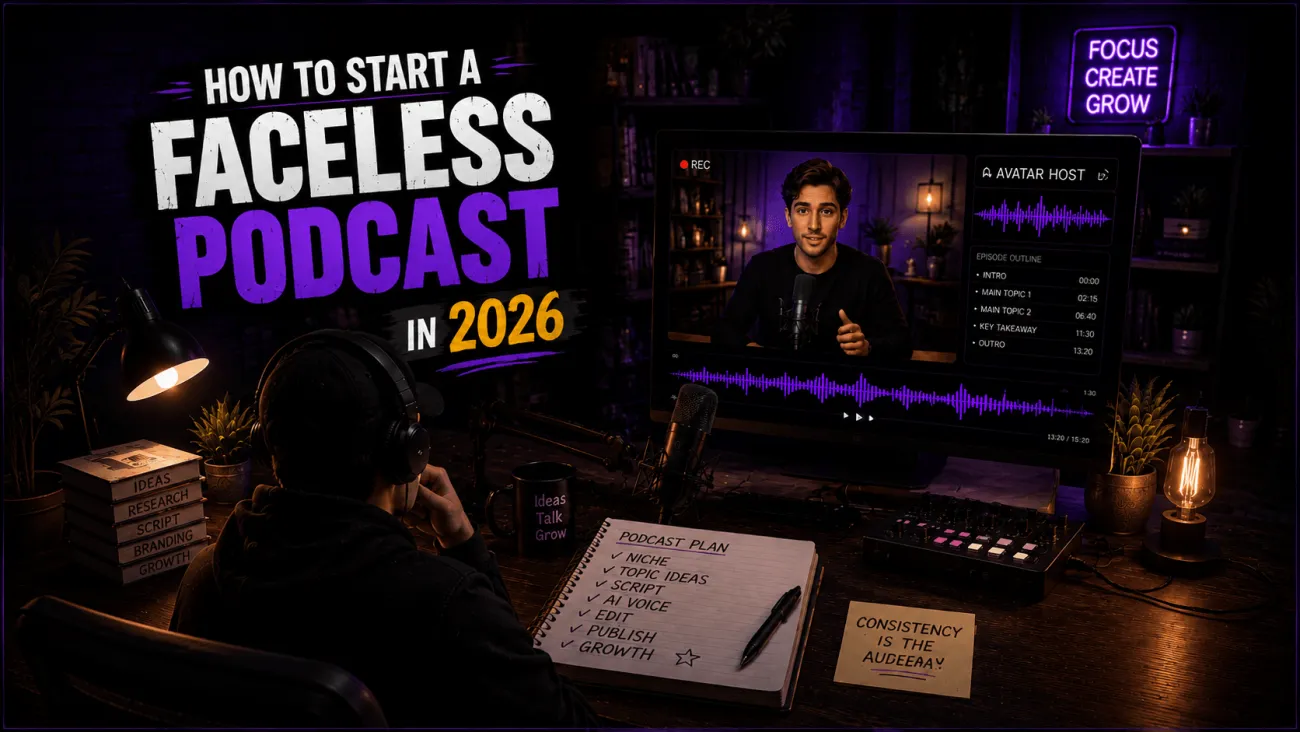

Most people who dream of starting a podcast never actually get started—and usually, it’s because of one thing: the camera.
It’s not the microphone, not the editing, not figuring out RSS feeds. It’s the camera. The thought of sitting on camera, looking straight into a lens, knowing that your face will be tied to every opinion you share, forever.
That’s a real barrier, and it deserves to be taken seriously.
Here’s what we know for sure: in 2026, you don’t need a camera to grow a serious podcast audience. YouTube now reaches over 1 billion podcast viewers every month, and Deloitte reports that 27% of U.S. consumers watch video podcasts weekly. Even more striking, a growing portion of that content is created by people who never appear on screen.
The Short Version
If you already know you want to go faceless and just need the map:
-
Pick your format first. Audio-only, image podcast, or AI avatar video each has a different ceiling and a different production cost. For multi-platform reach, we recommend starting with the avatar format.
-
Your script is everything. AI voice quality is no longer the bottleneck. Stiff writing is. Write for the ear, not the page.
-
Dual-host format outperforms solo. Two AI voices in conversation creates natural pacing that single-voice narration can’t replicate.
-
18 to 22 minutes is the sweet spot. Episodes in this range consistently yield the highest completion rates across platforms.
-
Expect 3 to 6 months before the algorithm notices you. That’s not a flaw. It’s the timeline for every new channel, faceless or not.
The rest of this guide goes deeper on each of these. Jump to whichever section you need.
What Is a Faceless Podcast?
A faceless podcast works just like a traditional podcast. The difference is that you don’t appear on camera, and you don’t need to use your own voice.
The content, publishing schedule, and audience-building process remain the same. Only the production method changes.
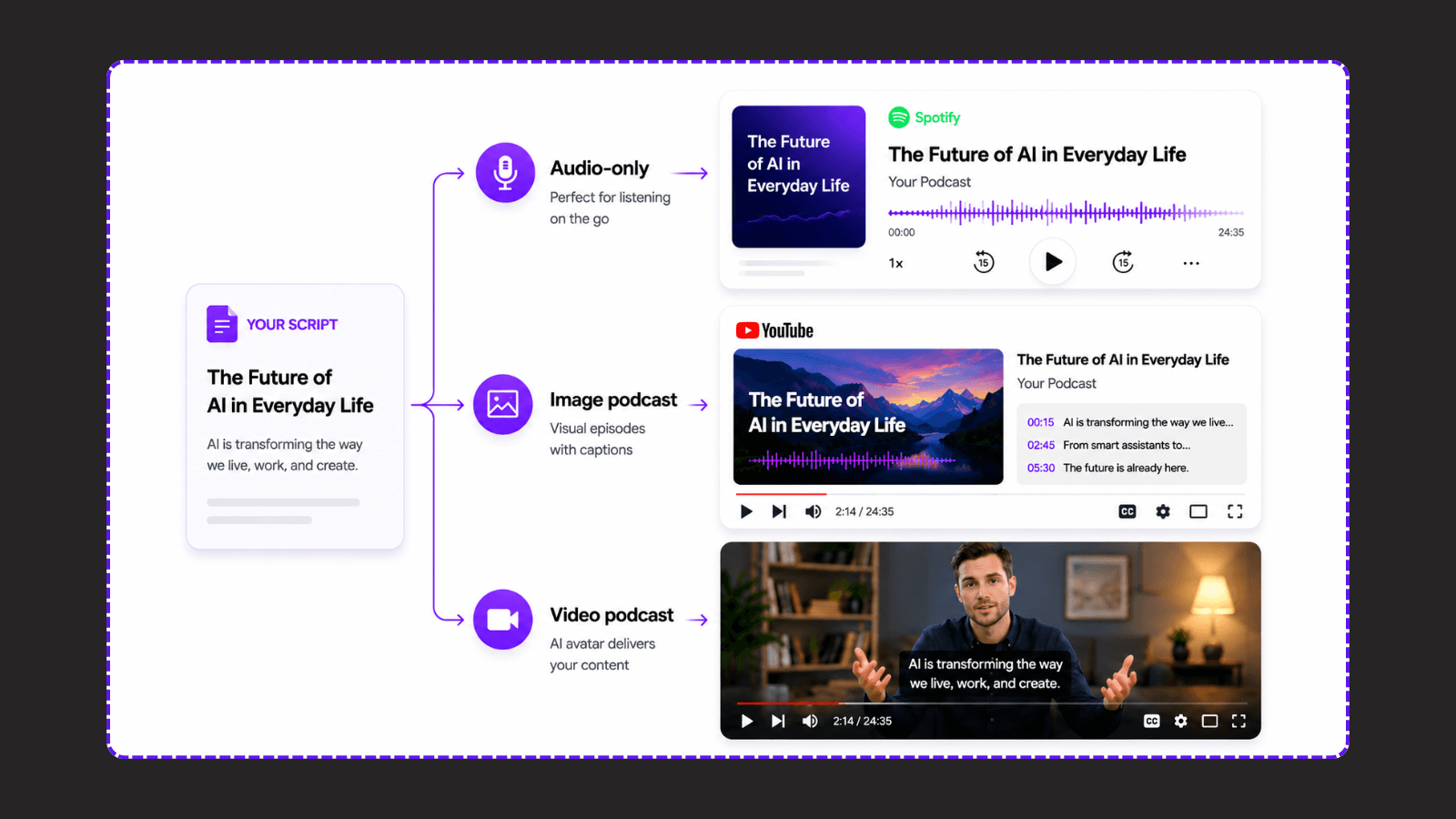
Today, creators generally choose from three different formats.
Audio-Only Podcast
This is the most traditional option. You create audio content and publish it to platforms such as Spotify, Apple Podcasts, and other podcast directories. The narration can come from an AI voice or a voice that has been modified for privacy.
Pros
-
Easy to get started
-
Requires the least amount of setup
-
Fastest production workflow
Cons
-
No visual component
-
Limited visibility on video-first platforms
-
Harder to repurpose into short-form content
Image Podcast
An image podcast combines audio with a static image, animated background, or waveform visualization. Many creators use this format to publish episodes on YouTube and create clips for Shorts, Reels, and TikTok. Most AI podcast tools can generate this format automatically.
Pros
-
Simple way to create video content from audio
-
Suitable for YouTube distribution
-
Easy to reuse across multiple platforms
Cons
-
Less engaging than a host-led video
-
Limited visual storytelling
-
Often struggles to hold attention during longer episodes
AI Avatar Video Podcast
An AI avatar podcast uses a virtual host to present your content. The host can look like a real person, a cartoon character, a brand mascot, or a custom avatar.
Pros
-
Strong performance on YouTube, TikTok, and Instagram Reels
-
Creates a visual connection with viewers
-
No need to appear on camera or record your own voice
-
Makes it easier to build a recognizable brand
Cons
-
More production steps than audio-only formats
-
Requires an AI tool that supports avatar generation
Which Format Should You Choose?
If your goal is simply to launch a podcast as quickly as possible, an audio-only format is enough. If you want to grow across YouTube, TikTok, Instagram Reels, and podcast platforms at the same time, an AI avatar video is usually the better starting point.
For most creators in 2026, starting with video and then distributing the audio version offers the most flexibility and the greatest long-term growth potential.
Why Start a Faceless Podcast Now
Three things made faceless podcasting viable at scale between 2024 and 2025: video podcasts went mainstream, AI voice quality crossed a credibility threshold, and the faceless creator aesthetic normalized across finance, education, and news niches.
What’s worth knowing: Deloitte reports that over 60% of top shows on leading streaming platforms now offer a video component, and 55% of Americans are now monthly podcast consumers. The audience exists. The platforms support it. The tools work. That’s the environment you’re entering.
Step 1: Pick Your Format Before You Pick Your Tools
The format decision shapes everything that comes after it, including tool choice, production time, platform strategy, and monetization options. Make this call first.
-
Audio-only works if your audience lives primarily on Spotify or Apple Podcasts and won’t miss a video component. Think daily news briefings, meditation, fiction. The production workflow is fast. The discoverability ceiling is lower.
-
Image podcast is a useful middle ground. It gets you onto YouTube without requiring a virtual host. A professionally designed cover image with an animated waveform and captions can perform well, particularly for longer-form episodes where the content is dense and visual interest matters less than information value.
-
Video podcast is the highest-effort, highest-ceiling format. You’re producing an actual video podcast, one that requires a script written for audio pacing, a virtual host that matches your brand tone, and video editing for caption style and background. The payoff is YouTube searchability, TikTok discoverability, and repurposable short clips from every episode.
These formats aren’t mutually exclusive, and that’s the point. The same script can produce an avatar video for YouTube, an audio file for Spotify, and a 60-second vertical clip for TikTok. That’s the case for building your production around the AI avatar format from day one. With PodcastorAI, you can handle all three formats inside a single workflow.
Step 2: Find a Topic Worth 50 Episodes
Many faceless podcasts fail because they run out of ideas long before they run out of motivation.
Before recording your first episode, try listing 50 episode ideas. If you struggle to get past 15 or 20, your niche probably needs work. A niche that’s too narrow will leave you with no material. A niche that’s too broad will make it difficult to stand out.
A simple test is whether you can describe your show in a single sentence that includes:
-
A specific audience
-
A recurring format
-
A clear angle
For example:
Weekly breakdowns of under-reported AI regulation news for founders building in regulated industries.
That’s a podcast. “AI and tech news” is just a topic. If you’re stuck for ideas, don’t stare at a blank document. Go where your future audience is already asking questions, sharing opinions, and consuming content.
Some of the best places to find episode ideas include:
-
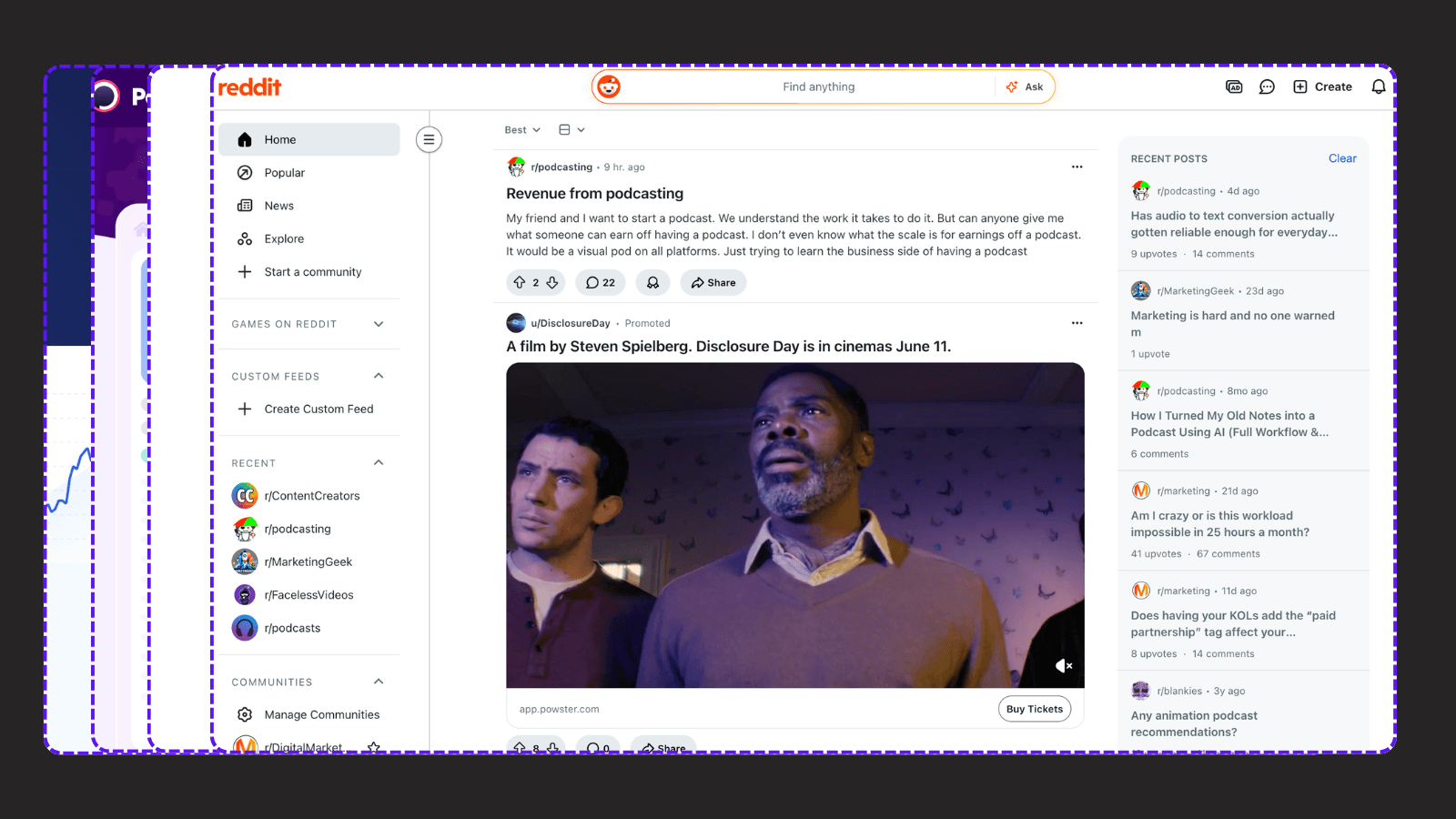
Reddit – Browse niche communities and recurring discussions.
-
Podchaser — Explore top podcasts in your category, guest appearances, and audience interests.
-
Feedly — Build a personalized news feed around your niche and track new developments automatically.
-
Exploding Topics – Find emerging trends across industries.
-
Listen Notes – Research what other podcasts are already covering and identify content gaps.
Step 3: Turn Your Ideas Into a Podcast Script
In the past, creating a podcast script meant staring at a blank document and writing every section yourself. That’s still an option. But in 2026, most creators start somewhere else.
Option 1: Write the Script Yourself
If you enjoy research and writing, begin with a simple outline.
Focus on:
-
Short, conversational sentences
-
Clear transitions between sections
-
Real examples instead of abstract explanations
-
A structure that sounds natural when spoken aloud
If possible, consider a dual-host format. Two voices create a more dynamic listening experience and often hold attention longer than a single narrator.
For a typical 15-minute episode, you’ll need roughly 2,200 to 2,500 words of finished script.
Option 2: Start With PodcastorAI
Many successful creators no longer begin with a blank page. Instead, they start with source material:
-
A URL
-
A blog post
-
A PDF
-
Research notes
-
A YouTube transcript
-
Even a rough idea written in a few sentences
PodcastorAI can turn those inputs into a structured podcast draft within minutes. The goal isn’t to replace your expertise. It’s to eliminate the most time-consuming parts of the process.
For beginners, this makes podcast creation accessible without needing professional writing skills. For experienced creators, it speeds up research, surfaces related subtopics, and helps identify keywords and angles worth covering.
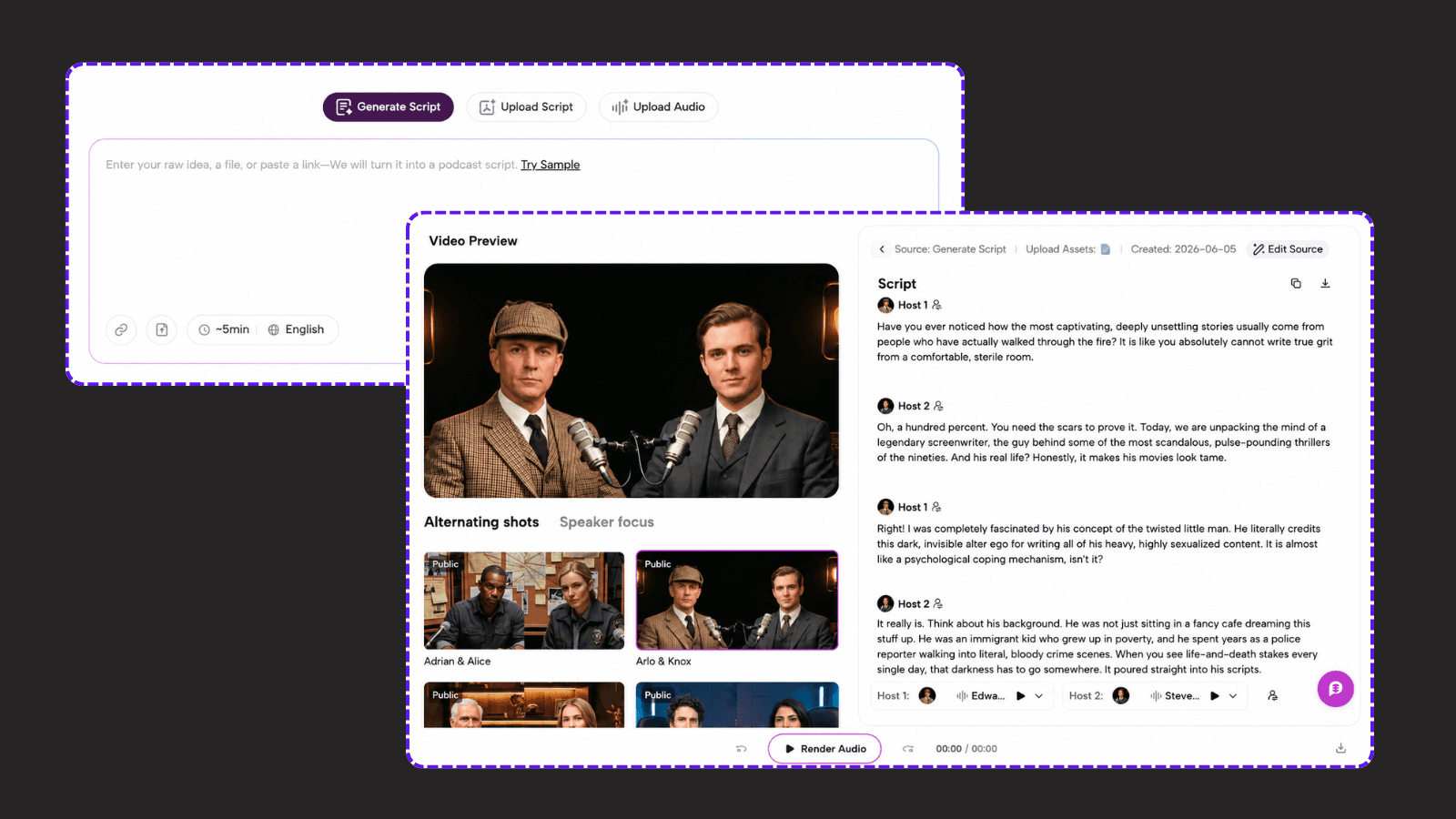
What AI Can Help With
-
Turn articles into podcast scripts
-
Convert PDFs and reports into episode outlines
-
Generate single-host or dual-host conversations
-
Expand rough notes into structured episodes
-
Surface related keywords and subtopics
-
Rewrite scripts for different tones and audiences
-
Move directly from script to audio and video production
The best podcasts aren’t written entirely by AI or entirely by humans. They’re created by people with something worth saying and tools that help them say it faster.
Step 4: Turn Your Script Into a Podcast
Once your script is ready, it’s time to choose how people will experience it.
In 2026, most faceless creators don’t stop at audio. They publish podcast videos to YouTube, TikTok, Instagram Reels, and other platforms where discovery is easier and audiences are larger.
| Format | Best for |
|---|---|
| Audio-only podcast | Traditional podcast listeners |
| Image podcast | Educational, news, and long-form content |
| Podcast video | Creators focused on growth |
For most new creators, a podcast video offers the greatest upside. You can always extract the audio and publish it to Spotify or Apple Podcasts later. Going in the opposite direction is much harder.
Choose a Visual Style That Fits Your Content
If you’re creating a podcast video, the presentation style matters. Different formats create different audience expectations.
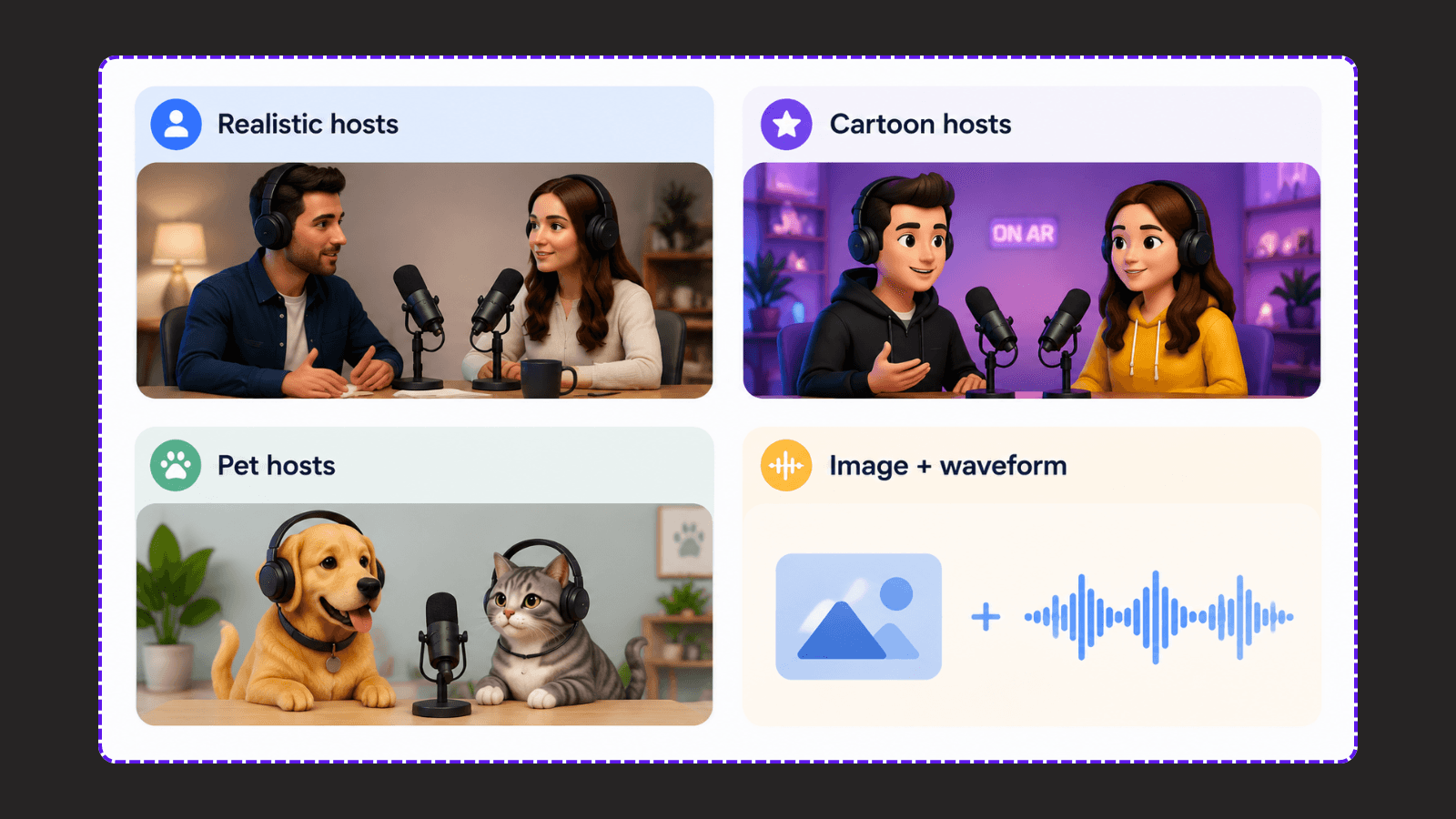
| Style | Best for |
|---|---|
| Realistic hosts | Business, finance, education, news |
| Cartoon hosts | Lifestyle, entertainment, creator brands |
| Pet hosts | Viral content, social media growth, novelty formats |
| Image + waveform | Interview, analysis, and audio-first shows |
Tools like PodcastorAI support all of these formats, from image podcasts and realistic hosts to cartoon and pet-hosted podcast videos, allowing you to turn a script into a finished episode without switching between multiple tools.
Step 5: From Script to Published Episode
At this point, you have three things:
-
A topic worth covering
-
A finished script
-
A format that fits your audience
Now it’s time to turn that into a real episode.
Once you’ve chosen your format and finalized your script, the rest of the process is surprisingly straightforward. What once required multiple tools, complicated editing workflows, and hours of manual work can now be handled inside a single AI-powered production process.
A typical workflow looks like this:
| Stage | What Happens | Typical Time |
|---|---|---|
| Research & source gathering | Collect articles, PDFs, notes, or source material | 15–30 min |
| Script creation | Generate or write the first draft | 20–45 min |
| Review & refinement | Fact-check content and add your perspective | 15–30 min |
| Voice & visual setup | Choose voices, hosts, and presentation style | 5 min |
| Episode generation | Generate audio and video outputs | 5–10 min |
| Caption review | Check subtitles and final formatting | 10–15 min |
| Content repurposing | Create clips for Shorts, Reels, and TikTok | 15–20 min |
Total production time: approximately 2–3 hours per episode.
According to SparkPod, AI-native podcast workflows can reduce production time by as much as 70% compared with traditional recorded-and-edited workflows, which often require 8 to 12 hours to produce a polished 20-minute episode. Once you’ve published a few episodes and established a repeatable workflow, that number often drops even further.
Step 6: Publish Once, Distribute Everywhere
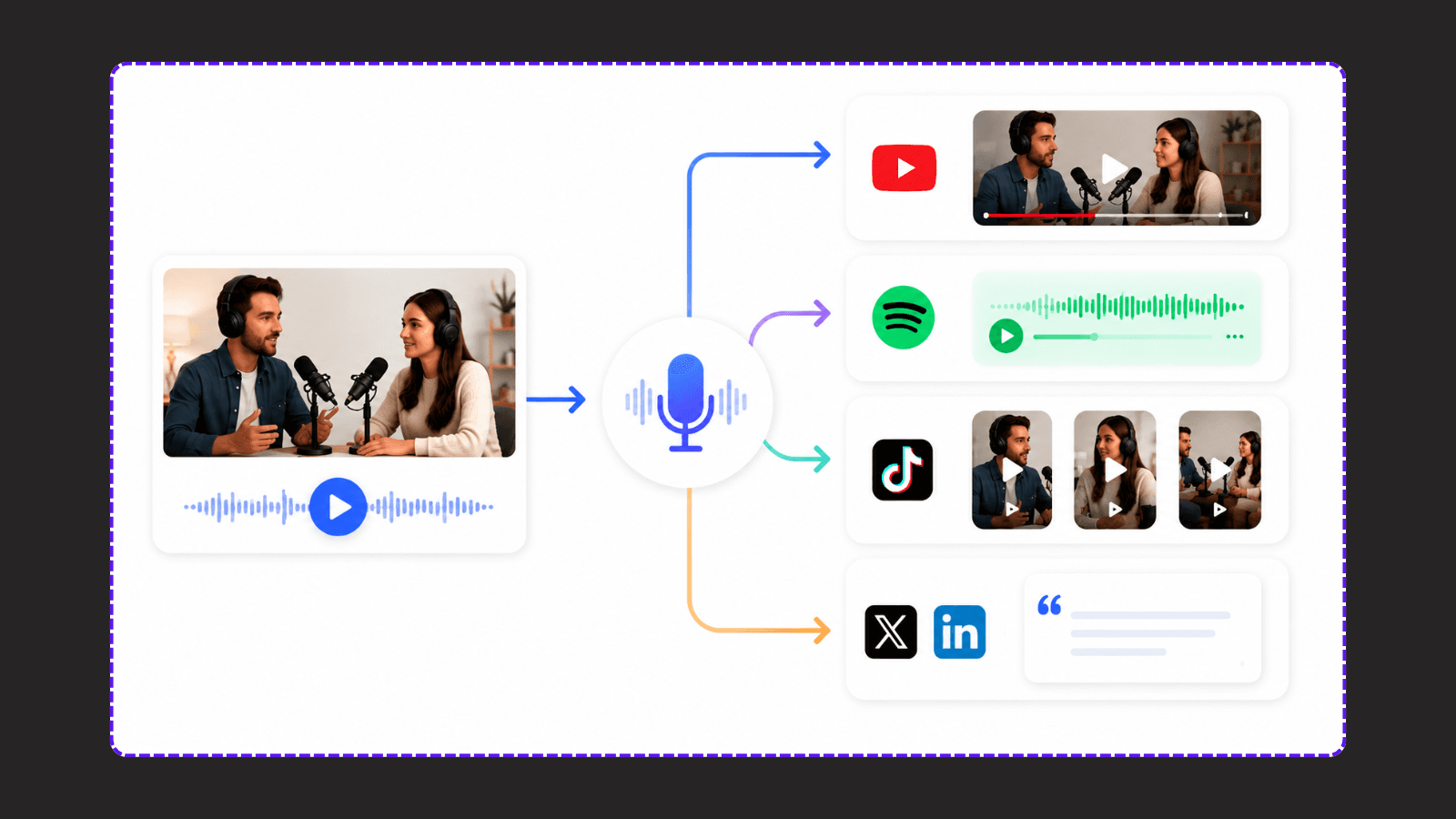
One of the biggest advantages of faceless podcasting is that a single episode can be repurposed into multiple content formats.
A 15-minute episode doesn’t have to remain a 15-minute episode. It can become long-form content, short-form videos, social posts, and podcast episodes at the same time.
A typical distribution workflow looks like this:
-
YouTube: Full-length video upload (16:9 ratio)
-
Spotify / Apple Podcasts: Audio version of the same episode
-
TikTok / Instagram Reels: 3–5 short clips built around the strongest moments
-
X / LinkedIn: Quotes, insights, and discussion starters pulled from the episode
Most creators assume the full episode drives growth. In reality, short-form clips often do the heavy lifting.
For many faceless podcasts, clips are the discovery engine. They introduce new audiences to your content, while the full episode builds trust and turns viewers into subscribers. The goal isn’t to create more content. It’s to get more value from the content you’ve already created.
Step 7: Stay Consistent Long Enough for Compounding to Work
The average podcast goes inactive after 21 episodes, which typically represents 5 to 6 months at a weekly cadence. Most channels never reach the point where the algorithm starts recommending them organically.
Build your production calendar around a sustainable frequency before you optimize for output volume. One weekly episode, published consistently for 18 months, outperforms three weekly episodes published for 6 months and then abandoned.
If you followed the process in this guide, you already have the pieces:
-
A repeatable topic framework
-
A workflow that can be sustained
-
A format that fits your audience
Now the job is simple. Keep publishing.
What Nobody Tells You: The Real Pitfalls
I’m including this section because the creator communities on r/podcasting and r/ContentCreators are full of people who tried the faceless format and hit the same walls. Here’s an honest account of where it actually goes wrong.
The robotic-voice problem is almost always a script problem. The most common complaint we hear from new faceless podcasters is that the output sounds stiff. The instinct is to blame the AI voice, but in almost every case, the script is the actual problem. AI voices read exactly what you write. If your writing is formal, padded, or built for reading rather than listening, the audio will sound robotic no matter how advanced the TTS model is. The fix is rewriting the script, not switching tools.
YouTube started flagging mass-produced AI content in mid-2025. Since July 2025, YouTube has been demonetizing channels that produce repetitive, templated AI-generated content without original value. The tell is usually identical episode structure, nearly identical scripts across topics, and zero editorial perspective. The format itself isn’t the issue. The lack of original contribution is. “Faceless does not mean AI slop.”
Long episodes are harder to pull off than short ones. Episodes longer than 40 minutes are genuinely difficult to sustain with AI-only narration unless there’s real variety built into the format, including different segments, tonal shifts, or a two-host structure that creates natural contrast. If you’re starting out, 18 to 22 minutes is the episode length with the highest completion rates across platforms. Start there. Go longer once you understand your audience’s tolerance.
The passive income framing will kill your channel. A consistent pattern in creator community discussions: people who start faceless podcasts expecting passive income, meaning low effort, automated content, and set-and-forget growth, abandon by month three. The channels that grow are the ones where a human is still doing real editorial work: choosing topics deliberately, reviewing AI output critically, and engaging with the audience. The AI removes the production overhead. It doesn’t remove the creative judgment.
Listener trust is harder to build than it used to be. “AI Fatigue” is real. Viewers have developed pattern recognition for AI-generated content, and research from Edison Research VP Megan Lazovick indicates that many listeners perceive AI host replacements as a breach of trust. The solution isn’t to hide the format. Be transparent about it and let the content quality be the credibility signal.
Frequently Asked Questions
What is a faceless podcast?
A faceless podcast is a podcast where the host doesn’t appear on camera or use their real voice. Instead of recording yourself, you use either an AI-generated voice for audio-only distribution, or an AI avatar as a virtual host for video podcast distribution on YouTube, TikTok, and Instagram Reels. The content, format, and publishing cadence are identical to a traditional podcast. Only the production method changes.
Does a faceless podcast actually grow an audience?
Yes, and the evidence is observable. Several channels in the finance, education, and news commentary niches on YouTube have built subscriber bases exceeding 500K using entirely faceless or AI-hosted formats. The format doesn’t limit growth. Content quality and publishing consistency are the controlling variables. YouTube’s recommendation algorithm doesn’t distinguish between a human face and an animated avatar; it distributes based on watch time, click-through rate, and session data.
Do I need to disclose that my podcast uses AI voices or avatars?
Platform policies vary and are evolving quickly. TikTok began automatically labeling AI-generated content through C2PA integration, applying labels to output from 47 different AI platforms. YouTube requires disclosure for AI-generated content that could realistically be mistaken for real people. Our recommendation: include a disclosure in your channel description or episode show notes regardless. It builds trust rather than undermining it.
What’s the difference between an audio-only faceless podcast and an AI avatar video podcast?
An audio-only faceless podcast is a traditional audio file distributed to Spotify, Apple Podcasts, and similar directories, where the voice is AI-generated or anonymized. An AI avatar video podcast adds a synchronized video of a virtual host, making the content suitable for YouTube and short-form video platforms. Both formats use the same underlying script and audio. The video format is an additional production step that significantly expands distribution reach.
How much does it cost to start a faceless podcast?
Ongoing costs are lower than traditional podcast production. Most AI podcast platforms offer free tiers with limited monthly generation credits. Paid plans that unlock higher-quality voices, extended episode lengths, and advanced host customization typically run $20 to $50 per month. Compare this to a basic home recording setup of $300 to $800 upfront, plus your physical presence at every recording session.
How much does it cost to start a faceless podcast with PodcastorAI?
PodcastorAI offers four plans to match different stages of growth:
| Plan | Price | Credits/mo | Audio | Video |
|---|---|---|---|---|
| Trial | Free | 50 credits | Up to 12 min | Up to 5 min |
| Audio Creator | $9.9/mo | 300 credits | Up to 75 min | Up to 30 min |
| Video Starter | $26/mo | 600 credits | Up to 150 min | Up to 60 min |
| Creator Pro | $49/mo | 1,500 credits | Up to 375 min | Up to 150 min |
The Trial plan is free with no credit card required. Most new creators start there and upgrade once they’ve found a format and publishing rhythm that works. Compare this to a basic home recording setup — microphone, audio interface, acoustic treatment — which runs $300 to $800 upfront, and still requires your physical presence at every session.
Can I use my own voice in a faceless podcast?
Yes. Voice cloning lets you record a short reference sample and use a synthetic version of your voice for all future episodes. You get the consistency and scale of AI production while the output sounds specifically like you. Current implementations retain accent, pacing, and tonal characteristics with high fidelity. PodcastorAI Voice Clone option supports this directly.
The Honest Part
Most guides on faceless podcasting end with an optimistic paragraph about how anyone can do this. That part is true. The tools are accessible, the costs are low, and the format legitimately works.
What doesn’t get said: the faceless format removes one barrier, the camera, while leaving the actual hard part of podcasting intact. You still need a niche precise enough to own, an opinion strong enough to be worth hearing, and the patience to publish consistently through the first six months when almost no one is listening.
The AI handles the production. The rest is still on you. Start with PodcastorAI and generate your first faceless video podcast from any URL, PDF, or text prompt, with your choice of realistic, cartoon, or pet AI avatar host. Free to start.