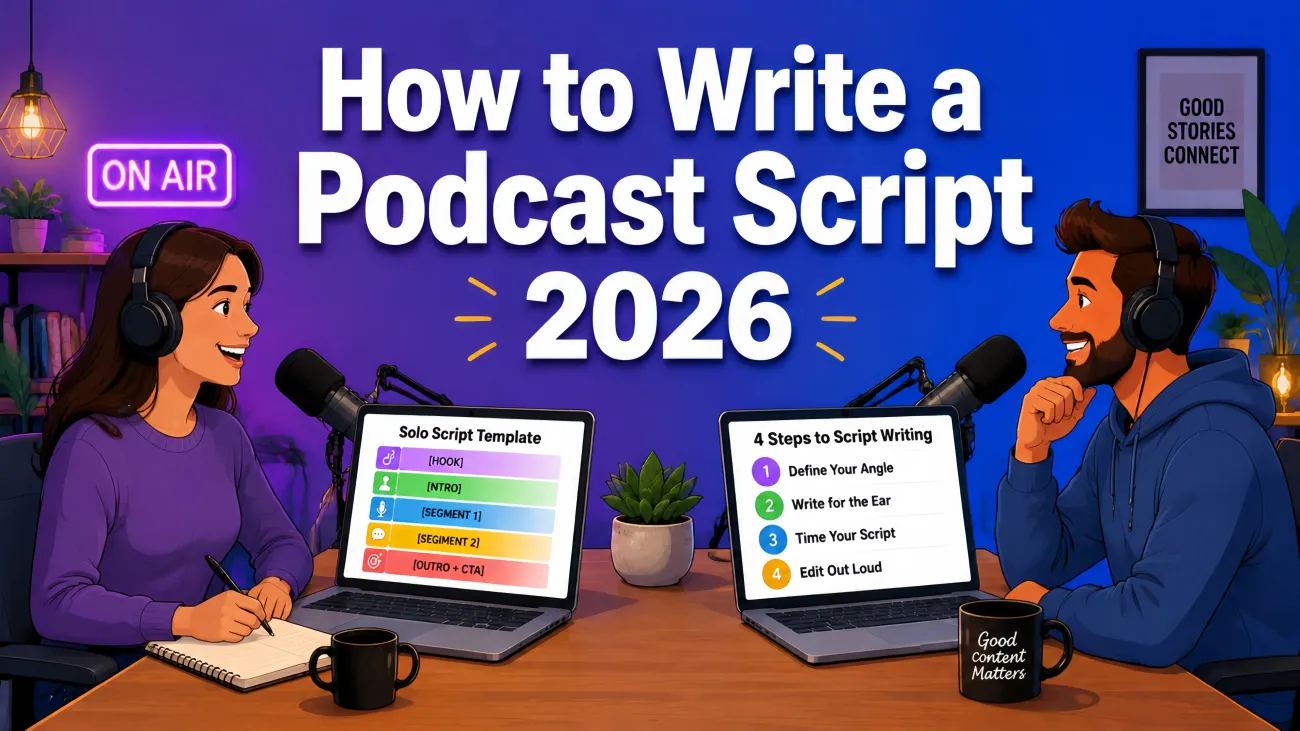

How to write a podcast script is one of the most searched questions among new podcasters, and for good reason. You sit down with a great idea, hit record, and three tangents later you have 45 minutes of unusable audio. Editing ends up taking three times longer than the recording itself.
A podcast script solves this problem directly: it gives your episode structure and direction so you can stay on topic, sound natural, and publish episodes worth listening to.
This guide covers everything from choosing the right script format to free copy-and-use templates for solo, co-host, and video podcasts.
Do You Really Need a Podcast Script?
The short answer is yes, but probably not in the way you think. Most podcasters skip scripting because they fear sounding robotic. That concern is understandable, but a script is not a teleprompter. It is a map: it tells you where you are going without controlling every step you take.
Even the most experienced podcasters who sound completely off-the-cuff are working from some form of structure. They have planned the arc of the episode, identified the key moments, and know exactly how they will close. They just do not need every word written out anymore. If you are just getting started, a script will save you hours of editing time and help you show up to every recording with confidence.
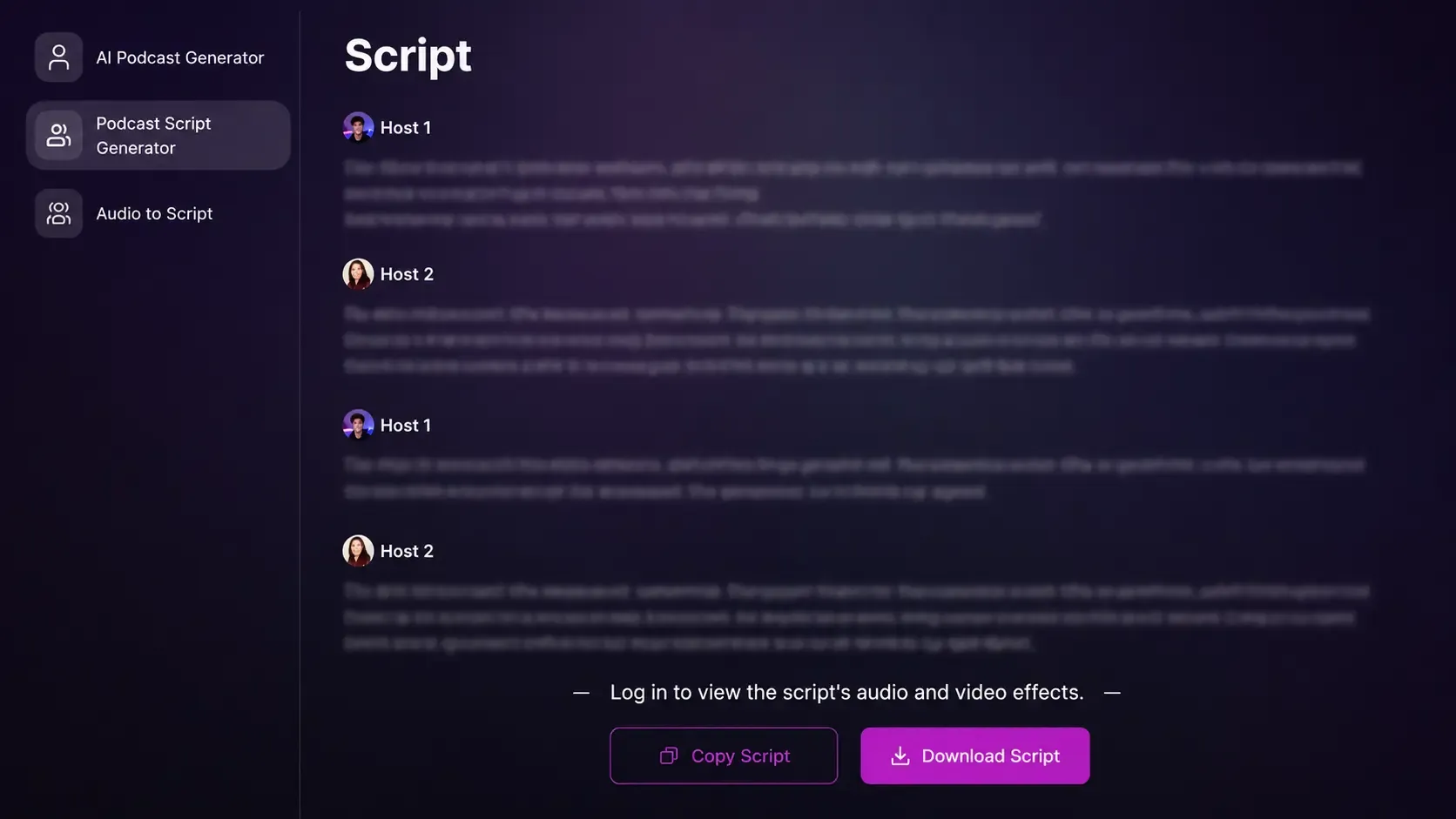
Today, many creators use AI podcast tools to speed up scripting, outlining, and episode planning before recording. Platforms like PodcastorAI combine podcast script generation, audio transcription, and AI podcast creation into a single workflow, helping creators move from idea to published episode much faster.
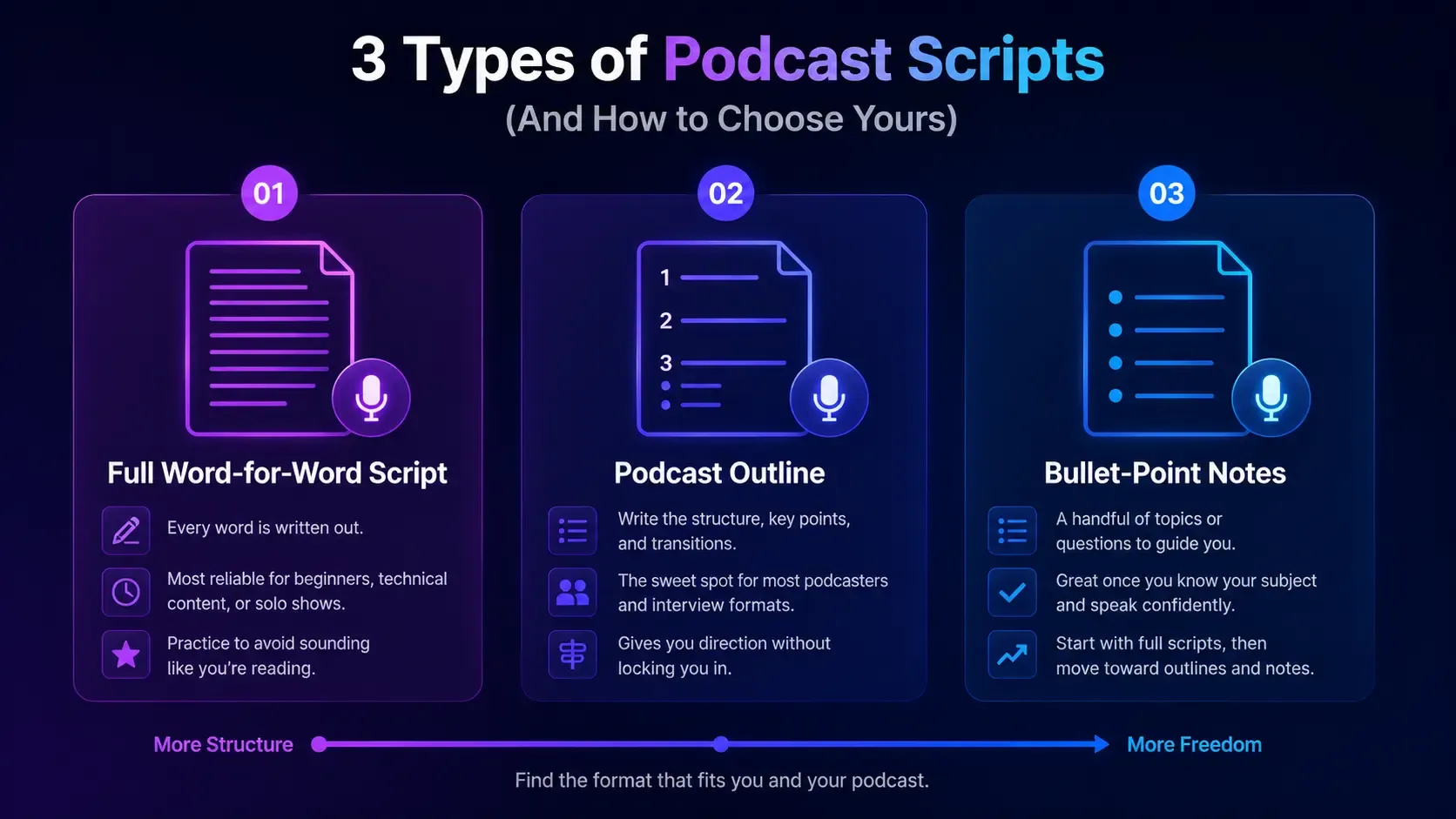
3 Types of Podcast Scripts (And How to Choose Yours)
Not every script looks the same. The right format depends on your experience level, your podcast format, and how comfortable you are in front of a microphone. For a practical example of a simple outline, you can see a creator’s workflow on Reddit.
Full Word-for-Word Script
Every sentence, every transition, every aside is written out in full. This takes the longest to prepare, but it is the most reliable option for beginners, highly technical content, or solo informational shows where precision matters. The main risk is sounding like you are reading. Practice reading it aloud several times before recording and mark your script with pauses and emphasis cues.
Podcast Outline
This is the sweet spot for most podcasters. You write out the structure of your episode: the key sections, the main points you want to hit, and the transitions. Within each section, you speak naturally. A podcast outline gives you direction without locking you in, and it is especially effective for interview and co-host formats where you cannot fully control the conversation.
Bullet-Point Notes
The lightest structure is a handful of topics or questions to keep in front of you while you record. This works well once you are comfortable with your subject matter and confident enough to fill the space naturally. Most podcasters start with full scripts and gradually work toward outlines and notes as they gain experience.
The Anatomy of a Great Podcast Script
Whatever format you choose, every strong podcast episode shares the same core structure. Here is how each part works.
The Hook (First 30 Seconds)
Your hook is the most critical part of your script. Most listeners decide whether to keep listening within the first 30 seconds, so you need to earn their attention before introducing yourself or explaining what your show is about. Three approaches that work consistently:
-
Open with a question that speaks to your listener’s situation: “What if you could record a professional podcast without a microphone, a studio, or ever showing your face?”
-
Lead with a surprising fact: “The average podcast listener subscribes to six shows but only regularly listens to three of them.”
-
Drop into the middle of a story: start with the most interesting moment, then rewind to give context.
What does not work: opening with “Welcome back to another episode of…” Save the housekeeping for after you have hooked them.
The Podcast Intro Script
After the hook, your intro does two things: introduces you or your guest, and tells the listener what they will get out of this episode. Keep it tight at 60 to 90 seconds. A strong podcast intro script follows this pattern:
“I’m [Name], and today we’re talking about [topic], specifically [angle]. By the end of this episode, you’ll know [specific takeaway].”
For co-host shows, this is also where you establish the dynamic between your two voices, so listeners immediately know who they are listening to and why.
The Main Body
The most reliable structure is the three-segment approach. Segment 1 introduces the problem or main idea. Segment 2 explores it through examples, stories, data, or conversation. Segment 3 resolves it with a practical takeaway or clear conclusion. For longer episodes, expand to four or five segments, but keep each one focused on a single idea. Topic drift is what makes episodes feel bloated and unfocused.
Transitions
Transitions are the connective tissue of a well-scripted episode. They signal that you are moving from one idea to the next and make the whole thing feel intentional rather than improvised. A simple formula: summarize what you just covered, then preview what is coming next. For example: “So that’s the three-part structure for solo episodes. Now let’s look at how things change when you’ve got two voices in the room.”
The Outro and CTA
Your outro should close the episode with intention and give the listener one clear next action. One CTA, not three. Asking someone to subscribe, leave a review, follow you on social media, and join your newsletter in the same breath means they will do none of it. Pick the one action that matters most right now and ask for that. End with something memorable: a final thought, a question for the listener to sit with, or a preview of your next episode.
How to Write a Podcast Script: Step by Step
Step 1: Define Your Angle, Not Just Your Topic
“Productivity” is a topic. “The one scheduling habit that eliminates decision fatigue” is an angle. Your angle is what makes this specific episode worth listening to. It answers the question: why should someone choose this episode over the 50 other episodes on the same topic? Before writing a single word of your script, nail down your angle in one sentence.
Step 2: Write for the Ear, Not the Eye
Podcast scripts are not essays. The way people listen is completely different from how they read. Use short sentences and cut anything over 20 words. Use contractions like you’re, they’ll, and it’s because they sound human. Avoid complex sentence structures with multiple clauses. Read your script aloud as you write it: if you run out of breath, the sentence is too long.
Step 3: Time Your Script
Before recording, know how long your episode will be. Spoken English runs at approximately 130 to 150 words per minute at a natural, conversational pace.
| Episode Length | Approximate Word Count |
|---|---|
| 10 minutes | 1,300–1,500 words |
| 20 minutes | 2,600–3,000 words |
| 30 minutes | 3,900–4,500 words |
| 45 minutes | 5,850–6,750 words |
| 60 minutes | 7,800–9,000 words |
These are starting points. Your actual pacing will vary based on how much you naturally pause, how fast you speak, and how many music or transition segments you include.
Step 4: Edit Out Loud
Once your script is written, do not just read it on screen. Record yourself reading it aloud and listen back. Every sentence that trips you up, every section you want to rush through, every moment where you lose the thread: those are your edits. A script that looks clean on the page but sounds awkward out loud is not ready to record.
The Podcast Script Workflow Framework
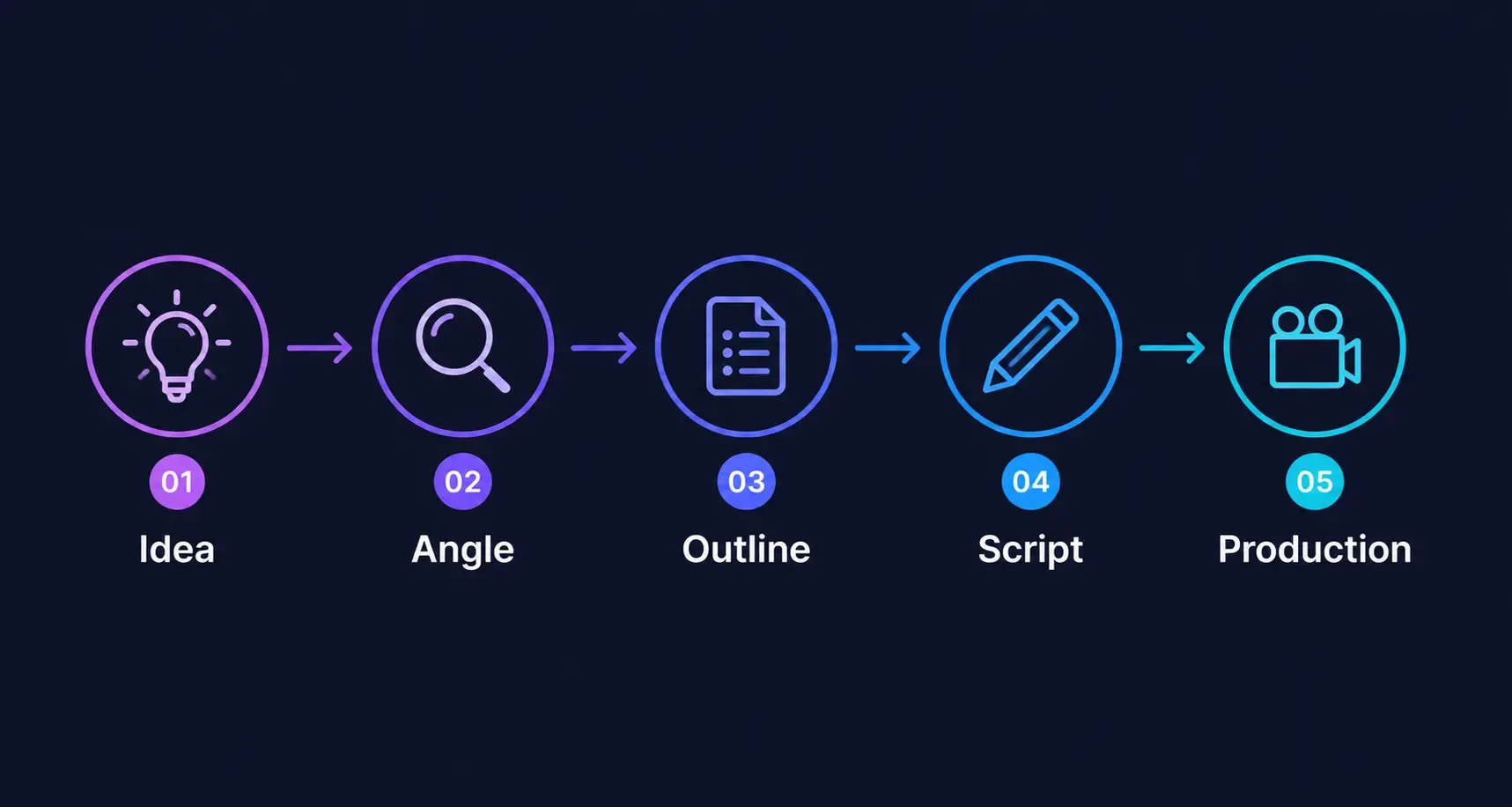
Most strong podcast episodes follow the same underlying workflow, even if the format changes from creator to creator.
Instead of thinking about podcast scripting as “writing everything word for word,” it helps to think of it as a repeatable production system.
A simple podcast scripting workflow usually looks like this:
1. Idea
Start with the core topic, question, or story you want to explore.
This is the raw concept behind the episode.
2. Angle
Narrow the topic into a specific perspective or takeaway.
A strong angle answers:
“Why is this episode worth listening to right now?”
3. Outline
Break the episode into sections:
-
hook
-
intro
-
main talking points
-
transitions
-
conclusion
This creates structure before scripting begins.
4. Script
Expand the outline into speaking points, transitions, examples, and storytelling moments.
Depending on your format, this could be:
-
a full word-for-word script
-
a structured outline
-
bullet-point notes
5. Production
Once the script is ready, the episode moves into recording, editing, transcription, captions, and publishing.
For video podcasts, this stage may also include:
-
visual direction
-
camera notes
-
clips for social media
-
on-screen captions
The more consistently you follow a repeatable workflow, the easier podcast creation becomes over time. Many experienced creators refine this process into a system they can reuse for every episode.
Podcast Script Templates (Copy and Use)
Solo Podcast Script Template
This template works for any solo episode: educational content, storytelling, opinion pieces, or news commentary. Copy it, fill in your own details, and adjust the number of segments based on your episode length.
Hook: 1–2 sentences. Open with a question, a surprising fact, or drop into a story mid-action.
Intro: Introduce yourself and your episode’s specific angle (60–90 seconds). Tell the listener what they’ll take away.
Segment 1 — The Problem or Main Idea:
- Core point
- Supporting detail / story / example
- Transition to Segment 2
Segment 2 — The Exploration:
- Core point
- Supporting detail / story / example
- Transition to Segment 3
Segment 3 — The Resolution or Takeaway:
- Core point
- Practical action the listener can take
Outro:
- Final thought or memorable closing line
- Single CTA or next episode teaser (optional)
Two-Person Podcast Script Template
Writing for two voices is a different challenge. The script needs to account for who says what, how the conversation flows, and where the natural handoffs happen without making it feel rehearsed. Here is a framework for co-host shows, interviews, and debate-style episodes.
Intro — Host A: Hook + episode angle
Intro — Host B: Introduce Host A and yourself (if needed). Set up central tension or question.
Segment 1:
- Host A: Opens with main point/question
- Host B: Responds/adds perspective
- Handoff cue: “What’s your take on…”
Segment 2:
- Host B: Leads segment
- Host A: Responds and builds
- Handoff cue
Segment 3:
- Both hosts: Reach conclusion or agree to disagree
Outro — Both Hosts:
- Each host: One closing thought
- Single CTA
For a detailed guide with templates and examples, check out Captivate’s step-by-step podcast script guide.
How to Write a Script for a Video Podcast
Most scripting guides assume you are producing audio only. If you are making a video podcast — which is increasingly where audience growth happens on YouTube and TikTok — your script needs to do more work than a standard audio script.
A video podcast script includes everything an audio script does, plus several additional elements. Visual cues note what the viewer sees at any given moment: whether both hosts are on screen, whether there is a cutaway, or whether a graphic is appearing. A simple bracketed note in your script is enough:
[Host A on camera, speaking directly to lens] [B-roll: cut to screen recording] [Return to Host B]
On-screen text prompts note where captions, title cards, or lower thirds should appear in the timeline.
Energy direction flags dry or technical sections with reminders like [pick up energy here] to guide your performance during recording.
Screen ratio awareness also matters: a 16:9 script for YouTube has different pacing requirements than a 9:16 script for TikTok or Instagram Reels. For vertical video, shorter segments and more direct-to-camera moments perform better because viewers scroll fast.
Common Podcast Script Mistakes to Avoid
Starting with your introduction.
“Hi, I’m [Name], welcome to [Show]” is one of the fastest ways to lose a listener in the first 10 seconds. Lead with the hook and save the intro for after you have earned their attention.
Writing for the eye, not the ear.
If your sentences would look natural in a blog post, they are probably too formal for a podcast script. Read everything aloud before you record.
Cramming in too many CTAs.
One ask, clearly stated, is far more effective than three requests muddled together at the end. Decide what matters most this episode and ask for only that.
Ignoring transitions.
Jumping between topics without a bridge makes your episode feel disjointed. Every segment should end with a line that closes the current idea and sets up the next.
Never updating your template.
After each episode, note what you skipped, what you added, and what did not land as expected. Your script template should improve with every episode you publish.
Why Podcast Workflows Are Changing in 2026
Podcast creation is no longer just about recording audio.
Today, creators are expected to publish across multiple formats at once, including audio podcasts, video podcasts, short-form clips, captions, transcripts, and social content. A single episode often needs to work across YouTube, TikTok, Instagram Reels, and podcast platforms simultaneously.
As a result, podcast production has become much more time-consuming than before. Many creators now spend more time scripting, editing, repurposing, and formatting content than actually recording.
To keep up with faster publishing schedules, more creators are turning to AI-assisted podcast workflows. AI tools can help generate podcast outlines, turn notes into scripts, convert audio into transcripts, and streamline editing and production.
Instead of using separate tools for scripting, transcription, captions, and publishing, creators are increasingly moving toward integrated AI podcast platforms.
Tools like PodcastorAI combine:
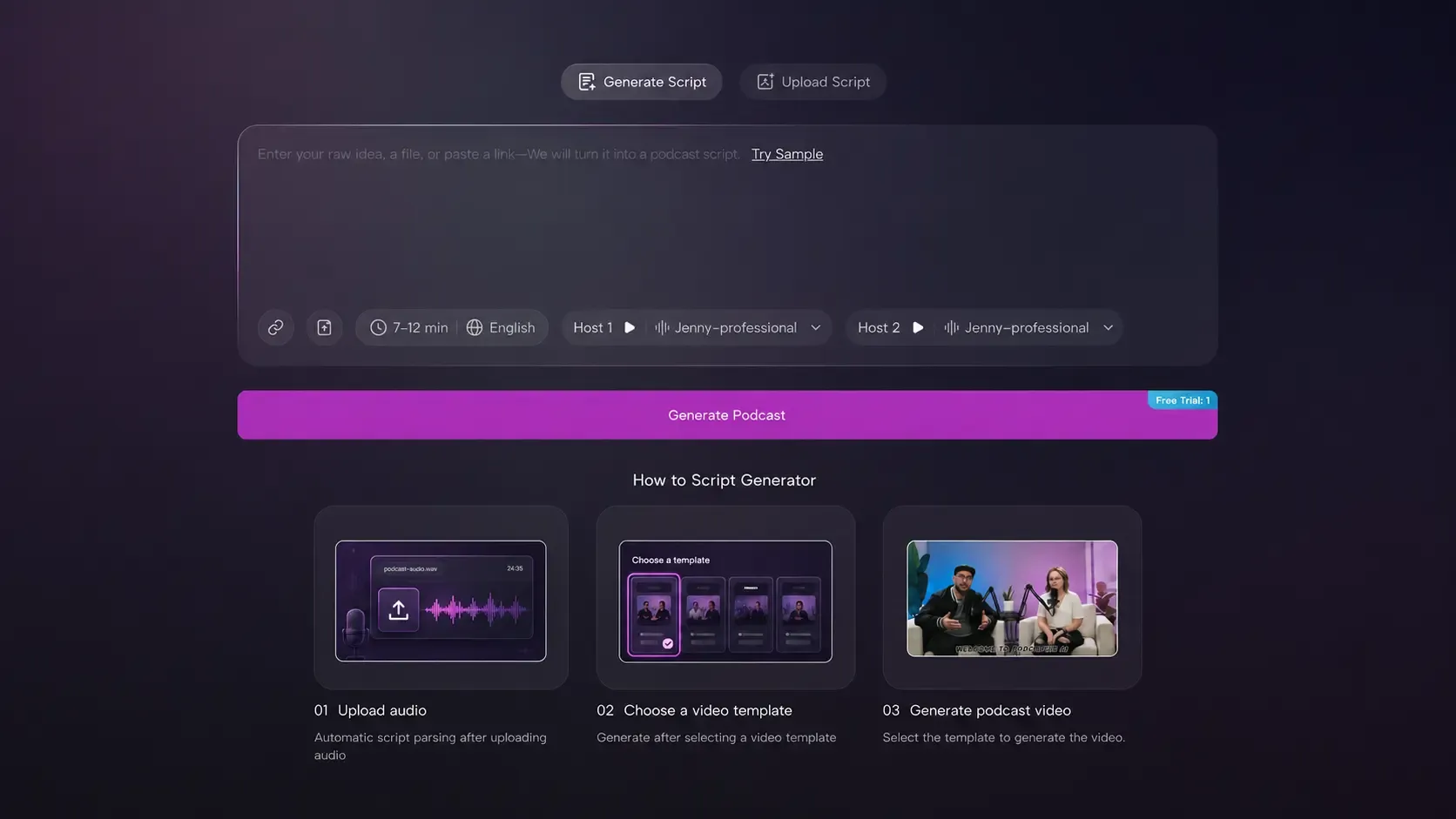
-
AI Video Podcast Generator
This shift is changing how creators plan, produce, and scale podcast content in 2026.
How AI Can Write Your Podcast Script (And What to Watch Out For)
The most time-consuming part of scripting is not the writing. It is the thinking: deciding the angle, structuring the argument, and figuring out what to cut.
AI tools are genuinely useful for getting from zero to a workable first draft. Give an AI a topic, a URL, a PDF, or a rough idea, and you get back a structured script outline in seconds. That is a meaningful time saving, especially when you are publishing on a weekly schedule.
Where AI falls short is voice. An AI-generated script will be structurally sound but often reads as generic. Your specific perspective, your examples, the particular way you phrase things: that is what makes people come back for the next episode. The most effective approach is to use AI for structure and add your own voice during editing.
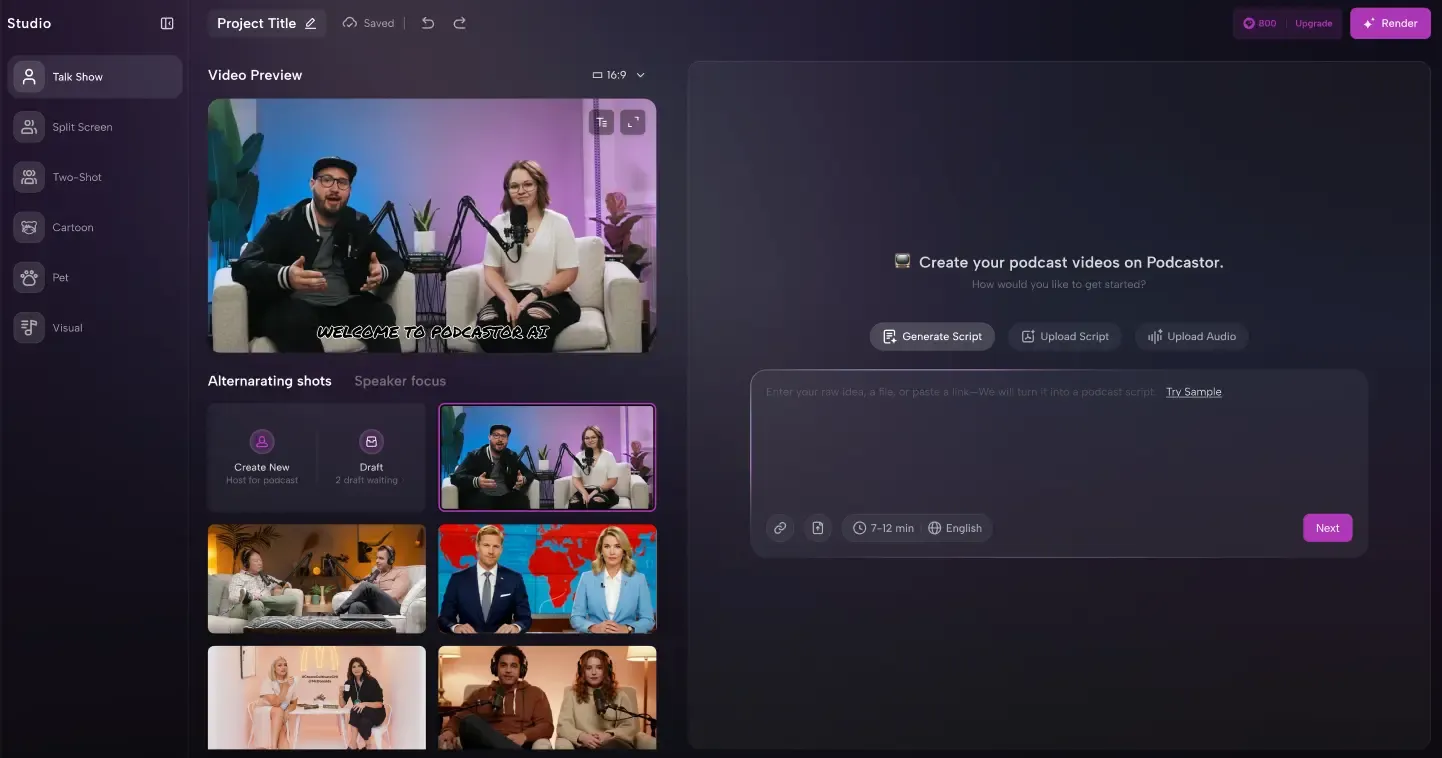
If you want to try this workflow, PodcastorAI takes a topic, a link, or a document and turns it into a structured podcast outline and ready to record script with its AI Podcast Script Generator. You can also convert existing audio into editable transcripts with audio to script support, or generate full video podcast content for solo or two-person formats with its video podcast generator. From there, you can edit, add audio, and publish — all within the same platform.
Conclusion
Writing a podcast script is not about scripting every single word. It is about giving your episode enough structure to stay focused, sound intentional, and get finished.
Start with the right script type for your experience level, build around the core structure of hook, intro, body, and outro, and use the templates in this guide as your starting point. Whether you are writing a podcast script for a solo show, a two-person co-host format, or a video podcast, the fundamentals remain the same: define your angle, write for the ear, time your script, and edit out loud.
The more episodes you publish, the faster and more natural the process becomes.
Get Started with PodcastorAI
Podcast creation is shifting from manual production to AI-assisted workflows. PodcastorAI helps creators move from ideas, documents, and recordings to ready-to-publish podcast content faster without complicated editing software.
Join the waitlist to get early access!
Frequently Asked Questions
How do you write a podcast script for beginners?
Start with a podcast outline rather than a full word-for-word script. Define your angle first, write a hook that earns attention in the first 30 seconds, break your main content into two or three segments, and close with one clear CTA. Use the solo podcast script template in this guide as your starting point and read everything aloud before recording. Once you are comfortable, move toward lighter structures like bullet-point notes.
What are podcast script generators?
Podcast script generators are AI tools that produce a structured podcast script from a topic, URL, document, or text prompt. They handle the first draft: the structure, the segment breakdown, and the transitions. You then edit the output to add your own voice, examples, and perspective before recording. Tools like PodcastorAI support both solo and two-person formats.
Can AI write a podcast script automatically?
Yes. Current AI tools can generate a complete, structured podcast script from a topic or source document in seconds. The quality of the structure is generally solid, but the output tends to sound generic without human editing. The most effective approach is to use AI to produce the first draft and refine it with your own voice, specific examples, and original perspective before recording. This cuts preparation time significantly without sacrificing quality.
Is it free to use an AI podcast script generator?
Many AI podcast script generators offer a free tier with limited monthly usage. The number of free generations varies by platform. Paid plans typically unlock longer scripts, more formats, and commercial usage rights. It is worth testing a free tier before committing to a subscription to check whether the output quality suits your needs.
How does PodcastorAI help with podcast script writing?
PodcastorAI offers three tools that cover different stages of the scripting process. The Podcast Script Generator takes a topic, URL, or uploaded document and produces a structured script for solo or two-person podcast formats. The Audio to Script tool works in the opposite direction: upload an existing audio recording and it converts the speech into an editable transcript you can refine and reuse. Once your script is ready, the AI Podcast Generator takes it through to a finished audio or video episode.