How to make a true crime podcast is one of the most searched questions in podcasting right now, and the demand for true crime content shows no sign of slowing. True crime is consistently the top-performing podcast genre, with listeners logging more hours per episode than almost any other format. The real challenge is transforming a real case into a compelling audio story that keeps listeners engaged from the first hook to the final word.
If you have tried to start and ended up staring at a blank document, it is usually not because the case is uninteresting. Most aspiring true crime creators already have a case in mind; what they often lack is a clear system to turn raw research, such as court records, witness accounts, and news archives, into a polished, publishable episode.
This guide walks you through every step of that process, from selecting and researching a case to structuring it as a narrative, writing and recording a true crime script, and publishing your episodes. Tools like PodcastorAI can help streamline this workflow, enabling you to quickly move from case notes to a well-crafted script and episode, so you can focus on telling the story rather than getting stuck in the mechanics.
What Makes a Great True Crime Podcast
A true crime podcast is a non-fiction audio show that investigates real criminal cases, covering murders, disappearances, fraud, wrongful convictions, and unsolved mysteries through research, narration, and storytelling. Unlike news reporting, which focuses on recency and brevity, true crime podcasts reconstruct cases in depth, building the human context around a crime, following the investigation, and examining what the outcome reveals about the justice system, the community, or the individuals involved.
Successful true crime podcasts, whether serialized or anthology formats, share key qualities:
-
Ethical seriousness They handle subjects with care, treating victims and their families respectfully and avoiding sensationalism.
-
Structured narrative & tension Information is revealed deliberately, pacing details to maintain suspense rather than delivering everything at once.
-
Consistent voice & perspective A reliable host voice and point of view keep listeners engaged and give them a reason to subscribe.
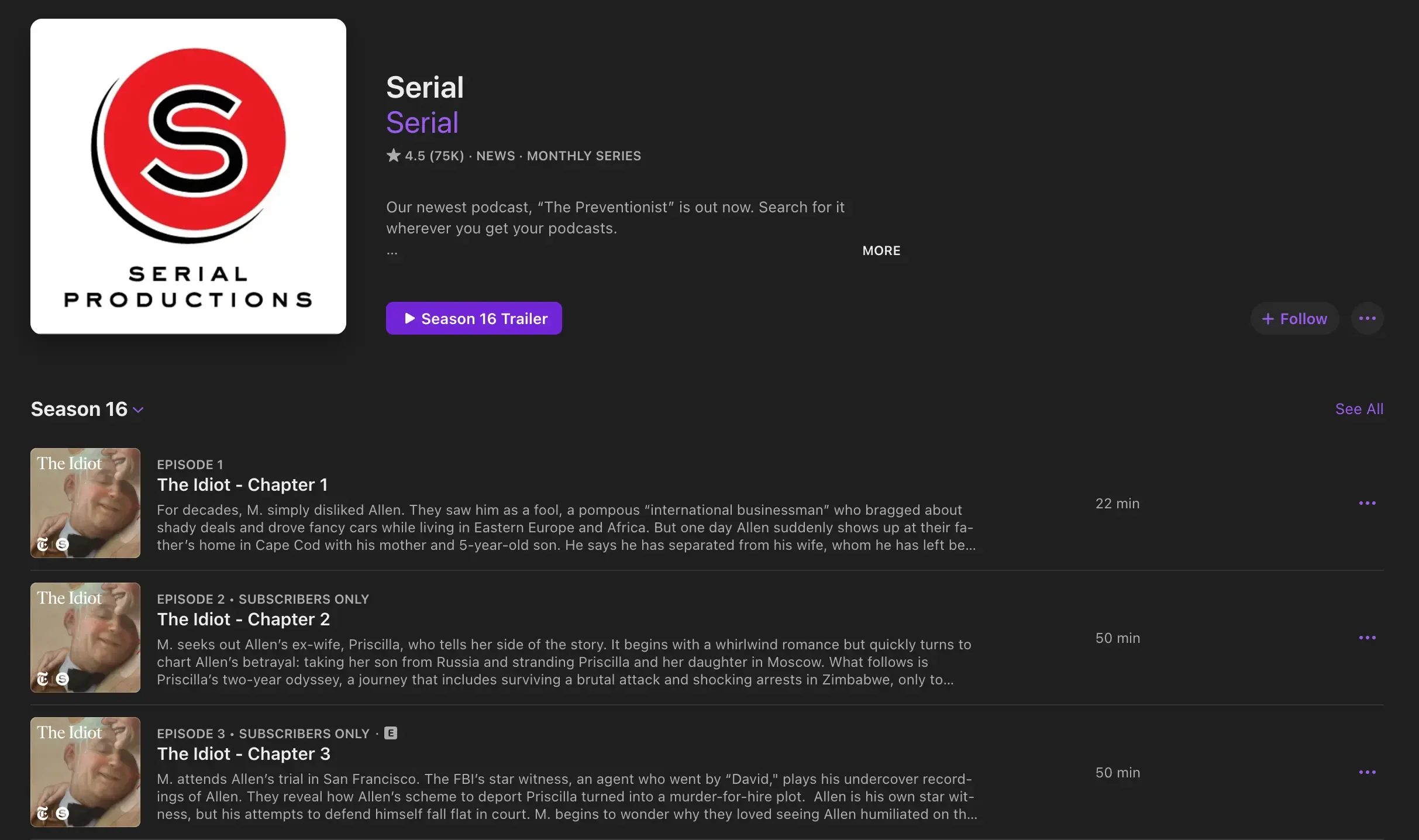
Serial, the hit true crime podcast hosted by Sarah Koenig, captivated millions of listeners from its debut in 2014, averaging over 1.5 million weekly listeners and showcasing the power of compelling serialized storytelling. By carefully pacing revelations, threading uncertainty through the investigation, and centering episodes on human stories, it set a new benchmark for true crime podcasts and influenced the genre for years to come.
If you approach true crime as merely an exercise in delivering facts, your show risks blending into the thousands of podcasts already in the space. Approached as narrative craft, however, it becomes possible to create a podcast that resonates deeply with audiences.
Step 1: Choose and Research Your Case
Case selection is the most consequential creative decision you will make. A strong production cannot save a weak case. A weak production can sometimes be forgiven if the case is genuinely compelling.
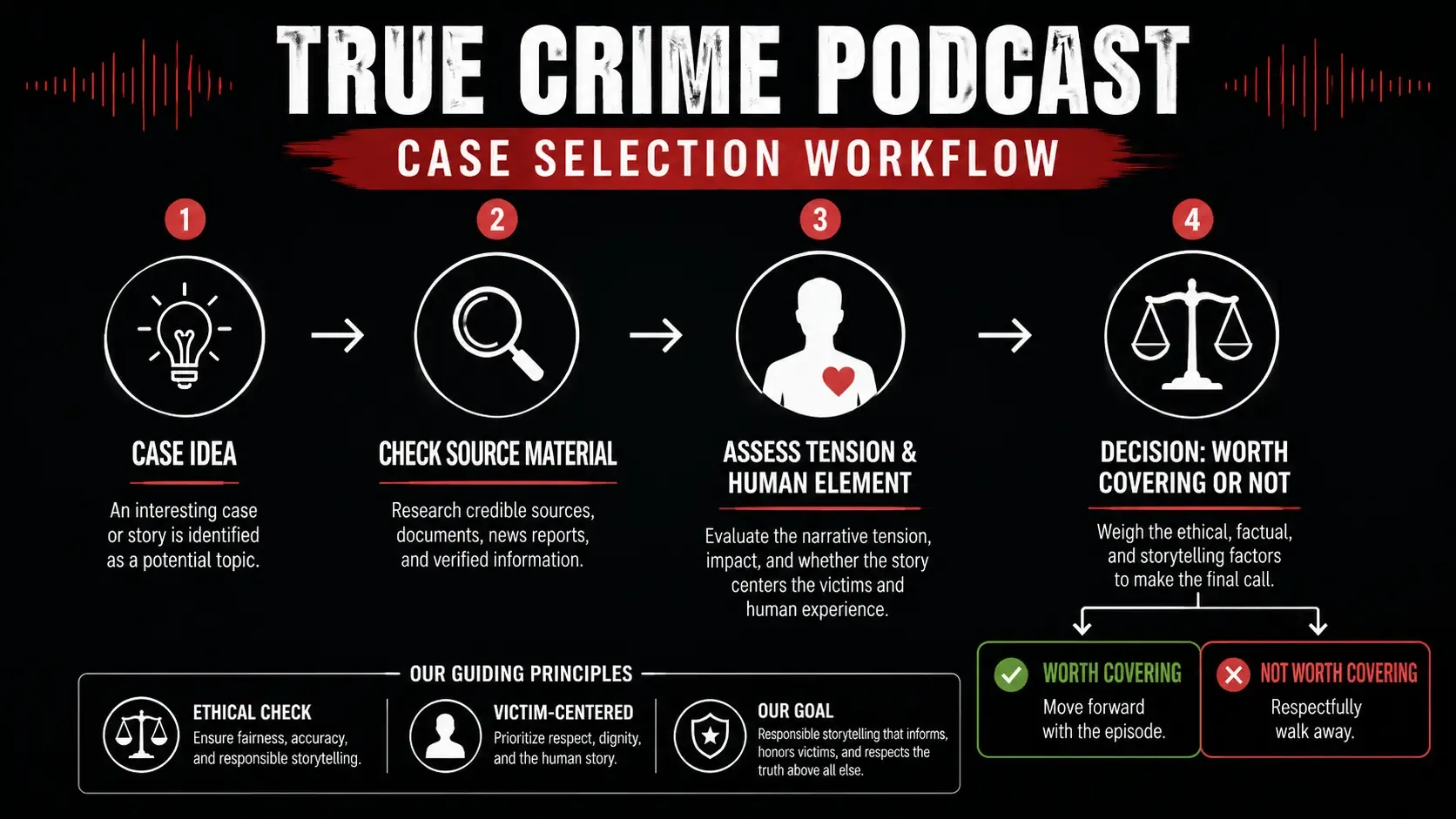
What Makes a Case Worth Covering
The cases that work best in the true crime format tend to share specific characteristics. There is enough documented source material to tell a coherent story. The case contains genuine unresolved tension, whether that is an open verdict, disputed evidence, an unknown motive, or a systemic failure that contributed to the outcome. And the story has a human center: a victim whose life is worth understanding, not just a set of facts to be reported.
Avoid cases where the publicly available record is too thin to fill a credible episode, cases where coverage could actively harm ongoing legal proceedings, and cases where the primary appeal is spectacle rather than substance.
Where to Find Cases
Court records, local newspaper archives, and freedom of information requests are the three most reliable sources for documented case material. Podcast research communities on Reddit, including r/TrueCrime and r/UnresolvedMysteries, regularly surface lesser-known cases with rich source material behind them. If you are building a serialized show, confirm that your chosen case has enough documented material to sustain multiple episodes before you commit to a format.
Building Your Case File
Before writing a single word of your script, organize everything you know about the case into a structured research file. Separate your materials into four categories: established and documented facts, disputed or uncertain elements, source documents with their reliability levels noted, and gaps in the record where you cannot confirm what happened.
This case file becomes the foundation of your script. The distinction between what is confirmed and what is alleged is not only an ethical requirement. It is a structural tool: those gaps and disputes are where your narrative tension lives.
Step 2: Structure Your Episode Like a Crime Narrative
This is where most true crime podcasts get it wrong. They present information in the order it was discovered, not in the order that creates the most compelling story. Chronological is not the same as narrative.
The 5 Part True Crime Episode Structure
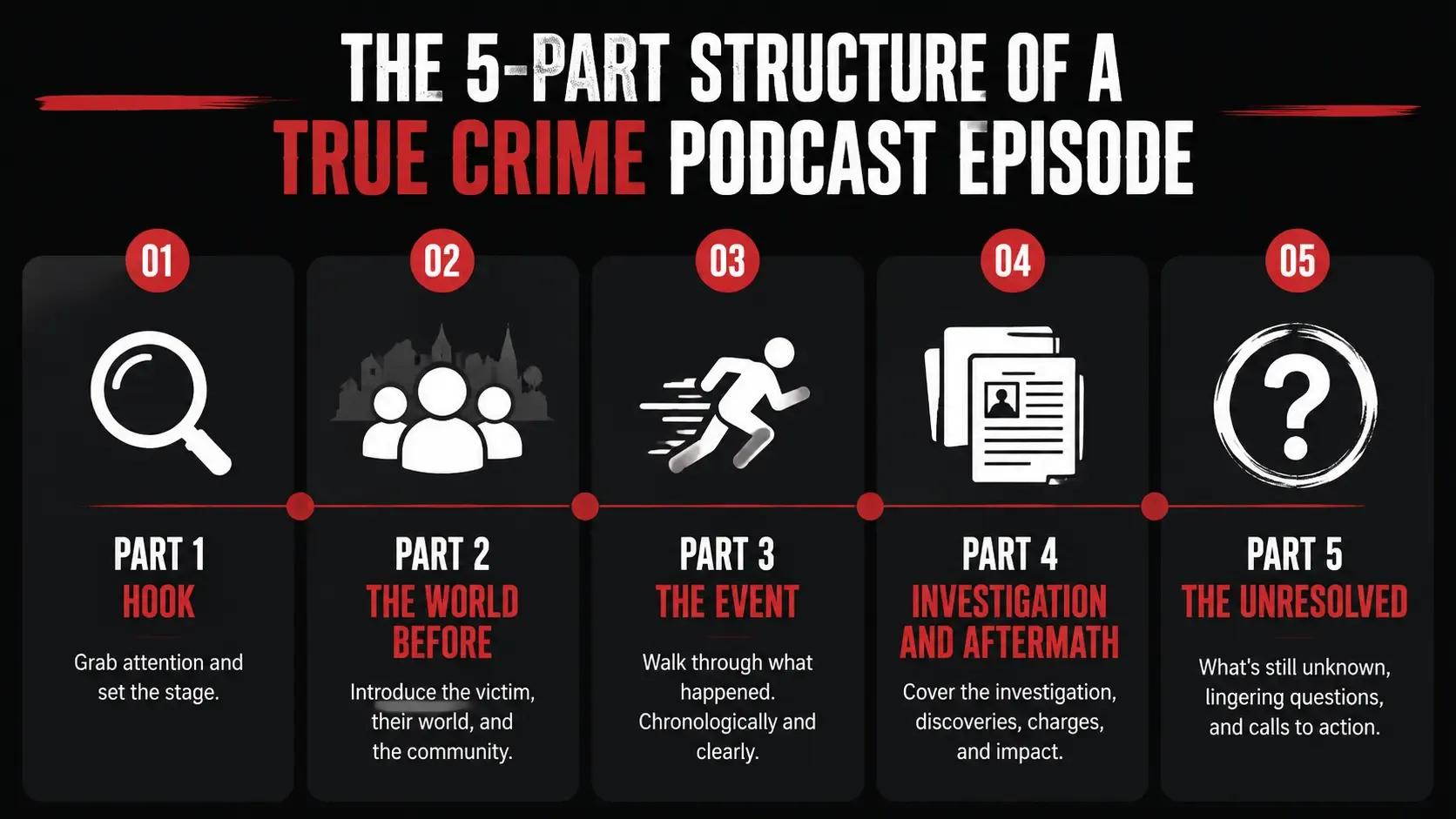
Strong true crime episodes follow a structure borrowed from long-form investigative journalism and crime fiction. The specific content of each part varies by case, but the function of each section stays consistent across every format.
Part 1: The Hook
Start at the most compelling moment in the story. This might be the discovery of a body, a detail that overturns the official account, a courtroom exchange, or a single line from a victim’s journal. You do not need to explain the full context yet. The hook’s only job is to earn the next three minutes of attention.
Part 2: The World Before
Establish the people and place before the crime occurred. Who was the victim? What was their life like? What was the community and context around them? This is the section most podcasters rush through, but it is where the listener develops emotional investment. A crime without context is an incident. A crime with human context becomes a story.
Part 3: The Event
Reconstruct what happened, carefully distinguishing between what is documented and what is inferred. Use present tense narration to create immediacy. Slow down at the key moments. This is where your research discipline pays off: the more thoroughly you have organized your case file, the more precisely you can narrate the event itself.
Part 4: The Investigation and Aftermath
Follow the investigation, legal proceedings, and aftermath for the people involved. This section often contains the most structural complexity because multiple timelines are running in parallel. Map these before you script them.
Part 5: The Unresolved
Close with what remains open. What do we still not know? What does this case reveal about a larger pattern or system? What do you believe happened, and why? This final section is where your voice as a host matters most. It is also what gives listeners a reason to come back to the next episode.
How to Build Suspense with Timeline Pacing
Suspense in audio storytelling is created through deliberate information delay. You control what the listener knows at every moment. Use this.
Withhold key details until they carry maximum weight. If you know who did it from the start, hold the evidence back and let the listener experience the investigation in real time. Signal that something important is coming: “what the detective found next would change the direction of the case entirely.” Then give yourself a full paragraph before delivering the payoff.
Vary your pacing. Slow down with specific detail in high-stakes moments. Speed up through passages of procedural information. The contrast between the two is what creates tension.
Step 3: Write Your True Crime Podcast Script
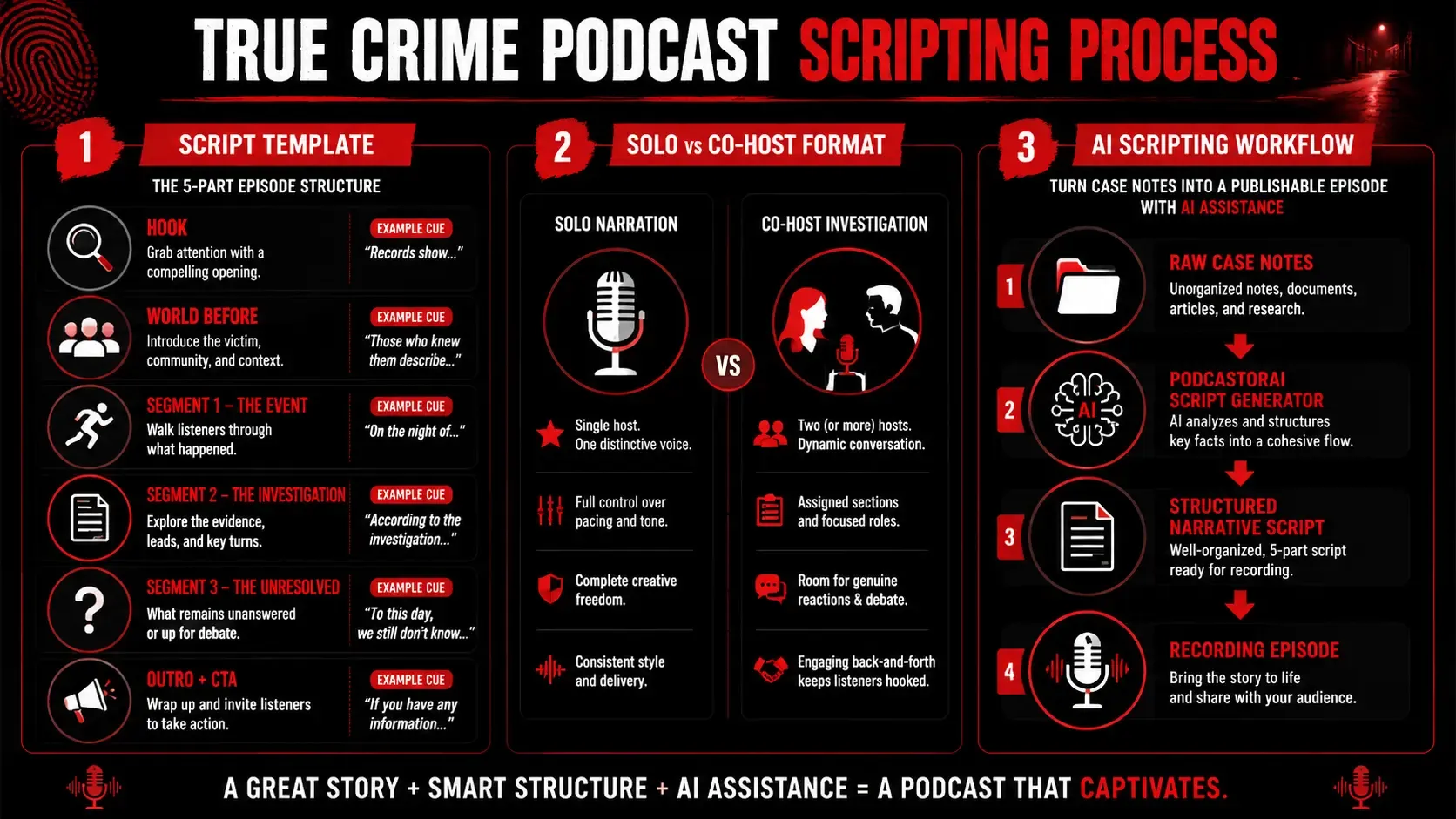
Scripting for True Crime: Core Principles
True crime scripts have specific requirements that distinguish them from general podcast scripts.
Write every factual claim with a qualifier that reflects your confidence level. “Police records confirm…” signals certainty. “Witnesses reported…” signals that you are relaying testimony. “One theory holds…” signals that you are presenting a possibility. This is not just ethical precision. It makes your narration sound authoritative rather than sensationalized.
Handle victim identity with care. Introduce victims as people before introducing them as victims. Name them fully. Include at least one detail about their life that has nothing to do with the crime. The listener should know who this person was, not only what happened to them.
Avoid language that aestheticizes violence. The goal is to make the listener feel the weight of what happened, not to create shock through graphic detail.
True Crime Script Template
Use this framework as your starting structure. Adjust the number of segments based on your episode length and case complexity.
| Segment | Description |
|---|---|
| HOOK | Open at the most compelling moment. Drop the listener into a scene mid-action. One to two sentences only. |
| WORLD BEFORE: The Victim and the Context | Introduce the victim as a person. Establish the time, place, and community. Build emotional investment before introducing the crime. (2–3 minutes) |
| SEGMENT 1: The Event | Reconstruct what happened. Distinguish documented facts from inference. Use present tense for immediacy. Slow down at key moments. Qualifier cues: “Records show…” / “According to the autopsy…” / “Witnesses described…” |
| SEGMENT 2: The Investigation | Follow the investigation and legal proceedings. Handle multiple timelines carefully, one thread at a time. |
| SEGMENT 3: The Unresolved | What remains open? What is your read of the evidence? What does this case reveal beyond the individual crime? |
| OUTRO + CTA | Close with your final thought. One CTA only. |
Solo Narration vs. Co-Host Investigation Format
The two dominant formats for true crime podcasts require fundamentally different scripts.
Solo narration gives you complete control over pacing and voice. Every word goes through you. This format suits heavily researched, carefully structured cases where the narrative needs tight control. The risk is that it demands a strong, distinctive voice to sustain listener attention across a full episode.
The co-host investigation format creates natural dialogue and lets listeners experience two people piecing together a case in real time. It requires a script that functions more like a detailed outline, with each host assigned specific sections of the research while leaving room for genuine reaction. The dynamic between two hosts and their different interpretations of the same evidence can itself become part of the story.
Using AI to Turn Case Notes into a Script
The most time-consuming step in true crime scripting is not the writing itself. It is the transition from a raw case file to a structured narrative. You may have dozens of documents, witness statements, court records, and timeline notes. The challenge is assembling them into a script that flows as a coherent story.
AI tools have become genuinely useful for this stage. You can feed a case summary, a set of key facts, or a rough narrative outline and get back a structured first draft that maps your material onto the five-part structure. The output requires significant editing to add your voice, verify factual accuracy, and handle the ethical dimensions properly. But starting from a structured draft rather than a blank page cuts the scripting time considerably.
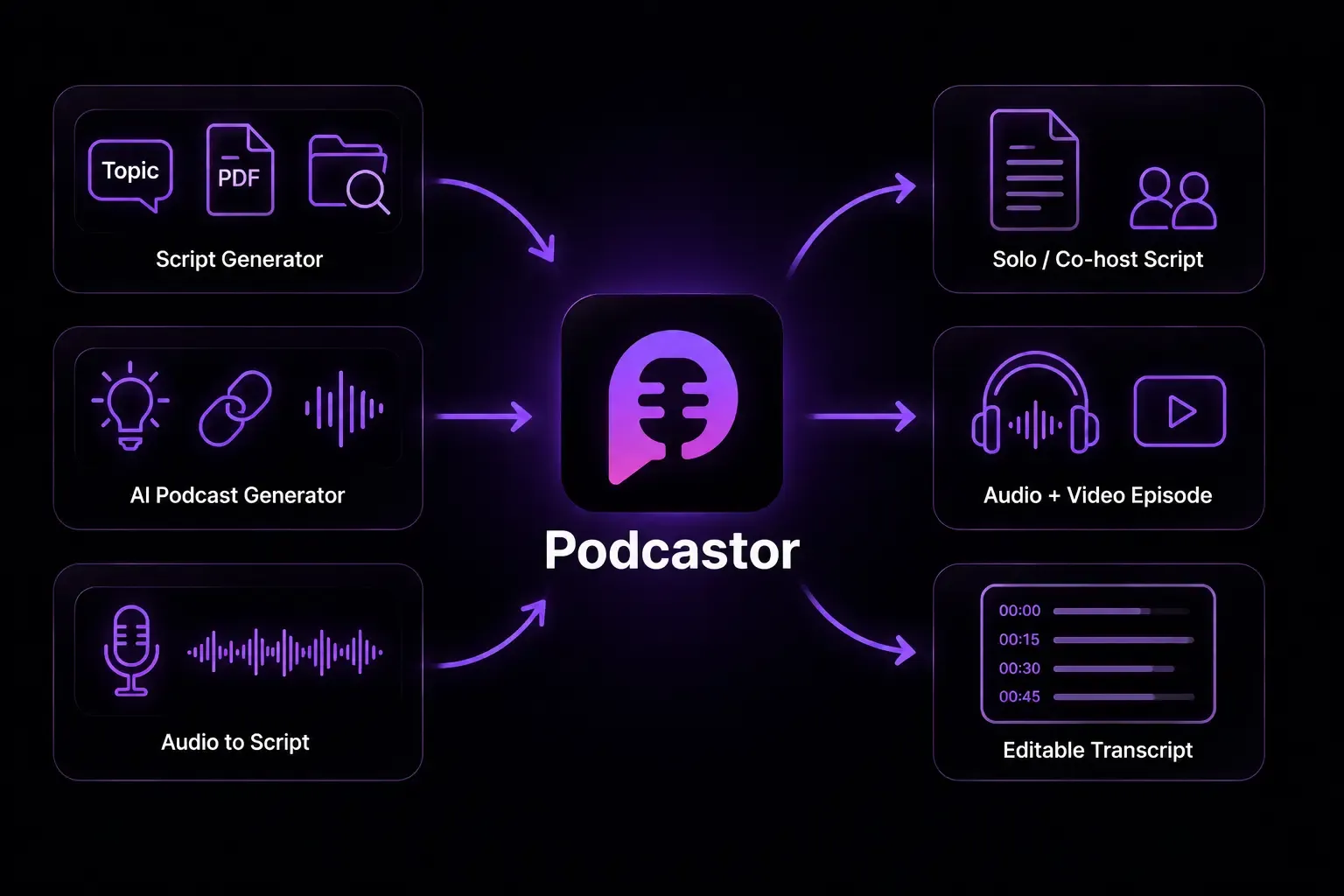
PodcastorAI is building a script generation workflow designed specifically for this kind of content production. The Podcast Script Generator takes a topic, a document, or a case summary and produces a structured narrative script for solo or co-host formats. The Audio to Script tool works in the other direction: upload raw interview recordings or research audio and convert them into editable transcripts you can build directly into your case file.
If you want to be among the first to use these tools for true crime production, early access is available on the waitlist.
Step 4: Record for Atmosphere
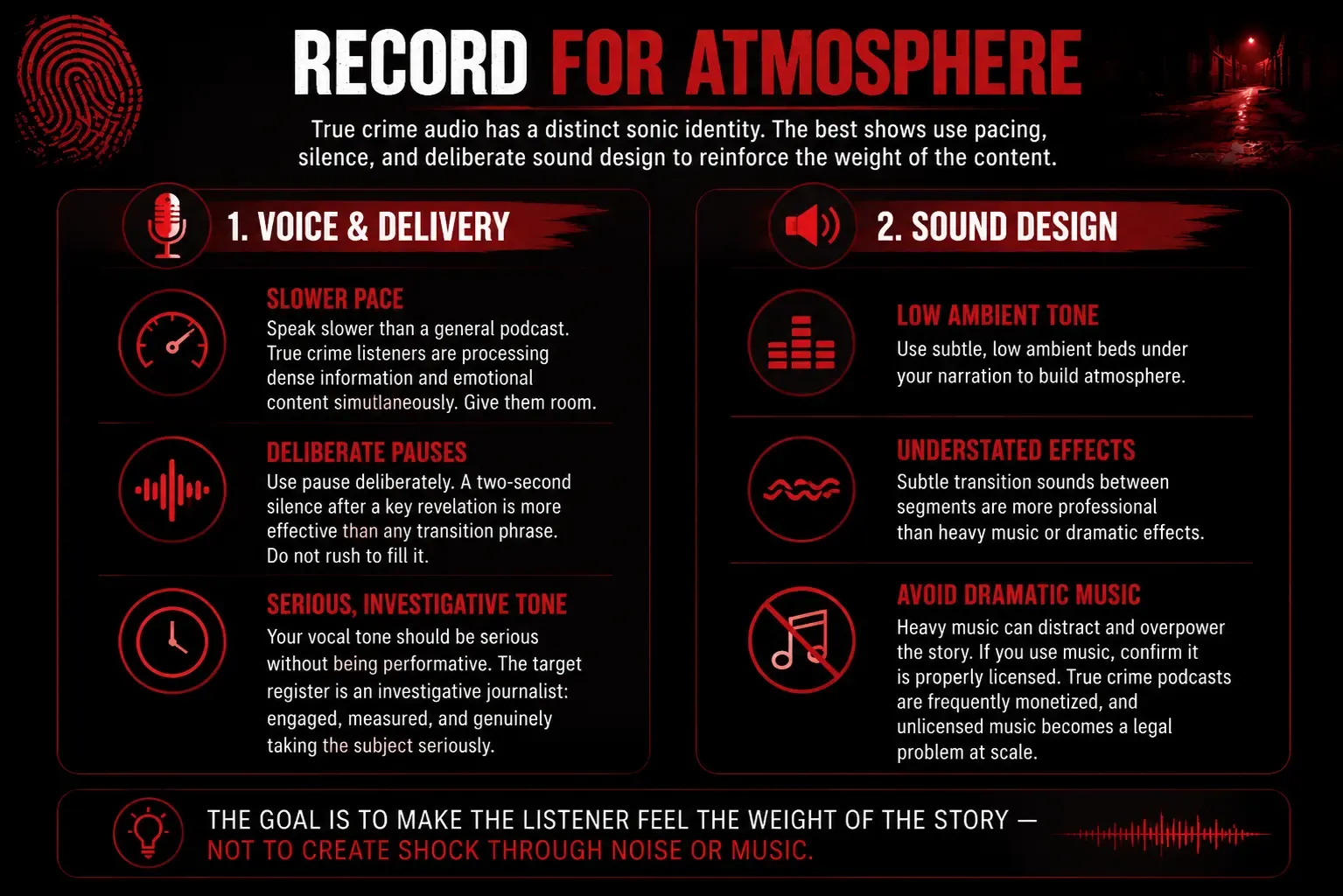
True crime audio has a distinct sonic identity. The best shows use pacing, silence, and deliberate sound design to reinforce the weight of the content.
Voice and Delivery
Record at a slower pace than you would for a general podcast. True crime listeners are processing dense information and emotional content simultaneously. Give them room.
Use pause deliberately. A two-second silence after a key revelation is more effective than any transition phrase. Do not rush to fill it. Your vocal tone should be serious without being performative. The target register is an investigative journalist: engaged, measured, and genuinely taking the subject seriously.
Sound Design
Understated is more professional than dramatic. A low ambient tone under your narration and a subtle transition sound between segments is a stronger choice than heavy musical scoring. If you use music, confirm it is properly licensed. True crime podcasts are frequently monetized, and unlicensed music becomes a legal problem at scale.
Step 5: Publish and Grow Your True Crime Audience
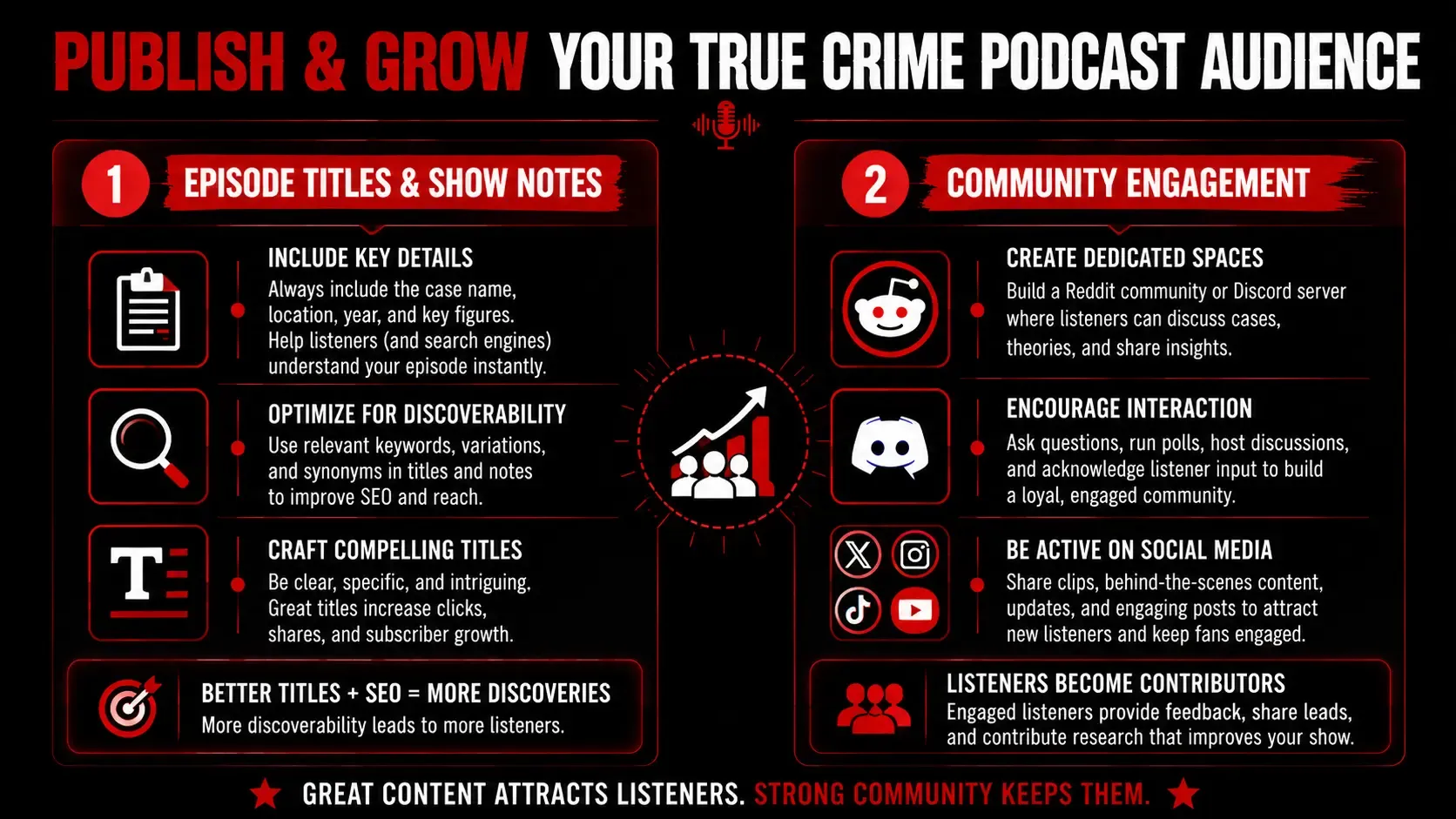
Episode Titles and Show Notes for True Crime SEO
Your episode title is the primary discovery mechanism for new listeners on every podcast platform. Include the case name, the location if it is relevant, and a detail that creates curiosity without resolving the central question. “The Disappearance of [Name]: What the Investigation Missed” is more searchable and more compelling than “Episode 12.”
Write show notes that function as a standalone case summary. Include the full names of key figures, the case location, the year, and the current legal status. These details make your episode discoverable in podcast search and in Google.
Building a Listener Community
True crime audiences are among the most engaged in all of podcasting. They research alongside you, track developments in cases you have covered, and surface new information from their own networks.
Create a dedicated space for this engagement: a Reddit community, a Discord server, or a social channel where discussion is encouraged. Listener theories, corrections, and direct contact from people with connections to cases you have covered become both a community and a research resource for future episodes.
Common Mistakes True Crime Podcasters Make
Leading with equipment instead of story.
The most common reason new true crime podcasts fail to find an audience is not audio quality. It is weak narrative structure. A compelling case recorded on a decent USB microphone outperforms a poorly structured story recorded in a professional studio.
Using chronological order as a substitute for narrative structure
What happened first is not always what should come first in your script. Build your episode around narrative tension, not the sequence of events.
Treating victims as props.
Every true crime story involves real people and real families. The ethical responsibility to handle their stories with care is not separate from the quality of your podcast. It is part of what makes the podcast worth listening to.
Covering too many cases too quickly
Serialized shows that stay with one case across multiple episodes consistently outperform anthology formats on audience retention and subscription growth. Depth builds loyalty in this genre more than volume does.
Publishing without a script
Improvising a true crime episode produces rambling narration that undermines your credibility as an investigator. Even a bullet-point outline that maps the five-part structure significantly improves the quality of the final recording.
Conclusion
How to make a crime podcast that stands out comes down to three things: the quality of your research, the structure of your narrative, and the care you bring to the people whose stories you are telling. The technical production elements matter, but they are secondary to whether you have built a story worth hearing.
Start with a case that has genuine depth. Build your case file before you write a single line of script. Structure your episode around the five-part true crime format. Write with the precision of an investigative journalist and the pacing instincts of a crime novelist. The shows that do this consistently are the ones that build lasting, loyal audiences.
Feeling inspired to start your own true crime podcast right now? With PodcastorAI, you can quickly turn your ideas into engaging, memorable episodes that captivate listeners. Join the waitlist today and accelerate your journey toward creating a podcast that stands out!
Frequently Asked Questions
How do you start a true crime podcast for beginners?
Start with a single, well-documented case rather than trying to plan a full show. Research thoroughly until you have a case file with confirmed facts, verified sources, and a clear narrative. Outline your episode using the five-part true crime structure before recording — doing this first makes your initial episode much stronger.
What is the best format for a true crime podcast?
The two main formats are solo narration (full control over pacing & voice, ideal for deeply researched cases) and co-host investigation (dynamic dialogue for complex cases). Choose the format that fits your natural workflow.
How much do true crime podcasters make?
Income varies by audience size and monetization. Host-read ads typically earn $15–$25 CPM. A show averaging 10,000 downloads can earn $150–$250 per ad slot. Patreon and listener-supported models are common for bonus content. Early shows usually earn little; audience depth matters more than launch speed.
Can I make a true crime podcast for free?
Yes — a basic microphone and free software (Audacity, GarageBand) are enough. Free hosting is available via Spotify for Podcasters. The main investment is time for research, scripting, and structuring — which tools like PodcastorAI can significantly reduce.
How can PodcastorAI help with true crime podcast production?
PodcastorAI streamlines the most time-intensive steps:
-
Podcast Script Generator: turns case summaries or outlines into structured scripts for solo or co-host formats.
-
Audio to Script: converts raw interviews or research audio into editable transcripts.
-
AI Podcast Generator: transforms scripts or ideas into professional audio podcasts with natural AI voices, and even produces video podcasts using two-shot, split-screen, or animated formats.
Early waitlist members receive one free month of the Starter plan, covering script generation, AI audio production, and video podcast creation — helping you publish your first episode faster!