
TL;DR
-
Podcasts are one of the most effective ways to learn Spanish. They build listening comprehension and natural rhythm through real, contextual speech you can take anywhere.
-
This guide covers what makes a Spanish podcast good for learning, how to actually learn from one instead of passively listening, and a few shows worth knowing at each level.
-
It also shows how to create your own Spanish learning podcast, which is ideal for teachers and creators who want content matched to a specific level and topic.
-
With PodcastorAI, you can turn a topic into a bilingual, level-appropriate script and generate natural-sounding Spanish audio with voices powered by ElevenLabs and MiniMax.
Most people who want to learn Spanish already know that listening matters. Spanish podcasts for learning are everywhere, and the advice to “just listen more” is repeated constantly. The hard part is knowing which podcasts actually fit your level, and what to do with them once you press play.
When the podcast is too fast, you tune out after two minutes. When it is too slow, you get bored and stop. And when you do find one that fits, passive listening on a commute rarely turns into real progress. Months pass, your podcast app fills with half-finished episodes, and your Spanish sounds the same as it did before.
This guide fixes both problems. It explains why podcasts work for learning Spanish, how to study with them so the listening sticks, a short list of shows worth knowing, and how to create your own Spanish podcast when no existing show matches what you or your students need.
Why Podcasts Work So Well for Learning Spanish
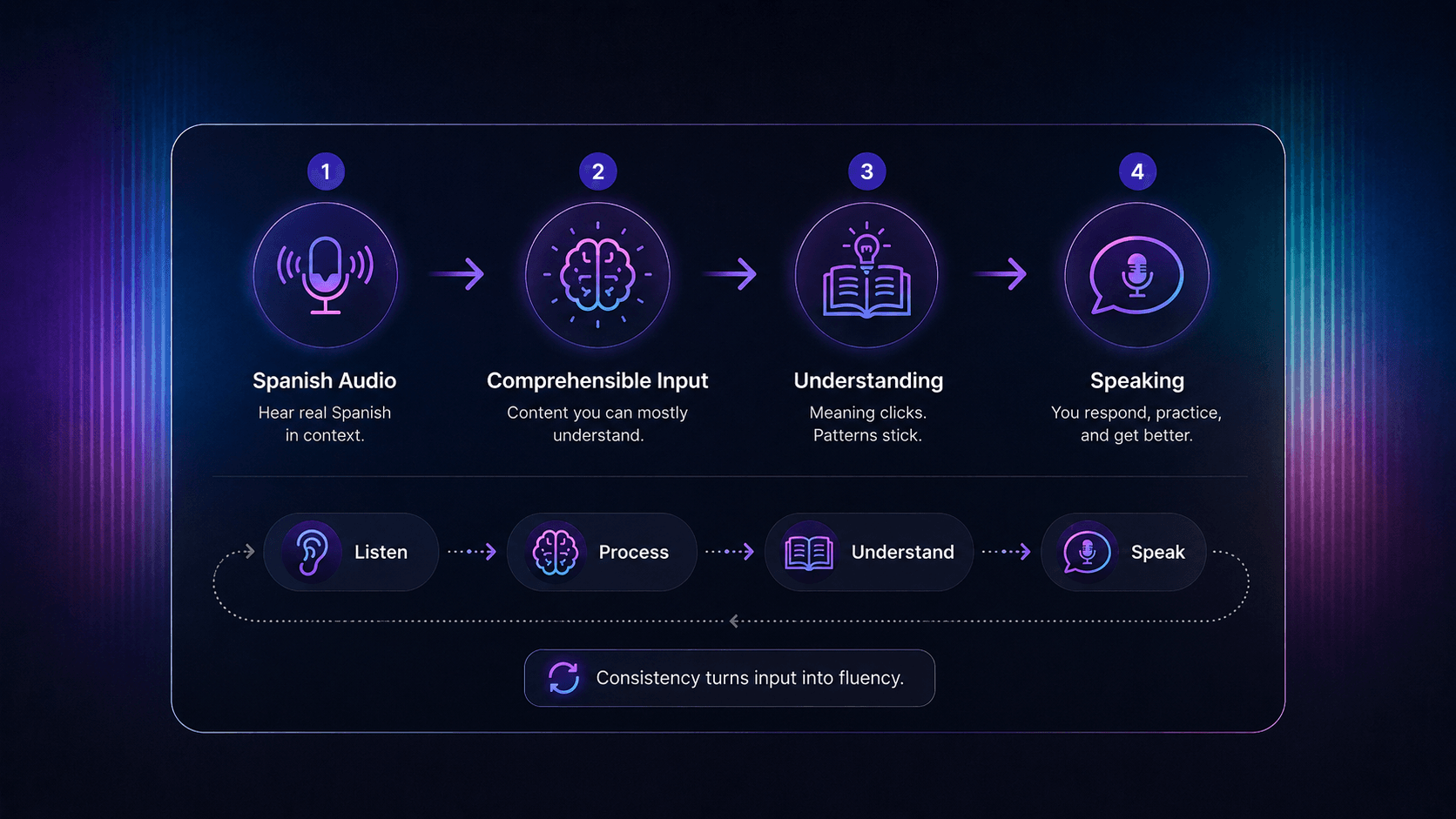
Podcasts work for learning Spanish because they train your ear on real, connected speech rather than isolated words. A Spanish language learning podcast exposes you to natural rhythm, intonation, and the way native speakers actually link sounds together, which textbooks cannot reproduce.
Listening comprehension is the skill most learners neglect and the one that limits real conversation. You can memorize hundreds of words and still freeze when a native speaker talks at normal speed. Podcasts close that gap by giving you hours of input at a pace you control.
They also fit into time you already have. Research on language acquisition consistently points to comprehensible input, meaning content you understand around 70 to 80 percent of, as a primary driver of progress. A 20-minute commute, five days a week, adds up to over 80 hours of Spanish listening in a year without blocking out any extra study time.
The format rewards consistency over intensity. Short, regular exposure beats occasional long sessions, and podcasts make that consistency easy to sustain.
What Makes a Spanish Podcast Good for Learning
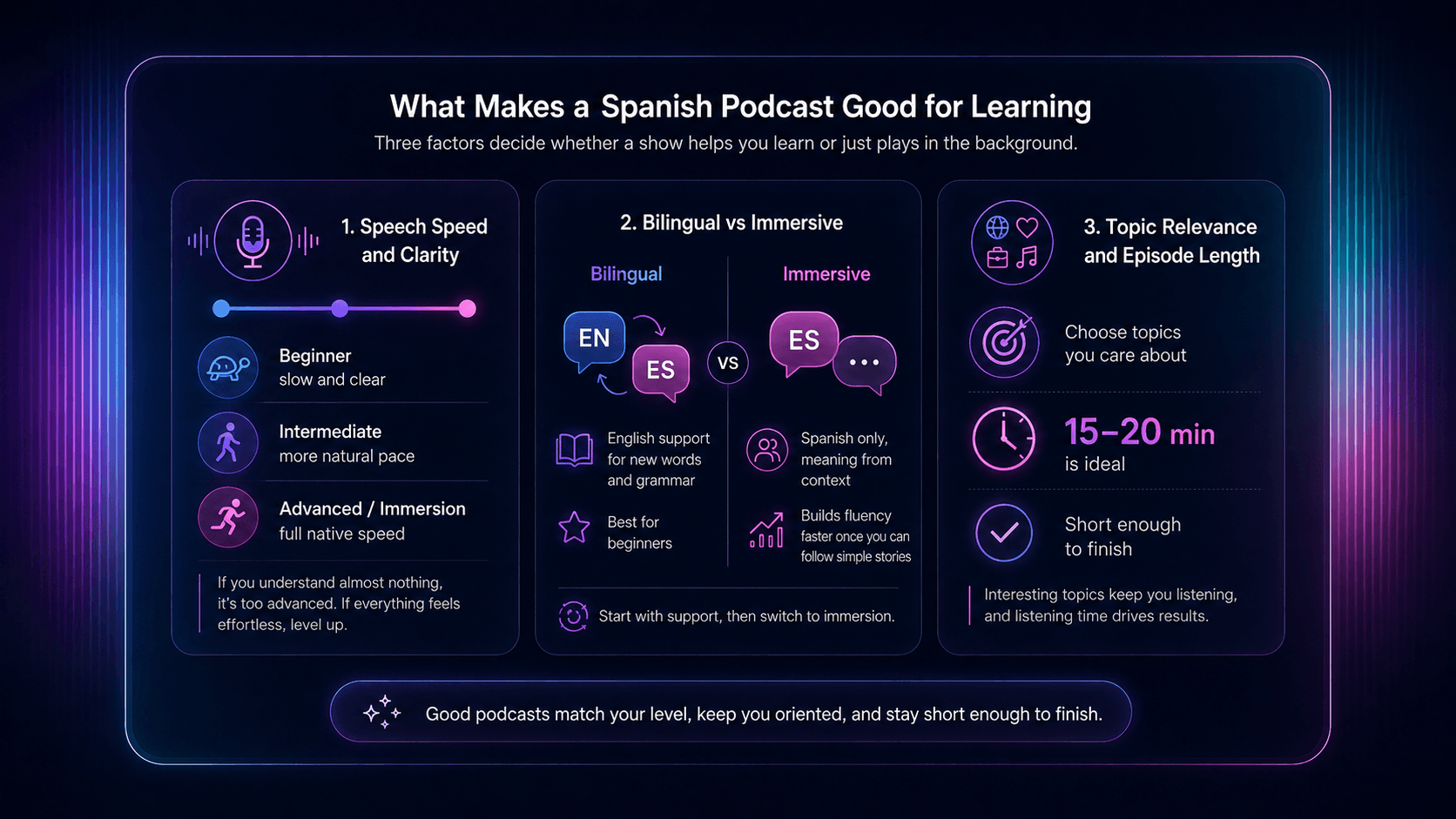
A good Spanish learning podcast matches your level, explains enough to keep you oriented, and stays short enough to finish. Three factors decide whether a show helps you learn or just plays in the background.
Speech speed and clarity
Speech speed is the single most important factor for learners. Spanish podcasts for beginners should use slow, clear pronunciation with deliberate pauses between phrases. Intermediate shows can move closer to conversational pace, and advanced or immersion podcasts run at full native speed with no slowdown.
If you understand almost nothing in the first minute, the show is too advanced. If you understand everything effortlessly, it is time to level up.
Bilingual versus immersive explanation
Bilingual podcasts explain new vocabulary and grammar in English, which lowers the barrier for early learners. Immersive podcasts stay entirely in Spanish and push you to infer meaning from context.
Beginners usually progress faster with bilingual support. Once you can follow a simple story in Spanish, switching to immersive content accelerates fluency.
Topic relevance and episode length
Topics you care about keep you listening, and listening time is what produces results. A 15 to 20 minute episode on a subject you enjoy will teach you more than an hour on something dull that you abandon halfway through.
These three factors are not just listening criteria. They are also the design rules you would follow if you created your own Spanish podcast, which we cover later.
How to Actually Learn from Spanish Podcasts
Knowing how to use podcasts to learn Spanish means listening actively, not just pressing play. Passive background listening builds familiarity with sound, but active techniques are what convert listening into comprehension and speech.
Start with active listening. Pick one episode and listen with full attention, pausing to replay sentences you miss. This is slower than casual listening, but it produces far more learning per minute.
Use shadowing for pronunciation. Play a short segment, pause, and repeat what the speaker said out loud, copying their rhythm and intonation. Shadowing trains your mouth to produce sounds your ear is learning to recognize.
Repeat episodes instead of always chasing new ones. The second and third listen of the same episode is where comprehension jumps, because you already know the context and can focus on words you missed.
Keep light notes. Jot down three to five new words or phrases per episode and review them later. The goal is not to capture everything, only the few items worth carrying forward.
5 Best Spanish Podcasts for Learning (Beginner to Advanced)
A handful of well-made shows cover most learner needs from beginner to advanced. Rather than list dozens, here are five reliable picks, each chosen for a specific level so you can find the right starting point quickly.
For absolute beginners, Coffee Break Spanish teaches through short, structured lessons with English explanation. Notes in Spanish then eases you into natural conversation at an early-learner pace. At the intermediate stage, News in Slow Spanish delivers current events at a reduced speed with transcripts, bridging learner content and real-world Spanish. For advanced learners and full immersion, Hoy Hablamos offers daily episodes entirely in Spanish, and Radio Ambulante presents long-form Latin American stories in rich, native-speed Spanish.
The podcasts below were chosen for clear learning purpose, level fit, episode structure, transcript availability, and usefulness for repeated listening.
| Podcast | Best for | Listening style | Learning support | Best use |
|---|---|---|---|---|
| Coffee Break Spanish | Beginners | Structured lessons with English explanation | Clear lesson format, beginner-friendly pacing | Start here if you want guided Spanish lessons instead of full immersion |
| Notes in Spanish | Beginner to Intermediate | Natural conversations at a learner-friendly pace | Transcripts and real-life dialogue topics | Use it to move from textbook Spanish into everyday conversation |
| News in Slow Spanish | Intermediate | Current events spoken at a reduced speed | Transcripts and news-based vocabulary | Use it when you want real-world topics without full native-speed audio |
| Hoy Hablamos | Intermediate to Advanced | Daily episodes fully in Spanish | Transcripts and broad topic coverage | Use it to build consistency and get closer to natural Spanish listening |
| Radio Ambulante | Advanced / Immersion | Long-form Latin American storytelling at native speed | Narrative context and high-quality journalism | Use it when you are ready for rich, real Spanish immersion |
These shows are a strong foundation. But they share a limitation: they are made for a general audience, not for your specific level, your vocabulary goals, or the topics your students need. That is where creating your own becomes valuable.
How to Create Your Own Spanish Learning Podcast
Creating your own Spanish learning podcast lets you control level, topic, and pacing in a way no existing show can match. For Spanish teachers, tutors, and content creators, a custom podcast turns listening practice into targeted material built around exactly what your learners are working on.
The reason to build your own is simple. A beginner class studying the past tense needs episodes that use the past tense slowly and repeatedly. A general podcast cannot do that, but a custom one can.
What goes into a Spanish learning podcast
Every learning podcast, however you make it, comes down to four things. First, you decide the level and topic, picking one level and one focused subject per episode so the material stays useful. Second, you write a level-appropriate script, usually with a bilingual structure for beginners that introduces a phrase in Spanish, explains it briefly in English, then repeats it in context. Third, you produce clear audio in a natural-sounding voice. Fourth, you add captions and publish so learners can read along while they listen.
Done by hand, this is slow work. Writing a bilingual script from scratch, recording clean audio, and timing captions for each episode can take hours, which is why most teachers never get past the idea stage.
Where PodcastorAI fits
This is where a tool like PodcastorAI becomes useful. Instead of writing, recording, editing, captioning, and formatting each episode manually, you can turn a topic or lesson material into a structured podcast workflow.
It turns a topic into an editable script, generates natural audio with native voices, and produces captions and publish-ready files, all in one workflow. For language teachers and creators, that collapses hours of production into a process you can repeat for every episode. The five steps below show how it works.
Step 1: Start with your Spanish learning material
Begin with the material you already have using the PodcastorAI language learning podcasts generator. This can be lesson notes, vocabulary lists, grammar points, dialogues, article excerpts, or a simple topic idea. You can also input content in different formats, including text, URLs, PDF files, audio files, or uploaded documents. For example, a teacher might start from a reading passage in PDF form, a webpage article, or a short audio clip to build a Spanish listening lesson.
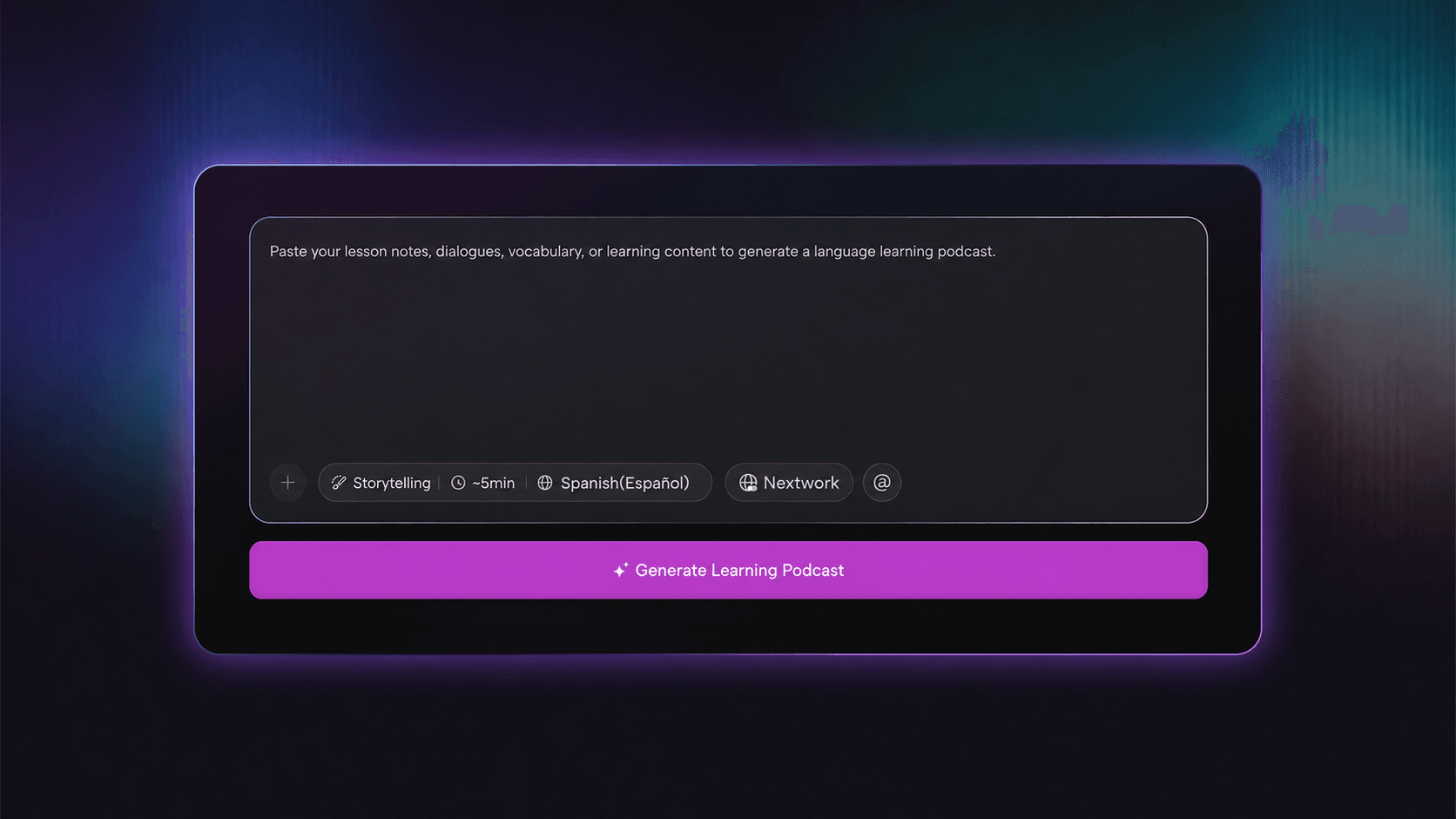
At this stage, you set the target language, episode duration, style, and narration mode so the content is shaped into a clear learning-focused episode from the beginning.
Step 2: Generate and edit the learning script
Next, turn the material into a structured two-host script. For Spanish learning content, this format works well because one host can introduce examples or explanations while the other asks questions, reacts, or practices the target phrases.
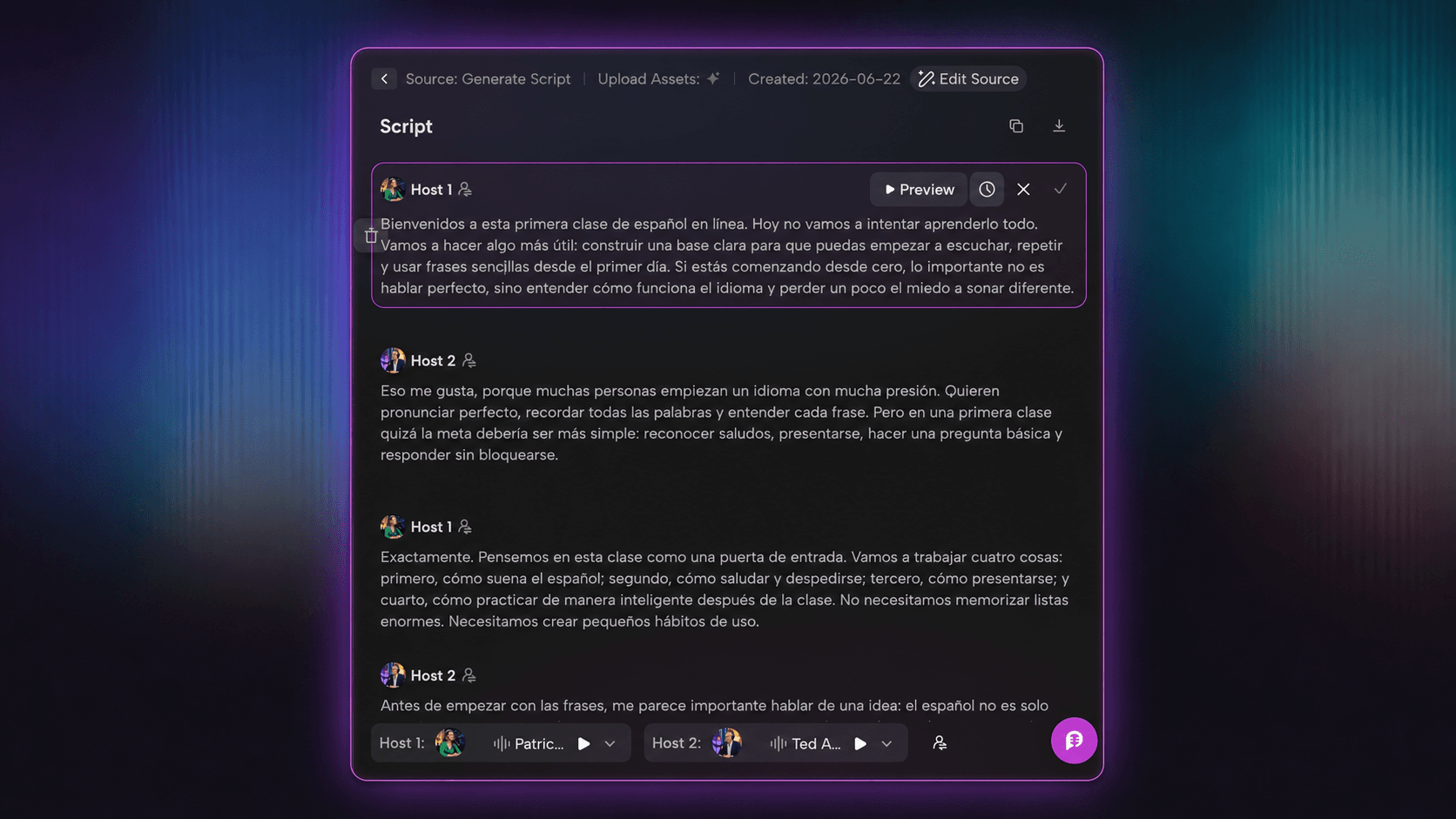
The script remains editable before audio generation. You can adjust the balance between Spanish and English, simplify difficult lines, add repetition, or make the pacing easier for beginners to follow.
Step 3: Choose AI hosts and customize the layout
Once the script is ready, choose the visual format for the episode. Available AI host formats include Talk Show, Split Screen, Two-Shot, Cartoon Host, and Pet Host. For a simpler audio-focused version, image-based video and waveform-based video are also available.
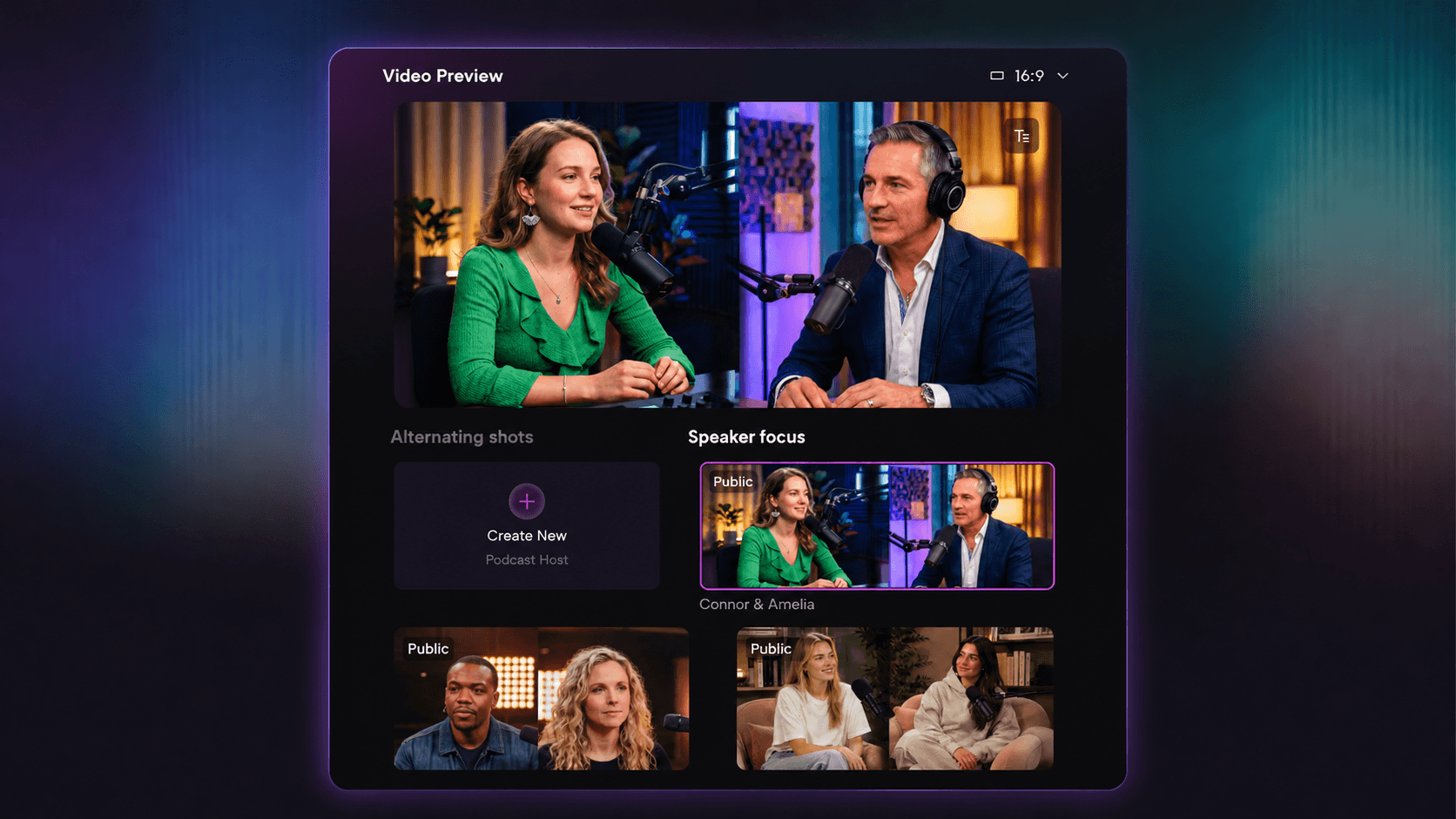
You can use a ready-made host template or create a custom host by uploading a photo or character asset. The custom host could be a teacher-style host, a virtual character, a cartoon character, a pet character, or another recurring host style. This is also where you choose the layout, subtitles, and visual format before rendering.
Step 4: Select Spanish voices from ElevenLabs and MiniMax
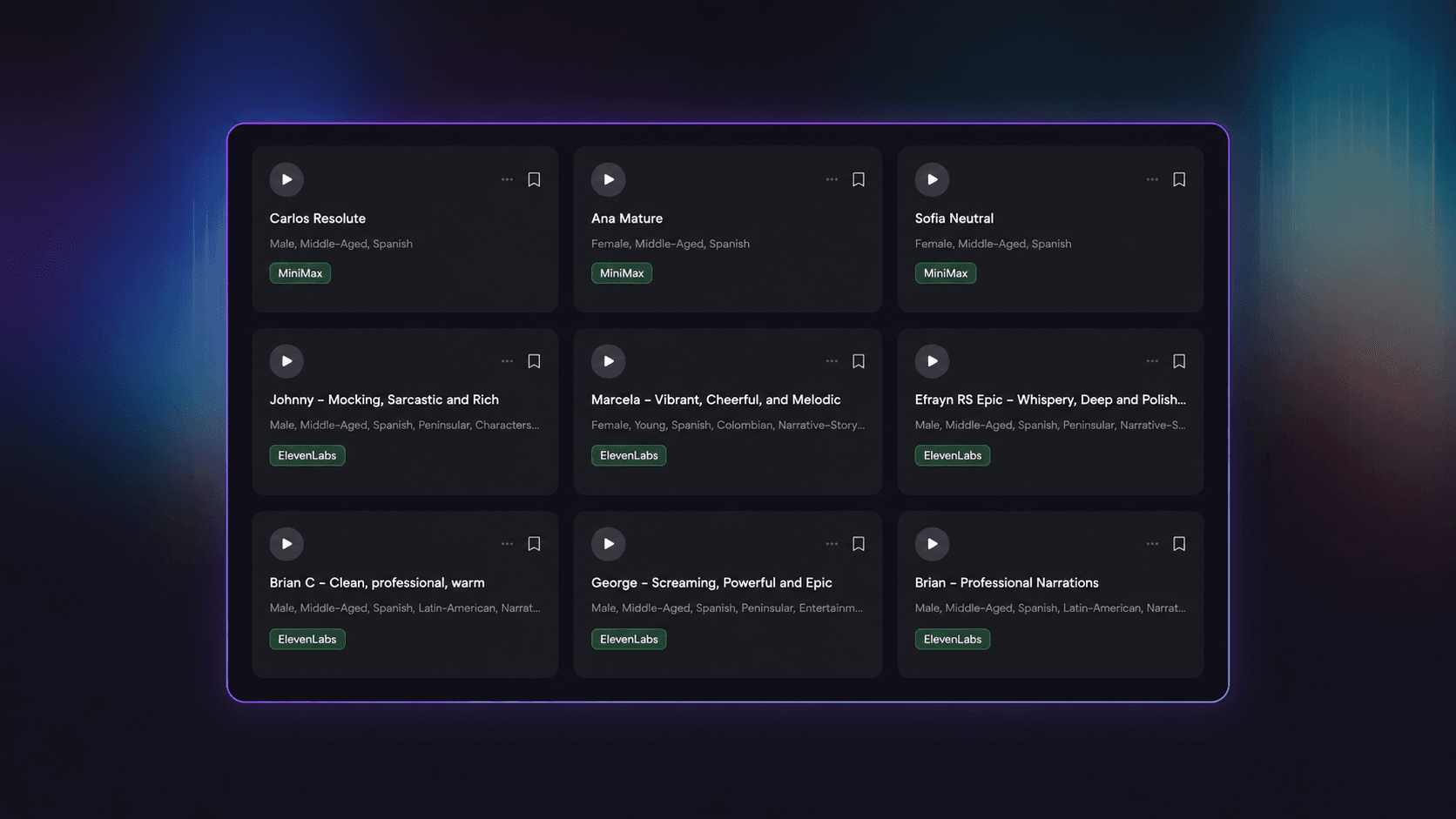
After the script and layout are set, choose the voices for the two hosts. The voice system includes models from ElevenLabs and MiniMax, along with PodcastorAI’s podcast-focused voice model.
You can shape how each voice sounds by setting simple instructions, such as tone, pacing, or speaking style—for example a calm teacher-like voice or a slower beginner-friendly delivery for learning content.
If you want a more personalized setup, you can also create a custom voice through voice cloning by uploading a short sample. This allows the same instructor or character voice to be reused across different episodes, keeping the listening experience consistent over time.
Step 5: Generate and preview the episode
Before exporting, review the script and confirm that the Spanish content, English explanations, pacing, and host setup are all correct. Make sure both the dialogue and voice choices match the intended learning level.
Once ready, click render audio to generate the full episode. This will produce the complete audio version of the podcast for review and listening. At this stage, you can preview the generated episode and check how the script and voices sound together before moving on to video creation.
Step 6: Export and publish
After reviewing the audio, you can choose how to output the episode. The audio version can be downloaded directly, while the video version can be rendered separately using the selected visual format, such as captions, waveform, or AI host visuals.
Once exported, the episode can be published or shared across platforms such as YouTube, TikTok, Instagram, Spotify, or Apple Podcasts, or embedded into teaching materials and learning content workflows.
Tips for Designing Podcasts That Help People Learn
The best learning podcasts are engineered for comprehension, not just recorded and released. If you create your own, a few design choices dramatically increase how much listeners absorb.
Control your speech speed deliberately. Speak 20 to 30 percent slower than normal conversation for beginner content, and leave clear pauses between sentences so listeners have time to process.
Repeat key vocabulary within the same episode. A new word heard once is usually forgotten. The same word heard three or four times across an episode, in slightly different sentences, tends to stick.
Limit new vocabulary per episode. Introducing five to eight new words in a short episode is plenty. Overloading an episode with new terms causes listeners to retain none of them.
Use a bilingual sandwich for beginner content. Say the phrase in Spanish, give a short English meaning, then return to Spanish. This keeps learners oriented without translating every word.
Common Mistakes (Listening and Creating)
The most common mistakes fall into two groups, one for learners and one for creators. Avoiding them saves months of wasted effort.
As a learner, the biggest mistake is choosing content that is too advanced because it feels more impressive. Comprehension drives progress, so a show you understand most of beats one that sounds difficult. The second mistake is listening passively only. Background listening alone rarely produces noticeable improvement without active techniques.
As a creator, the most common error is speaking too fast for the stated level, which makes the episode useless for the learners it targets. The other frequent mistake is covering too many topics or too much vocabulary in one episode, which dilutes the learning and overwhelms listeners.
Conclusion
Spanish podcasts for learning are one of the most efficient tools available, but only when you use them well. The shows that help most are the ones matched to your level, and the listening that works is active, repeated, and supported by light notes.
When no existing show fits, creating your own is now realistic. A custom Spanish learning podcast lets teachers and creators control level, topic, and pacing precisely, turning generic listening practice into targeted material. The same design rules that make a good podcast to listen to, controlled speed, focused topics, and repeated vocabulary, are the rules you follow when you build one.
If you want to create custom Spanish learning content, PodcastorAI takes your topic and target level, generates a bilingual script, and produces natural audio with native Spanish voices. PodcastorAI and publish your first episode without recording equipment.
FAQ
Can you learn Spanish just by listening to podcasts?
Listening builds strong comprehension and pronunciation, but it is rarely enough for full fluency on its own. Podcasts train your ear on natural speech, which is essential for understanding native speakers. To reach conversational ability, pair them with speaking practice and some grammar study. Used as the core of a routine with active techniques like shadowing, podcasts are powerful.
What level of Spanish podcast should a beginner start with?
Beginners should start with slow, clear shows that explain new material in English. Aim for content you understand around 70 to 80 percent of. If you understand almost nothing, the podcast is too advanced and will discourage you. Once you can follow simple conversations comfortably, move up to intermediate shows at a more natural speed.
Are there free Spanish learning podcasts?
Yes, many high-quality Spanish learning podcasts are free on Spotify, Apple Podcasts, and YouTube. Shows like Coffee Break Spanish and Hoy Hablamos offer free episodes, though some charge for transcripts or bonus material. Free podcasts are enough to build strong listening skills if you use them actively. To create your own free content, tools like PodcastorAI let teachers generate custom Spanish episodes for their students.
How do I make a Spanish podcast for my students?
Choose one level and one focused topic per episode, then write a script that matches their ability. Beginner episodes work best with a bilingual structure and slow, repeated vocabulary. Write the script yourself or generate it with AI, then record the audio or create it with AI voices and add captions. Keep episodes short, around 10 to 20 minutes, and focused on vocabulary your class is actively learning.
Can AI create natural-sounding Spanish audio?
Yes. AI voice models can now generate natural-sounding Spanish audio with realistic rhythm, pacing, and intonation. In PodcastorAI, you can use voices powered by ElevenLabs and MiniMax, guide the voice style through prompts, or use cloned and custom voice options when consistency matters.